
May 04, 2026
Conference: Similar, yet different. Monastic Infirmaries and Hospitals as spaces for charity in the Middle Ages (Kloster Eberbach, September 24-26, 2026)
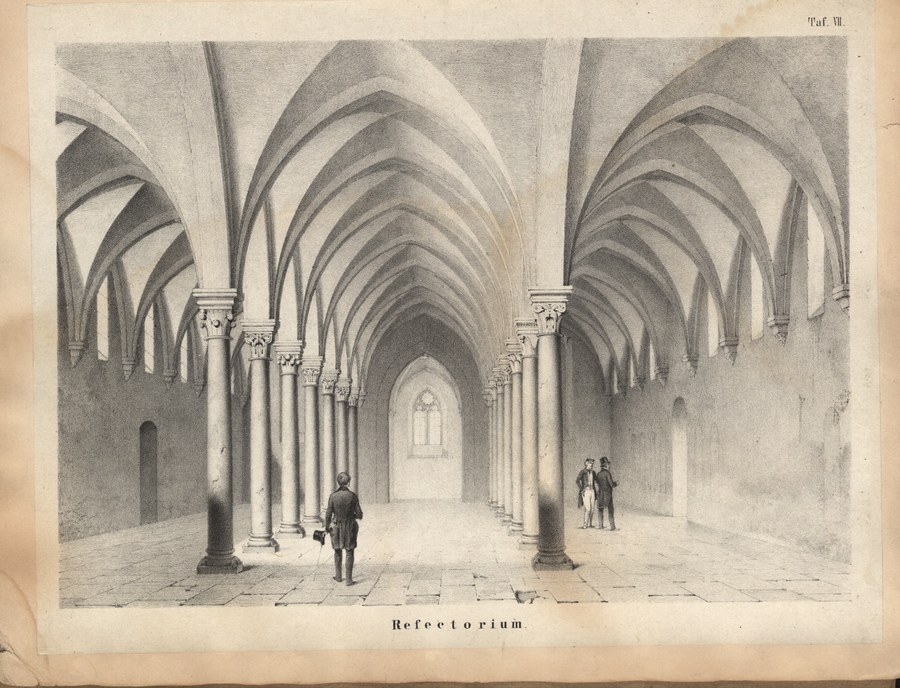
Infirmary of Eberbach Monastery, lithograph by Karl Rossel (1857)
Based on the demands in Matthew 25, care for the sick and hospitality are among the seven works of mercy. As fundamental pillars of active Christian charity, both tasks are reflected not only in the various rules and customary texts of monastic, collegiate, brother- and sisterhood communities. Numerous architectural traces also bear impressive witness to the charitable work of spiritual communities.
As part of an international conference taking place in the former Cistercian abbey of Eberbach, the facilities of monasteries, abbeys and other spiritual institutions that were formerly dedicated to caring for the infirm and guests will be examined from a regional, diachronic and institutional comparative perspective. Special emphasis is placed on topographical dispositions and the architectural form of spaces dedicated to charitable work. The conference will examine questions of cura corporis and cura animae as well as issues of hospitality in religious communities from the 12th to the 16th century. The considerations will focus on the vita religiosa of the regular canons and canonesses, Benedictine and mendicant communities, but also hospital orders, whose research, especially from a comparative perspective, remains a desideratum.
A major challenge of this approach lies in the fact that the terms ‘infirmary’ and ‘hospital’ are largely synonymous with healthcare facilities in many modern European languages. However, especially in Benedictine monasteries, infirmaries and hospitals must be distinguished from each other as institutions in the High Middle Ages. The differentiation derived from the Latin root reflects the underlying distinction between the care of weakened members of the communities in infirmaries and the admission of various groups of visitors to hospices. This can be understood on the one hand by examining traditional text sources and, on the other by dealing with the architectural remains in an artefact-sensitive manner. These functional buildings have been preserved in many places and document how the infirm and guests were treated in everyday life.
The conference will be rounded off by the inclusion of the infirmary hall from the first half of the 13th century, which has been preserved in Eberbach Monastery and can be considered an outstanding example of this type of architecture in a pan-European comparison, which was not only widespread in Cistercian abbeys.
All information about the conference can be found on the homepage of monastery Eberbach.
The program can be found here.