
Between Self-Determination and Social Expectations—The Concept of Solitude in the Female Religious Life in the Middle Ages
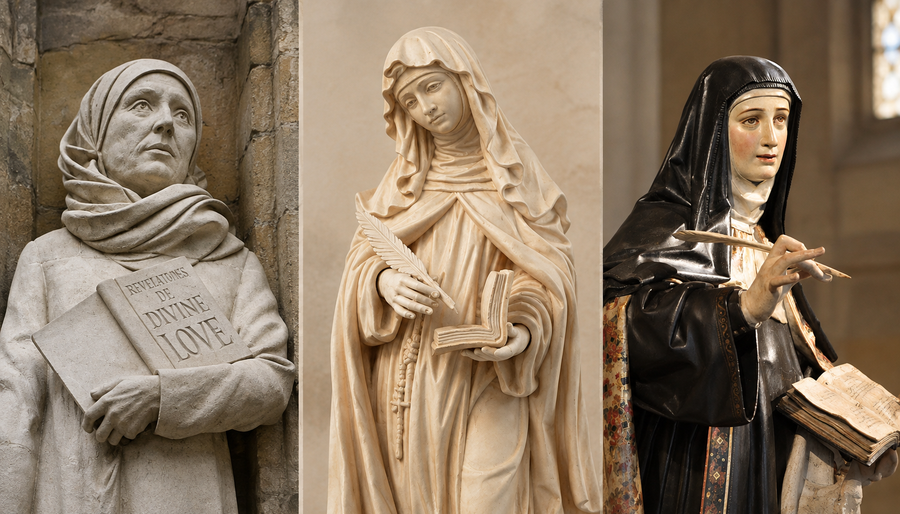
Statuarische Darstellungen von Juliana von Norwich (links), Gertrud von Helfta (Mitte) und Teresa von Ávila (rechts), jeweils mit Buch als Ausdruck ihrer schriftstellerischen Tätigkeit. (©Wikimedia/Museo Nacional de Escultura in Valladolid)
Scientific Director: Prof. Dr. Mirko Breitenstein
Research Assistant: Rebecca Hoppe
As long as humans have lived in community, they have also been familiar with the concept of loneliness. The lonely individual—whether isolating themselves from the community or being cast out of it—is a timeless and ancient phenomenon that takes on special significance, particularly in a monastic context.
In particular, it is women who are expected to shut themselves off from the world, who must take refuge in seclusion from the world’s dangers, or who themselves pose a worldly threat to their fellow believers. Research on these topics exists in a wide variety of forms—research that provides important insights but raises a fundamental problem: It is largely based on sources written by male authors. The women themselves—who retreat into solitude—and their respective backgrounds are not examined—a gap in the research that this project aims to address.
To this end, we will examine three women who left behind writings—mostly composed independently—in which they recorded their conceptions of solitude: Gertrude of Helfta, a Cistercian nun and mystic, wrote the *Legatus divinae pietatis* around 1300; Juliana of Norwich, who lived as a recluse in Norwich, wrote the *Revelations of Divine Love* between 1395 and 1416; and Teresa of Ávila, a Carmelite, mystic, and saint, documented her own life and her journey to God in her *Libro de la vida* in 1566. These texts not only offer insights into the lives of these women but also provide access to their inner understanding of retreat and seclusion. In doing so, they each articulate a specific ideal that is understood not merely as an external withdrawal from the world, but as a spiritual, theological, and existential space of experience.
The aim of the project is to reconstruct this ideal in its various manifestations, to uncover the underlying concepts, and to relate the findings to one another from a comparative perspective, thereby doing justice to a field of research that has been neglected for quite some time.