
Nov 13, 2025
Affective Polarization and In-Group Emotional Consensus: Evidence from the Climate and Immigration Divide in Germany
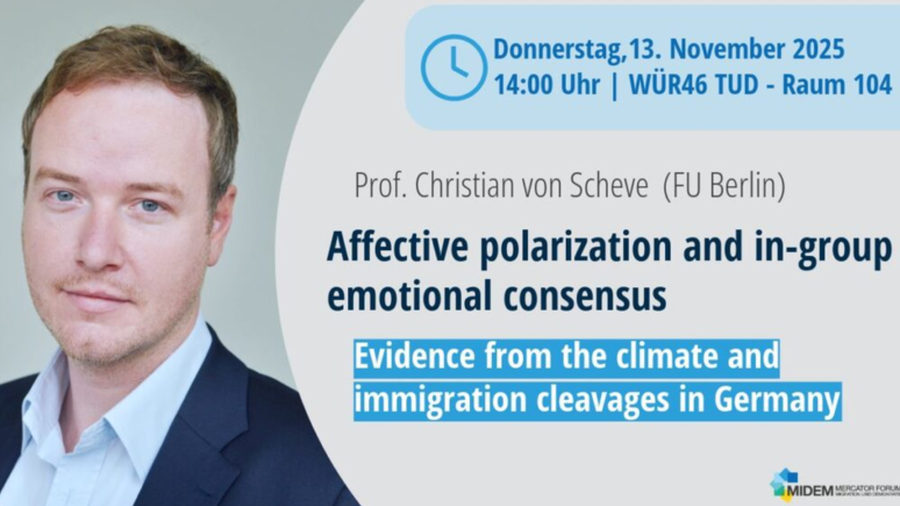
“Affective polarization” has become a key term used to describe the growing social and political divisions in many democracies. This concept is often measured in terms of the positive or negative feelings that individuals harbor toward opposing political or social groups. However, this approach often overlooks the complexity of the emotions that shape these divisions. In his lecture, Christian von Scheve will explain how examining the social and political dimensions of emotions can deepen our understanding of polarization. Drawing on a study of “issue-based polarization” in Germany—which focuses on climate change and asylum policy—the presentation examines how emotional orientations and feelings toward supporters and opponents of progressive policies contribute to the intensification of political divisions. Using cluster analysis, the study identifies two highly polarized groups, a distanced group, and a residual cluster, each of which exhibits distinct emotional patterns toward their allies and opponents.
The results show that polarized groups feel a stronger emotional affinity with like-minded individuals and perceive greater emotional differences from those who hold opposing views. Furthermore, these groups differ significantly in their sociodemographic characteristics and engagement styles, underscoring the emotional and structural dimensions of polarization. The emotional dynamics between individuals and groups thus play a central role in reinforcing social divisions.
In his presentation, Christian von Scheve will therefore demonstrate how emotions shape social and political landscapes and argue that the broader emotional and structural contexts must be taken into account when addressing polarization. A deeper understanding of emotional patterns is necessary to develop more effective strategies for overcoming divisions and promoting social cohesion.