
Sep 23, 2025
The Promise of Freedom and the Discontented “People”: East Germans During the Transition Process
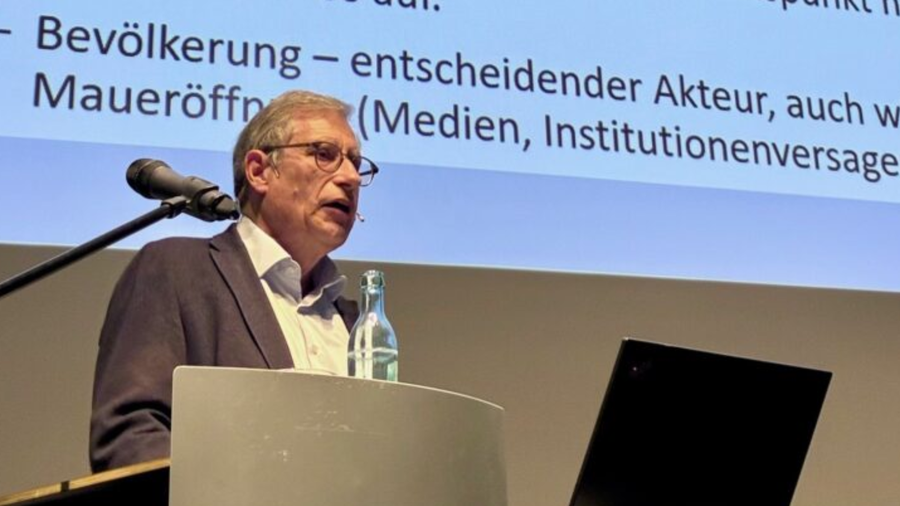
Lecture: “The Promise of Freedom and the Discontented People” – Prof. Dr. Detlef Pollack (University of Münster)
Together with MIDEM Director Prof. Dr. Hans Vorländer, Prof. Dr. Detlef Pollack discussed the causes and consequences of East Germans’ experiences of disappointment and examined the role of freedom in today’s world.
Freedom as an Imposition
Revolutions bring with them promises of freedom, yet reality often falls short of expectations. “Freedom is not only a promise, but also an imposition,” Hans Vorländer emphasized in his introduction. Freedom must be protected, institutionally safeguarded, and defended against authoritarian temptations.
From Optimism at the Time of Reunification to East German Disillusionment
Pollack recalls the year 1989, when the GDR was abandoned “lightheartedly.” East Germans did not want to reform the state; they wanted to get rid of it. However, when it came to choosing between the right to work and the social market economy, the majority opted for the latter.
Yet the initial euphoria increasingly gave way to disillusionment in the 1990s. The collapse of 70 percent of industrial production, the loss of one-third of jobs, and the upheaval of millions of lives left deep scars. People between the ages of 45 and 54 were hit particularly hard; they had been on the verge of the next step in their careers but were instead confronted with unemployment. With the loss of their jobs, not only did their income disappear, but so did their pride and sense of self. Disillusioned with politics, many people withdrew into their private lives—a reaction to their sense of powerlessness and the shattering of working-class self-confidence.
Relative Deprivation as a Driving Force
Today, according to Pollack, the differences between East and West Germany are no longer nearly as great. Nevertheless, many East Germans perceive their situation as worse than it objectively is. The rise of the AfD is driven less by actual disadvantage than by a sense of “relative deprivation”—the impression of being at a disadvantage compared to others. This perception is particularly pronounced among AfD voters.
In a study, Pollack distinguishes between “Defenders” and “Explorers.” In eastern Germany, “Defenders” account for 40 percent—twice the national average. This group holds a narrow view of belonging, feels threatened by outsiders, sees itself as marginalized, and distrusts institutions. The “Explorers,” on the other hand, advocate for openness, feel represented, and are more satisfied with democracy. From this perspective, the AfD’s successes appear less as a consequence of actual disadvantage and more as a symptom of a sense of threat, marginalization, and disillusionment with politics.
The Debate Over Reunification
In the ensuing discussion, Hans Vorländer questions the lack of a shared constitutional act. Pollack counters: Fortunately, the East had not been on an equal footing, he says, because without the socialist experiments, it would not have been possible to equate dictatorship and a planned economy with democracy and a market economy. Vorländer concedes that this debate is now outdated. In fact, support for the constitution in the East is high today—a finding recently confirmed by the MIDEM Basic Law Study.
Pollack emphasizes that politicians must expect more from citizens. We must not uncritically go along with complaints of discrimination. East Germans, according to Pollack, should also take a moment to reflect on themselves.
An Open Question
However, these findings raise an open question: Can resentment really be reduced solely to perceived injustices—and can it be overcome through appeals alone?