
Oct 21, 2026
Lea Ypi: Freedom, Dignity, and Historical Injustice—The Story of My Albanian Family
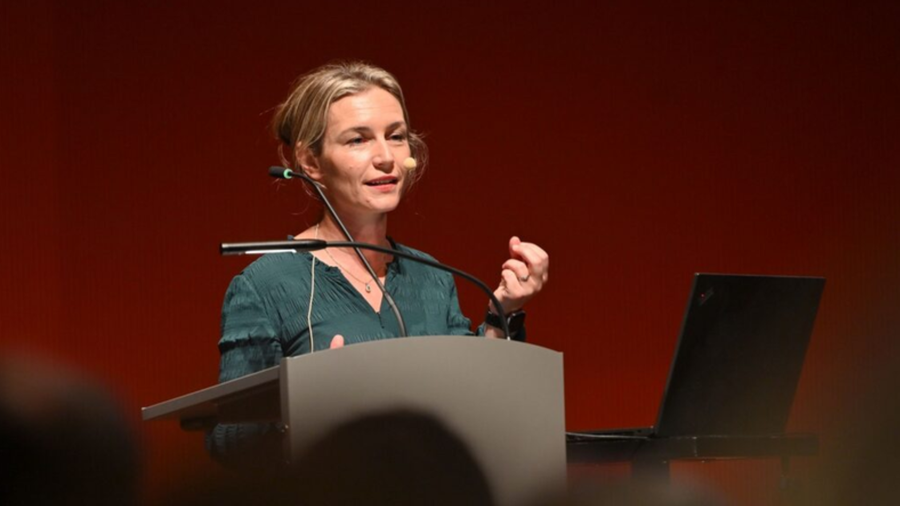
On October 21, 2025, as part of the Henry Arnhold Dresden Summer School 2025 and in cooperation with the Mercator Forum on Migration and Democracy (MIDEM) and the Deutsches Hygiene-Museum in Dresden, a lecture evening was held featuring philosopher and author Lea Ypi. The focus was on her new book *Aufrecht*, in which she explores central questions of freedom, dignity, and historical justice through the life story of her grandmother, Leman Ypi—themes that shaped the entire evening.
At the outset, Ypi quoted Friedrich Schiller from his poem *The Gods of Greece*: “Beautiful world, where are you?” He describes a world in which the gods have fled and people live in alienation—a world not unlike our own today: torn apart, marked by violence and a loss of faith. Ypi took up this motif to formulate the central question of her book. “Where can we find dignity and reconciliation today in a fragmented, disillusioned world?”
From this philosophical perspective, Lea Ypi took the audience on a journey through her family’s history—a journey from the vanished world of the Ottoman aristocracy, through the political upheavals of the Balkan states, to communist Albania. The search for traces of her grandmother thus becomes a reflection on the conditions of freedom in the face of historical catastrophes.
As in her bestseller *Frei*, Ypi explores in *Aufrecht* what it means to remain inwardly free within unfree systems. Freedom is presented not as the absence of coercion, but as a moral stance: as an insistence on humanity and self-respect in the midst of arbitrariness and injustice. Her grandmother Leman embodies this form of freedom by preserving her dignity even in times of political persecution and social ostracism—an example of the “redemptive power of art” of which Schiller spoke, understood as the ability to reconcile emotion and moral action.
These ideas were further explored in the subsequent discussion with Prof. Dr. Hans Vorländer, who opened and moderated the evening. The discussion focused on how freedom and dignity can be reimagined in times of social division, and how literary storytelling contributes to making historical injustice visible and overcoming it. Ypi’s interweaving of memory, fiction, and archival research opened up new perspectives on the question of how history is told—and how it can be liberated.
At the end of the evening, the discussion was opened up to the large audience in attendance. In a lively Q&A session, Lea Ypi and Hans Vorländer answered questions about political responsibility, the power of art, and the significance of freedom in the present day. It became clear just how deeply Ypi’s reflections on the “lost beautiful world” and the search for inner freedom resonated with the audience on a personal level.
The event took place in English and German with simultaneous translation.