
Digital Herrnhut

The "DigitalHerrnhut" project in the "Moravian Knowledge Network" (MKN)
In this sub-project, we utilise modern technical possibilities to make Moravian knowledge archives accessible for academic teaching. The central starting point for the virTUos sub-project is the creation and enrichment of 3D models of historical sites of the Moravian Church and their use in educational contexts (academic teaching also in international cooperation and citizen science). Some aspects, and some models, are briefly presented here on this page for illustrative purposes. You can find more detailed information on our blog.
Historische Quellen im digitalen Raum © Stiftung Innovation in der Hochschullehre
- In2024 and 2025, we expanded our collaborations to South Africa. We found valuable partners in the Genadendal Museum and the Moravian Theological Center (MTC) in Cape Town, with whom we worked together to develop a (revised) workflow for primary digitization in small archives(ImagoFolio), automatic transcription and annotation. With our experience in the creation of virtual excursions and the development of self-learning courses, a resilient collaboration in teaching and research for the future has emerged here under very special infrastructural conditions, which we report on in our project blog.
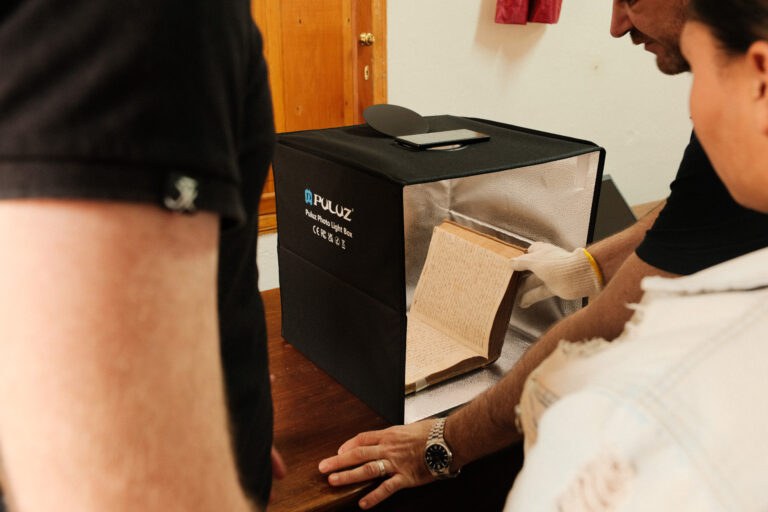
ImagoFolio in der Praxis.
- At DH2023 from July 10-14, 2023, the virTUos partners Katherine Faull (Bucknell University, USA), Philipp Tögel (KIT) and Alexander Lasch (TUD), with the participation of Juan Garcés (SLUB), presented possibilities and results of the cooperation with regard to research into Herrnhut knowledge archives in the panel"Transforming the Pietist Tradition: Disciplinary Innovation through Linked Digital Engagement".
Video recordings and presentations are available on the project blog
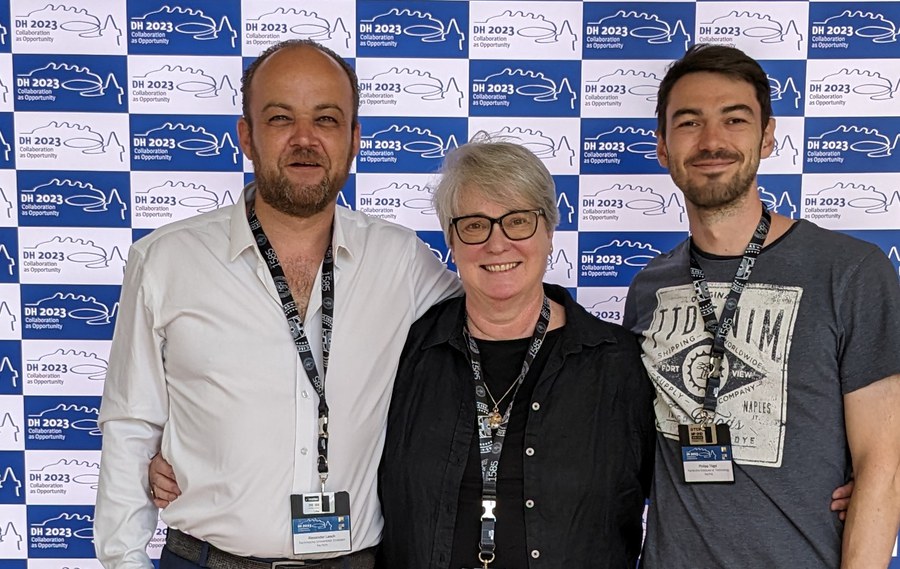
Alexander Lasch, Katherine Faull und Philipp Tögel auf der DH2023.
- At the interdisciplinary conference "Fraternal community as a universal model of life? The Moravian Church in the 18th and 19th Centuries between Uniformity and Plurality" on July 27-28, 2023, Kerstin Roth (TUD) and Marleen Schindler (TUD) spoke about their research on the use of language in Herrnhut songs. The conference offered participants the opportunity to make international contacts and exchange views on the different perspectives of research on the Moravian Church. You can find a detailed conference report on our project blog.
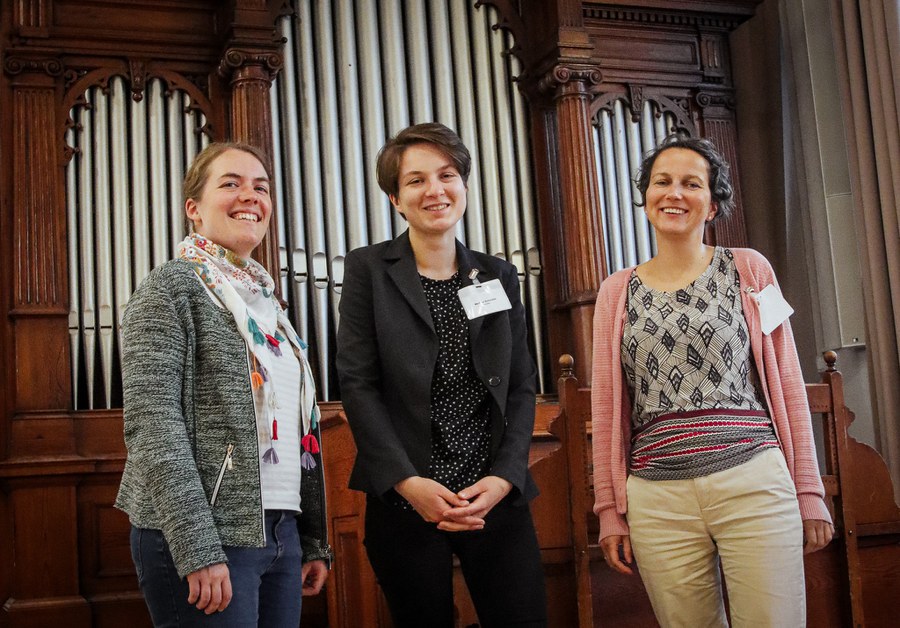
Kerstin Roth (TUD), Marleen Schindler (TUD) und Lubina Mahling (Sorbisches Institut Bautzen) vor der Orgel in der Aula des Instituts für Historische Musikwissenschaft (UHH)
- At the international conference "Halle and Herrnhut Pietism: Conflicts - Strategies - Practices", Halle, November 22-25, 2023,
Alexander Lasch presented his contribution"Are there still living people in Germany who were missionaries in America? and what are their names? and where are they? On the fragility of grammatical scholarly networks at the beginning of the 19th century". Relationships between historical-linguistic research and the innovative teaching projects developed for DigitialHerrnhut. Presentation, recording and further information on this contribution can be found here.
In her contribution "The Sisters' House in Kleinwelka: Common Life in Herrnhut Pietism", Lubina Maling referred directly to the virtual model of the Sisters' House, which is part of the virtual excursions in DigitalHerrnhut. You can find the recording and further information here.
In July 2022, the virtualised Kleinwelka Single Sisters' House (funded by CLiC & virTUos) was presented at the start of the Sommerreise der Bundesstifung Baukultur:
Kindermann, Nora, Alexander Lasch & Sarah Wagner. 2022. Kleinwelka als Wissensarchiv. Zenodo. https://doi.org/10.5281/zenodo.6850913.
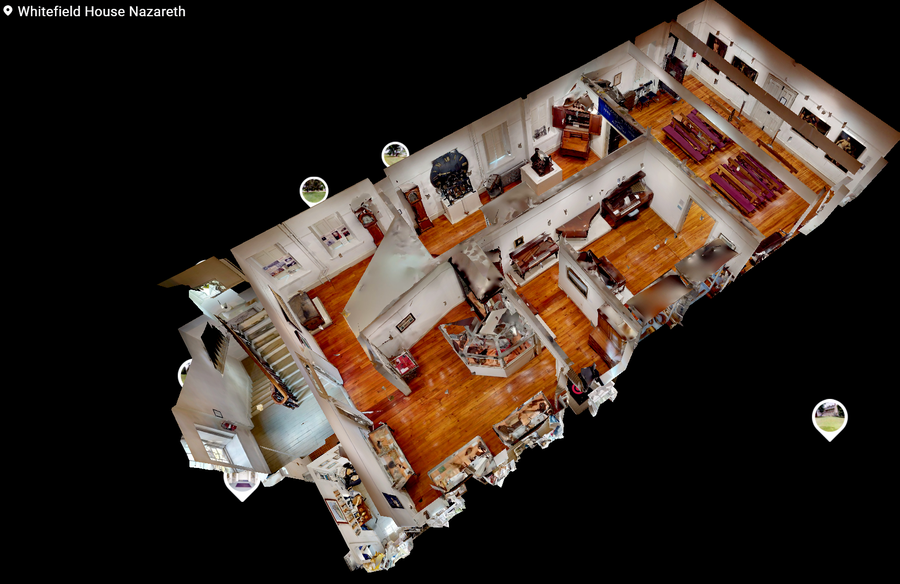
In September 2022, the first two 3D models from Nazareth, Pennsylvania, were added, which Robert C. Schuppe (funded by virTUos) and Dominik Hetjens (funded by CLiC) were allowed to record in August 2022. The building complex of Whitefield House & Gray Cottage is a special testimony to Herrnhut missionary activity on the east coast of what is now the United States.
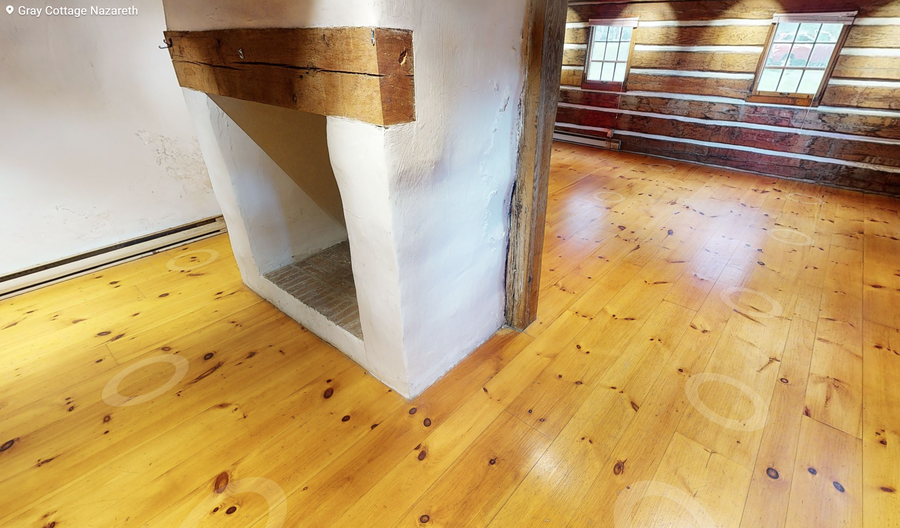
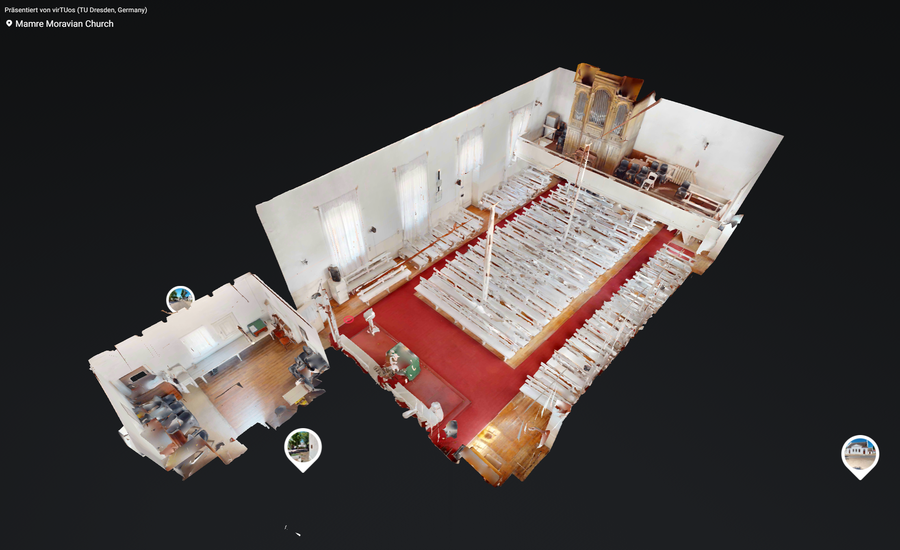
In February 2024, we were able to visit the oldest mission stations of the Moravian Church in South Africa, Genadendal (formerly Baviaanskloof) and Mamre (formerly Groenekloof), as well as the Moravian Theological Center in Cape Town. In addition to archive research and initial discussions on the initiation of international teaching and learning cooperations for the digital indexing of handwritten archive collections, we also had the opportunity to expand our virtual models to include the churches in Mamre (pictured) and Genadendal as well as the Genadendal Mission Museum (pictured):
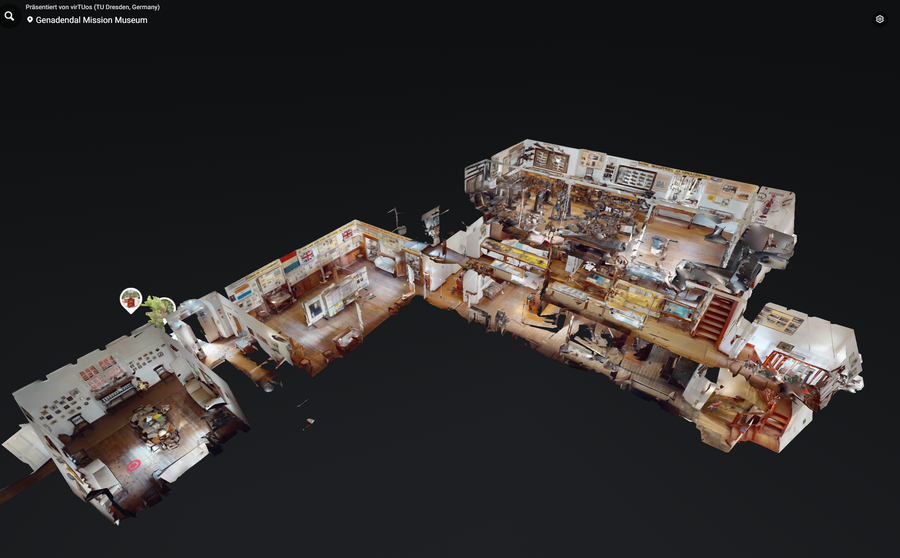
In the model of the museum, we will integrate our third self-learning module for acquiring the ability to read and transcribe German Kurrent script and to convert texts into a digital edition. All information about this first exploration can be found on our project blog.
The DigitalHerrnhut project is developing immersive self-learning modules that are embedded in 3D models as virtual excursions. With this tool, students can learn at their own pace and also contribute to the learning environment themselves. The self-study modules are offered in English and German and are designed as project courses in WikiVersity.
In the German Kurrentschrift sub-module, the teaching of subject-specific skills is being tested on the basis of gamification elements. In a virtual 3D environment, students can learn to read the handwriting used in German until around 1900. New spaces are unlocked by completing exercises. In this way, students can practise with a specific objective and at the same time boost their motivation by exploring historically significant places step by step.

Workshop virtual excursions (LL2025)
Alexander Lasch (TUD) & Robert C. Schuppe. 03.07.2025.
TU Dresden Campus Classics 2025 in Kleinwelka
With lectures and guided tours by Lutz-Wolfram Reiter (Johann August Miertsching), Dorit Kumpe (Gottesacker) and Ulrike Riecke (Schwesternhäuser), Bernd Domschke (Kirchensaal), Josephine Salomo (gardens and green spaces in Kleinwelka), Sarah Wagner (Botanical Garden and Mission, BMBF and BMFTR), Robert C. Schuppe and Alexander Lasch (virtual excursions for Digital Herrnhut in virTUos, Foundation for Innovation in University Teaching). 21.06.2025.
Working meeting on the strategic development of the MKNetwork
Juan Garcés (SLUB) & Alexander Lasch (TUD). 05.03.2025.
Workshop for further Collaboration IV ( (Cape Town, Dresden, Genadendal, Stellenbosch)
Juan Garcés (SLUB) & Alexander Lasch (TUD). 04.02.2025.
Workshop for further Collaboration III ( (Cape Town, Dresden, Genadendal, Stellenbosch)
Juan Garcés (SLUB) & Alexander Lasch (TUD). 28.10.2024.
Workshop for further Collaboration II (Cape Town, Dresden, Genadendal, Stellenbosch)
Juan Garcés (SLUB) & Alexander Lasch (TUD). 05.08.2024.
Workshop for further Collaboration (Cape Town, Dresden, Genadendal, Stellenbosch)
Juan Garcés (SLUB) & Alexander Lasch (TUD). 14.05.2024.
Systematic recording of Kurrent scripts
March 12 and 13, 2024
Cooperative workshop (Juan Garcés, dissemination partner SLUB, & Alexander Lasch, TUD-virTUos)
Moravian Knowledge Network Workshop
18.09.2023
Cooperative workshop (Juan Garcés and Kay-Michael Würzner, dissemination partners SLUB, & Alexander Lasch, TUD-virTUos)
Moravian Knowledge Network. Current research and perspectives
March 6 and 7, 2023
Cooperative workshop (Juan Garcés and Kay-Michael Würzner, dissemination partners SLUB, & Alexander Lasch, TUD-virTUos) Dominik Hetjens, Alexander Lasch, Lubina Mahling, Kerstin Roth, Josefine Salomo, Marleen Schindler & Robert C. Schuppe. 2023 Moravian Knowledge Network. Current research and perspectives (Dataset 1.0). Zenodo. https://doi.org/10.5281/zenodo.7707509.
Herrnhut in the Wikimedia universe - authority data and Wikidata
September 1 and 2, 2022
Cooperative workshop (Juan Garcés, dissemination partner SLUB, & Alexander Lasch, TUD-virTUos)
From handwriting to machine-readable text
August 1 to 3, 2022
Cooperative workshop (Juan Garcés, dissemination partner SLUB, & Alexander Lasch, TUD-virTUos)
Juliane Flade. 2022 How do I get started? Learning the basics of open cultural data by indexing manuscript sources of the Moravian Church. saxorum.hyptheses.org.
Anna Meyer. 2022 How do I get started? Learning the basics of open cultural data by cataloging manuscript sources of the Moravian Church. Where can you find Geckelemuckpeschünck*? - Impressions of the workshop: "Herrnhut in the Wikimedia universe". textlab.hyptheses.org.
Alexander Lasch & Marlene Wolf. 2025: Grammatographic scholarly networks in transition. In: Lena Schnee, Stefan Hartmann & Henriette Huber (eds.). Historische Grammatik(en) (Yearbook for German Language History 16). Berlin, Boston: De Gruyter. 7-25. https://doi.org/10.1515/jbgsg-2025-0003.
Sabine Hollmann. 2025. missionary movements in the Moravian Church. visualization of the South African journey of Christian Ignatius Latrobe. TUD Dresden University of Technology, (currently still) unpublished Master's thesis in the field of Digital Humanities. GitHub-Repo | Webview of the results.
Friederike Lasch. 2024. how to learn Kurrent? Promotion of self-directed learning through the digital self-learning module "Deutsche Kurrentschrift" in gifted education based on Joseph S. Renzulli's Enrichment Triad. Westfälische Wilhelms-Universität Münster, unpublished diploma thesis.
Alexander Lasch. 2024: Trust as a collective and communicative resource in Herrnhut rituality. In: Pavla Schäfer & Milena Belosevic (eds.). Language and trust: Facets of linguistic and interdisciplinary trust research. Berlin, Boston: De Gruyter. 185-204. DOI: 10.1515/9783111452883-009.
Alexander Lasch. 2024. (En)counting in the network work: The challenge of the autoplausibility of the network metaphor using the example of construction grammatical narratives. In: Matthias Attig, Katharina Jacob, Marcus Müller & Friedemann Vogel (eds.). Netz und Werk. On the sociality of linguistic action. Berlin, Boston: De Gruyter. 137-148. DOI: 10.1515/9783111086514-011.
Marlene Wolf. 2024. The diplomatic transcription of the Onondagoic
grammar by David Zeisberger and the investigation of its significance
in the network of scholars around the missionary of the Moravian Church.
At the same time scientific work for the 1st state examination. TU Dresden, unpublished.
Alexander Lasch. 2024. "who called them, Sunday *Indians or Shwannaks, that is, white people, the most opprobrious name they could invent. Powerful Constructions in the Service of Verbal Devaluation". In: Simon Meier-Vieracker, Heidrun Kämper & Ingo Warnke (eds.) Invective Discourse. Berlin, Boston: De Gruyter. 45-70. DOI: https: //doi.org/10.1515/9783111146553-004.
Juan Garcés, Anna S. Meyer, Arne Rümmler, Kay-Michael Würzner. 2023. giving wings to wings. In: Wolfgang Breul (ed.). The Moravian Church in the 18th and 19th Centuries. Theologie - Geschichte - Wirkung (Works on the History of Pietism 69). Göttingen: Vandenhoeck & Ruprecht. 675-698. DOI: https: //doi.org/10.13109/9783666565618.675.
Alexander Lasch. 2023. Differences "between us & the white people". Self-positioning in mission narratives. In: Wolfgang Breul (ed.). Die Herrnhuter Brüdergemeine im 18. und 19. Jahrhundert. Theologie - Geschichte - Wirkung (Arbeiten zur Geschichte des Pietismus 69). Göttingen: Vandenhoeck & Ruprecht. 531-550. DOI: https: //doi.org/10.13109/9783666565618.531.
Alexander Lasch. 2023. At the grave and beyond. Funeral sermons and Herrnhut life descriptions in (cognitive-linguistic-constructional-grammatical) comparison. In Susanne Haaf & Britt-Marie Schuster (eds.). Historical Text Patterns in Transition: New Approaches to their Exploration (=RGL 311). Berlin, Boston: De Gruyter. 419-438. DOI: https: //doi.org/10.1515/9783111086538-014.
Marlene Wolf & Alexander Lasch. 2023. index of the Gemein-Nachrichten (from 1765 (0.9). Zenodo. DOI: https: //zenodo.org/doi/10.5281/zenodo.8228849.
Alexander Lasch. 2023 But theſe habit of tying children to boards is gradually disappearing. Multiple formulas as constructions of modality in the context of construction-grammatical narratives. In: Alexander Ziem (ed.). construction grammar VIII: constructions and narration. Tübingen: Stauffenburg. 153-177.
Alexander Lasch. 2023. multimodal and agile corpora. In: Arnulf Deppermann, Christian Fandrych, Marc Kupietz & Thomas Schmidt (eds.). Corpora in German linguistics. Oral, written, multimedia (Yearbook of the Institute for the German Language 2022). Berlin, Boston: De Gruyter. 225-250. DOI: https: //doi.org/10.1515/9783111085708-011.
Alexander Lasch, Dominik Hetjens & Robert C. Schuppe. 2022. digitalHerrnhut. New approaches to historical linguistics through digitally supported learning environments - a workshop report. In: Jörg Meier (ed.). Language History and Education (Yearbook for German Language History 13). Berlin, Boston: De Gruyter. 129-146. DOI: https: //doi.org/10.1515/jbgsg-2022-0009.
Dominik Hetjens, Alexander Lasch, Marlene Rummel & Robert C. Schuppe. 2022. virtual excursion Kleinwelka. In: Lessons Learned II. DOI: https: //doi.org/10.25369/ll.v2i1.39.
Alexander Lasch. 2021. (Scientific) culture of digitality. In: Lessons Learned I. DOI: https: //doi.org/10.25369/ll.v1i1/2.27.
- Prof. Dr. Alexander Lasch (Professorship for German Linguistics and Language History, Project Management)
- Robert C. Schuppe (Project employee)
- Marlene Wolf (Project employee)
- Jördis Römer (Project employee)