
May 20, 2026
Dr. Kapteina at the 2nd HSBA–Ingeborg-Gross Research Retreat
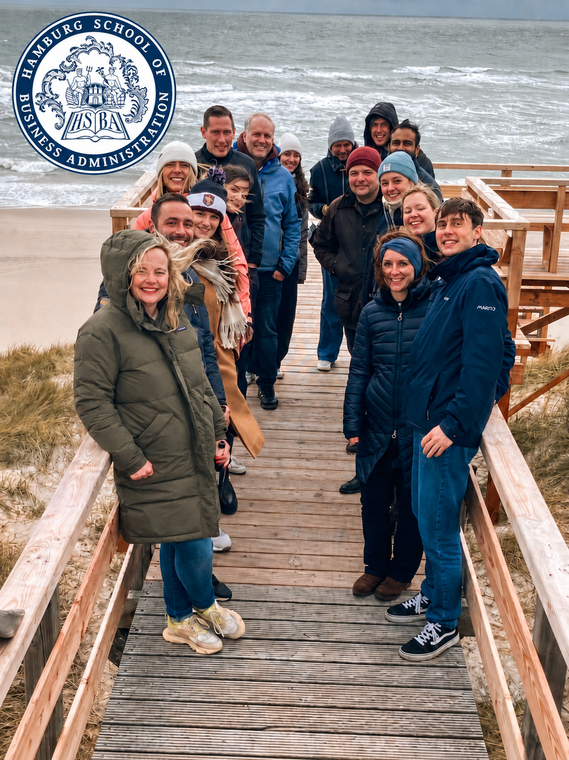
Participants of the Sylt 'Akademie am Meer'
The 2nd HSBA–Ingeborg-Gross Research Retreat took place on Sylt (Akademie am Meer, Germany) and brought together early-career scholars and international researchers for an intensive exchange on research at the intersection of business, society, and normative responsibility. The retreat was marked by challenging weather conditions, which, in their intensity, symbolically resonated with the research topics addressed and additionally framed the engagement with “extreme contexts.”
The retreat was organized and curated by Prof. Dr. Sarah Jastram, whose conceptual and academic leadership significantly shaped the framework for interdisciplinary exchange.
For IHI Zittau at TU Dresden, this format is of particular importance, as it connects empirically and theoretically driven research on societal responsibility, organizational change, and sustainability with international perspectives, thereby strengthening key objectives of TU Dresden in the field of Responsible Management.
This year’s contribution from IHI Zittau centered on Dr. Benedikt Kapteina, Postdoctoral Researcher at the Chair of Business Administration, especially Responsible Management, at IHI Zittau. In his talk “When Silence Becomes Costly,” he presented current findings from his research on Corporate Democratic Action (CDA).
Kapteina emphasized: “Organizational silence is not the absence of action, but a form of political positioning that becomes visible under conditions of democratic instability.”
Building on this, the presentation argued that organizational silence in politically unstable contexts is not neutral. Instead, under conditions of heightened uncertainty, it is interpreted by different stakeholders. This produces reputational, labor-market-related, and expectation-based effects that transform silence into an economically and normatively relevant form of organizational positioning. Corporate Democratic Action (CDA) is thus developed as an analytical approach that addresses a key gap in Corporate Political Activity research: the systematic neglect of silence as a strategically relevant category.
In addition, Dr. Kapteina presented a joint research project with Prof. Dr. Georg Wernicke (HEC Paris) and Prof. Dr. Markus Scholz (TU Dresden), which examines forms of organizational political positioning under conditions of democratic instability and further develops the theoretical foundations of Corporate Political Activity and Corporate Responsibility.
The retreat was further shaped by keynote lectures from internationally recognized scholars, including Madeleine Rauch (University of Cambridge), who presented research on war contexts, Samuel Barton (University of Hamburg), who discussed Arctic climate research and plankton ecology, and Laura Marie Edinger-Schons (University of Hamburg), who provided insights into sustainable transformation and systemic change. These contributions framed discussions on extreme contexts, uncertainty, and societal transformation.
The program was complemented by further contributions from doctoral and postdoctoral researchers, who brought diverse perspectives to current research questions and significantly shaped the interdisciplinary exchange.
We extend our sincere gratitude to Prof. Dr. Sarah Jastram, who conceptualized, organized, and curated the retreat and coordinated the invited contributions, as well as to Sabine Lebedinski, who significantly shaped the intellectual and atmospheric dimensions of the retreat and provided important impulses on stress and resilience. We also thank Johanna Ronning for her organizational support. Finally, we acknowledge the Ingeborg-Gross-Stiftung for its continued support of this academic exchange.