
Aug 31, 2026
Dr. Kapteina at the dialogue forum "Unternehmen für Demokratie" at the Federal Ministry of Finance
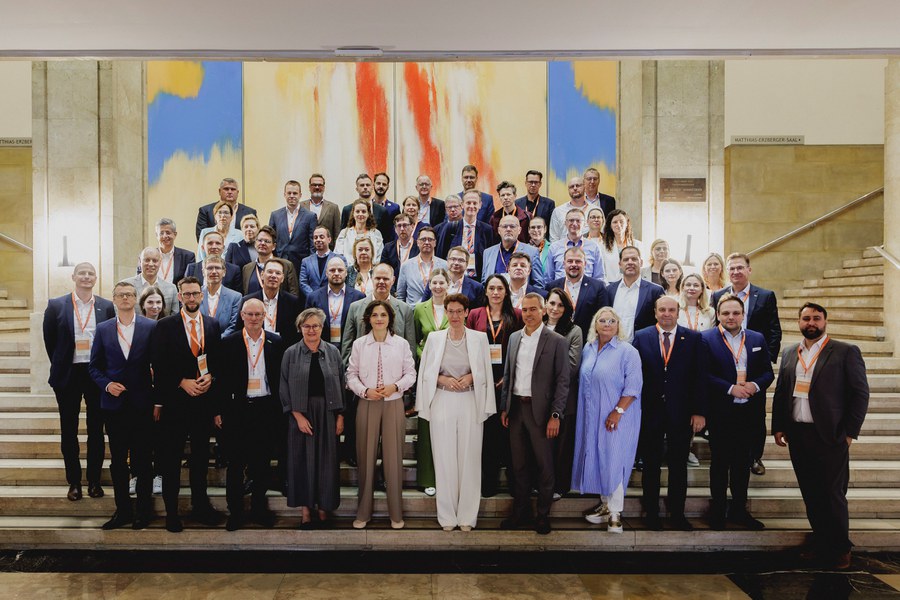
BMF-Dialogforum 'Unternehmen für Demokratie'
On 19 August 2026, Dr. Benedikt D. S. Kapteina, Postdoctoral Fellow at the Chair of Business Administration, esp. Responsible Management, at TU Dresden's International Institute (IHI) Zittau, took part in the dialogue forum "Unternehmen für Demokratie" (Business for Democracy) at the Federal Ministry of Finance in Berlin. The invitation came from Minister of State Elisabeth Kaiser, Federal Government Commissioner for Eastern Germany. It was addressed to the chair, which Dr. Kapteina represented, contributing its research perspective.
Background
The office of the Commissioner for Eastern Germany has been located at the Federal Ministry of Finance since May 2025 and lists democracy and civic engagement as one of its policy fields; the forum belongs to a series of dialogue formats at the ministry. It fell into a dense political moment, three weeks before the state election in Saxony-Anhalt and five weeks before the elections in Mecklenburg-Vorpommern and Berlin. The 2025 report of the Commissioner describes a region that has caught up economically while differences persist, including a still predominantly West German composition of leadership positions.
The initiative
The forum was linked to the initiative "Unternehmen für Demokratie", which emerged from the East German Business Forum and is organised by ifok GmbH. In late July 2026 the participating companies published a joint declaration on democracy and the social market economy. An accompanying study by the Wittenberg Center for Global Ethics shows that almost all respondents see democracy under pressure, while corporate engagement itself remains contested: approval, rejection and indecision are roughly balanced, and what matters is the type of measure. Structures already exist, such as the Business Council for Democracy with some two hundred companies and the joint initiative Zukunftswege Ost. The question was therefore less whether companies act than how scattered activities can be combined.
Programme
The three hour forum in the Erzberger Hall opened with welcoming remarks by Minister of State Kaiser and Dr. Katrin Leonhardt, Chair of the Board of Sächsische Aufbaubank, followed by an impulse by Thomas Richter (Infineon Technologies) on leadership in times of populism and extremism. Two discussion rounds asked what emphases executives can set in the face of anti democratic movements and how support for democracy outside metropolitan centres can be made more effective through closer cooperation between companies, initiatives and policymakers. The panel comprised Henning Banthien (ifok), Sylvia Pfefferkorn (Wirtschaft für ein Weltoffenes Sachsen), Stefan Vogt (Freudenberg Stiftung) and Angela Papenburg (GP Günter Papenburg AG). The meeting was designed as the starting point of continuing cooperation.
What the research shows
Dr. Kapteina studies how companies act politically when democratic institutions come under pressure, and when such action has an effect. The policy paper on CEO activism shows that publicly visible positioning by senior executives is limited in its effect. Under the concept of Corporate Democratic Action he sets out the conditions under which companies act as democratic actors: what matters is less the visibility of a commitment than its anchoring in structures, responsibilities and routines. The forum’s guiding question of which measures actually work therefore meets these findings directly.
This field is studied at the Chair of Business Administration, esp. Responsible Management at TU Dresden's International Institute (IHI) Zittau as a team, together with, among others, Prof. Dr. Markus Scholz and PD Dr. Eckhard Burkatzki.