
Aug 21, 2025
Kapteina: Guest Lecture at the University of Notre Dame
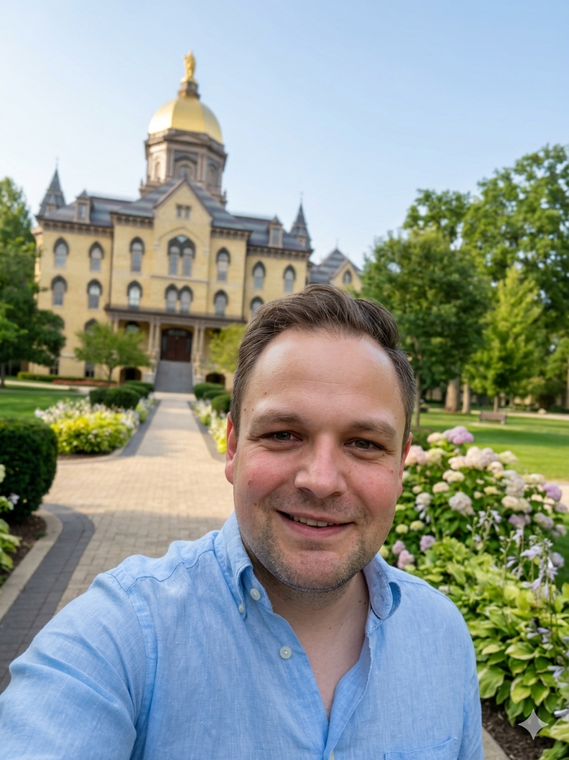
In August 2025, Dr. Benedikt Kapteina, Postdoctoral Fellow at the Chair of Business Administration, with a focus on Responsible Management, at the Technical University of Dresden, delivered a guest lecture at the University of Notre Dame (USA) at the invitation of Dr. Daniel Schwake. As part of the intensive program “Reimagining Business Excellence: Purpose Driven Leadership”, he presented his research on “Corporate Political Activism in Germany”.
The lecture was directly linked to a German-Israeli research project on Corporate Democratic Action (CDA), which Dr. Kapteina conducts together with the chairholder, Prof. Dr. Markus Scholz, and Dr. Schwake as co-leader. The project examines how companies operate as political actors in politically polarized and democracy-challenged contexts such as Israel, how they may strengthen or undermine democracy, and what responsibilities they hold toward society and institutions. Building on research on Corporate Political Activism and CEO Activism, the project investigates under which conditions corporate political engagement enhances democratic legitimacy and when it might instead exacerbate polarization or allow for avoidance of responsibility.
The University of Notre Dame is internationally recognized for integrating ethics, democracy, and value-driven leadership into research, teaching, and campus culture. The de Nicola Center for Ethics and Culture and the Institute for Ethics and the Common Good connect moral philosophy, theology, political science, and management research to address issues of justice, social cohesion, and democratic pluralism. The program “Reimagining Business Excellence: Purpose Driven Leadership” brings together executives, students, and scholars from various disciplines to explore strategic, ethical, and practical challenges in responsible corporate leadership.
Dr. Daniel Schwake, Executive Director of the University of Notre Dame Center in Jerusalem (Notre Dame at Tantur), is a long-standing expert on strategic management and ethics in the Middle East. His research at the intersection of business, government, and civil society in Israel and the region complements the CDA project and illuminates the role of companies in polarized societies.
In his lecture, Dr. Kapteina explained how and why companies are increasingly acting as political actors, particularly in the context of rising populism, disinformation, and democratic backsliding. While traditional corporate strategy often emphasized a separation of business and politics, Germany is witnessing a shift. Companies issue public statements, launch campaigns, or collaborate with civil society organizations to support democratic values, press freedom, rule of law, and social cohesion.
Drawing on prominent examples from Germany including European elections, extremist movements, and disinformation campaigns, Kapteina demonstrated how companies assume political responsibility. He also highlighted the limits of such engagement. Risks include being perceived as partisan, becoming entangled in polarizing debates, or overextending themselves in roles that are fundamentally the responsibility of state institutions.
The week of the “Reimagining Business Excellence” program combined academic modules with practical site visits, such as to university innovation centers including the IDEA Center, as well as interactive workshops and discussions. The program concluded with participants exploring key facilities and iconic sites of the Notre Dame campus, including the Golden Dome, the Sacred Heart Basilica, and the Grotto of Our Lady of Lourdes, to link theoretical reflection with the lived campus culture.
The discussion with international participants underscored the relevance of the topic for value-driven leadership and responsible management across diverse political and cultural contexts. Students, managers, and faculty members collectively reflected on when corporate engagement is meaningful, how it can be institutionalized in global companies, and the role of universities in preparing leaders for these challenges.
For the TU Dresden and the IHI Zittau, this lecture represents another step in making research on corporate political activism and democratic corporate responsibility, including the German-Israeli CDA project with Dr. Schwake, visible on the international stage while positioning German practice as a case study for global debates on Purpose Driven Leadership and democratic governance.