
Mar 27, 2026
Flying test lab for climate-friendly aviation: TU Dresden inaugurates research aircraft
The Institute of Lightweight Engineering and Polymer Technology (ILK) and the Institute of Aerospace Engineering (ILR) at the TUD Dresden University of Technology commissioned their new research aircraft today, March 26, 2026, at Kamenz Airfield and presented it to the public for the very first time. The aircraft will serve as a flying test lab for researching fossil-free aviation propulsion systems.
Climate-friendly propulsion systems – application-oriented performance data
The research focuses on innovative climate-friendly propulsion systems, such as electric, hydrogen-based, or hybrid concepts. In the future, these can be tested under real flight conditions and compared with one another. At the same time, energy systems, sensor technology, and structural components can be analyzed in their interaction. The operational and performance data obtained will help further develop technologies from the lab to practical application.

Prof. Maik Gude (left) and Prof. Johannes Markmiller in front of the aircraft.
“With the research aircraft, we are closing the crucial gap between theory and practical application. This is because sustainable aviation is not just about the engine, but about the holistic integration of propulsion systems into the aircraft. Now, we have a unique opportunity to demonstrate how lightweight fuel systems and complex structural components, for example, perform under the dynamic loads of real-world flight operations,” says Prof. Maik Gude, Director of the Institute of Lightweight Structures and Multi-Material Design at TUD.
Prof. Johannes Markmiller, Chair of Aircraft Engineering at TUD, underscores the project’s significance: “The fascination with flying has accompanied me throughout my entire professional life as a pilot and engineer. Thanks to the ‘FoFlu’ project, we are now propelling this experience into a new era. I am truly delighted that we can now push the technological boundaries here in Saxony under real flight conditions. This new research aircraft is far more than just a test platform for us. It is the key to unlocking the enormous potential of fossil-free propulsion systems and making the vision of climate-neutral aviation a reality.”
Minister of Science Sebastian Gemkow said at the presentation of the research aircraft: “This aircraft is another essential building block for successful structural transformation in the Lusatia research region. The project is largely financed by European funds from the so-called Just Transition Fund, which specifically supports forward-looking concepts. This is about nothing less than the future of aviation. Research into new propulsion and lightweight construction technologies is of enormous importance for the aviation industry.”
Field testing for innovative measurement systems and propulsion components
The test platform is based on a Diamond Aircraft DA62 MPP, a twin-engine special-purpose aircraft designed for research and survey missions. This aircraft is characterized by exceptional efficiency and modularity. Thanks to its fuel-efficient Jet-A1 piston engines, it achieves a flight duration of up to ten hours while keeping operating and maintenance costs to a minimum. Its particular strength lies in its flexible configuration. Various high-tech sensors and camera systems can be integrated into modular, interchangeable housings (pods) located at the aircraft’s nose, fuselage, and under the wings.
Advancing the aviation research region in Eastern Germany
The Kamenz site in Lusatia is emerging as a hub for a growing aviation landscape in Eastern Germany. The research aircraft is an integral part of the newly founded science and business platform OST4Aviation, which is driving the development of a region with high aviation research capabilities in Eastern Germany to more closely integrate expertise from science and industry. In the future, a dedicated refueling station for sustainable aviation fuels (SAF) and hydrogen will be available at the Kamenz site. This will create the necessary logistical foundation to test fossil-free propulsion technologies directly on-site under real-world conditions and to provide groundbreaking innovation for climate-neutral aviation.
About the FoFlu Project
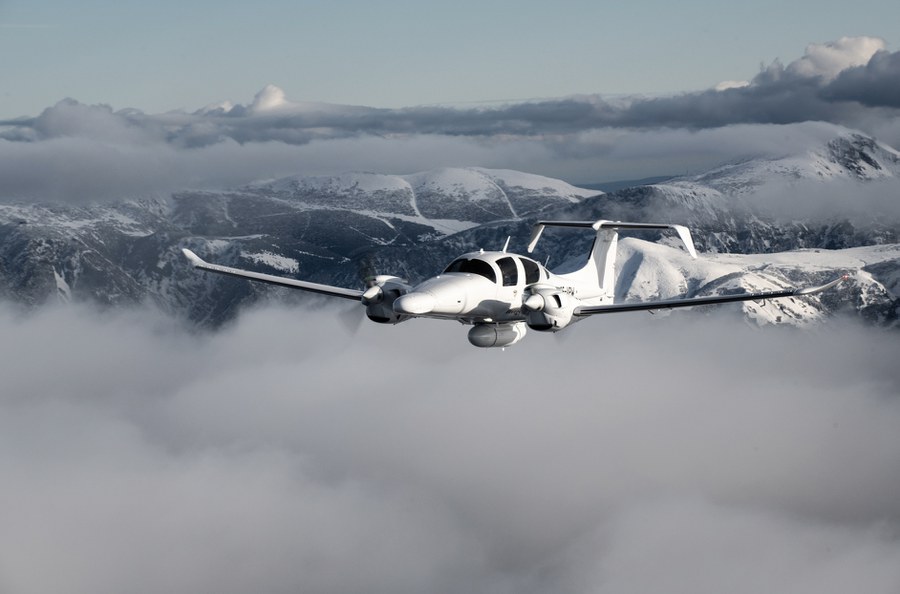
Research aircraft of the Technical University of Dresden, model: Diamond Aircraft DA62 MPP.
The research aircraft is part of the EU-funded FoFlu project (Modular Research Aircraft as
an Experimental Platform for Researching Future Fossil-Free Propulsion Systems in Real Flight Operations). The cost of the aircraft amounts to approximately EUR 3 million. Additional investments in hydrogen aircraft engines, infrastructure, and sensor technology will be made by the end of the project period. The project is funded by the European Union and the Free State of Saxony through the JTF InfraProNet program with a total funding volume of EUR 4.6 million for the funding period from August 2024 to June 2027.
Academic contact:
Dr. Sebastian Spitzer
Institute of Lightweight Engineering and Polymer Technology
Email:
Media contact:
TU Dresden
Press Office
Tel.: +49 351 463-32398
Email: