
09.09.2026
Forschende der TU Dresden und des DLR testen erfolgreich erste aktiv gekühlte Wasserstoff-Sauerstoff-Umlauf-Detonationsraketenbrennkammer Europas
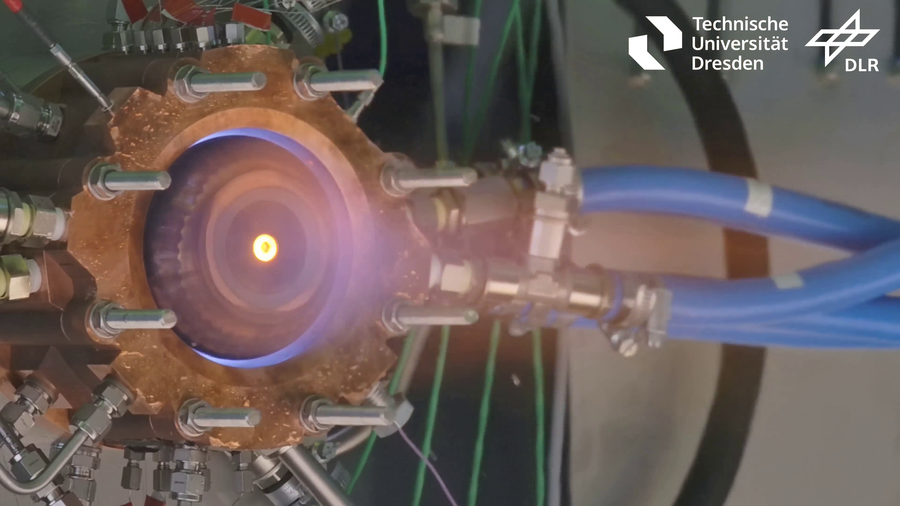
An der TU Dresden entwickelte Umlauf-Detonationsbrennkammer im Langzeitbetrieb - mit Düsensegment
Wissenschaftler der TU Dresden haben gemeinsam mit ArianeGroup und der Einrichtung für Raumfahrtantriebe des Deutschen Zentrums für Luft- und Raumfahrt (DLR) in Lampoldshausen im Rahmen des Forschungsprojekts "Numerical and Experimental Demonstration Study for Engines using Rotating Detonation" (NEDSERD) die erste wassergekühlte Umlauf-Detonationsraketenbrennkammer Deutschlands erfolgreich getestet. Diese sogenannte Rotating Detonation Rocket Engine (RDRE) wurde entwickelt, um das Betriebsverhalten sowie die thermischen Belastungen der Struktur genauer zu untersuchen und daraus Erkenntnisse für die Weiterentwicklung zukünftiger RDREs zu gewinnen. Im Gegensatz zu herkömmlichen Raketentriebwerken nutzen RDREs kontrollierte Detonationen anstelle von kontinuierlicher Verbrennung. Eine Technologie, die in der Raumfahrt der Zukunft Anwendung finden könnte.
Bisherige RDREs in Europa wurden zumeist ungekühlt betrieben und konnten nur für wenige Sekunden getestet werden. Dies schränkte die Möglichkeiten ein, präzise Aussagen über die Wärmeströme im stationären Betrieb zu treffen. Um diese Wissenslücke zu schließen, entwickelte die TU Dresden ein wassergekühltes RDRE, das mit der Treibstoffkombination Wasserstoff und Sauerstoff arbeitet. Die Tests haben gezeigt, dass mit einer Wasserkühlung ein additiv gefertigtes RDRE über längere Zeit stabil betrieben werden kann. Dies bildet die Grundlage für eine detaillierte Untersuchung des Betriebsverhaltens sowie für einen Weg hin zu einer Anwendung dieser Art von Triebwerken.
In klassischen Raketentriebwerken wird Treibstoff bei gleichbleibendem Druck verbrannt. Diese Technologie hat ihr Effizienzpotenzial jedoch nahezu vollständig ausgeschöpft. RDREs setzen stattdessen auf eine umlaufende Detonationswelle in der Brennkammer, die den Treibstoff explosionsartig verbrennt. Theoretisch ermöglicht dies eine effizientere Nutzung der Treibstoffe. Gleichzeitig gibt es durch die kürzere Verbrennungsregion das Potential, dass diese Triebwerke leichter und kompakter gebaut werden könnten. Für die Raumfahrt bedeutet dies potenziell einen geringeren Treibstoffverbrauch, höhere Nutzlastkapazitäten für Satelliten oder Instrumente sowie reduzierte Startkosten.
Im Rahmen des Projektes wurden zwei Testkampagnen durchgeführt. In der ersten Testkampagne wurde ein ungekühltes RDRE des DLR untersucht. Die zweite Testkampagne setzte auf ein größeres, mittels Laser Powder Bed Fusion (LPBF, auch bekannt als Metall-3D-Druck) gefertigtes und wassergekühltes RDRE. Der Fokus lag dabei auf umfangreichen Temperaturmessungen, um die thermischen Belastungen der Brennkammer besser zu verstehen. „Die zentrale Herausforderung bestand neben der Entwicklung der gekühlten Brennkammer selbst darin, die hohen Wärmebelastungen unter verschiedenen Betriebsbedingungen zu analysieren“, erklärt Dr.-Ing. Christian Bach, Leiter des Forschungsfelds Raumtransportsysteme. „Hierfür haben wir drei verschiedene Verfahren zur Temperatur- und Wärmestrommessung eingesetzt. Insgesamt haben wir die wassergekühlte Brennkammer in 9 Testläufen mit einer Gesamtdauer von etwa 80 Sekunden getestet, wobei die einzelnen Brennphasen bis zu 10 Sekunden andauerten. Die Ergebnisse zeigen, dass die Wasserkühlung durch den Kühlmantel eine effektive Lösung darstellt, um den längeren Betrieb zu ermöglichen und gleichzeitig eine Vielzahl an Daten aus dem stationären Betrieb zu gewinnen. Für die Treibstoffkombination Wasserstoff-Sauerstoff wurden diese Daten, soweit aus frei zugänglichen Quellen bekannt, zuvor noch nicht erhoben.“
An der TU Dresden entwickelte Umlauf-Detonationsbrennkammer im Langzeitbetrieb - ohne Düsensegment © DLR CC-BY 3.0
Umlauf-Detonationsraketentriebwerke könnten durch ihr Potential zu höherer Effizienz, leichterer Bauweise und dadurch gesteigerte Wirtschaftlichkeit die Raumfahrt evolvieren. Das Projekt NEDSERD der TU Dresden, des DLR und ArianeGroup bildet eine wichtige Grundlage, um diese vielversprechende Technologie für zukünftige Raketenanwendungen nutzbar zu machen.
Kontakt:
 © Thomas Eipper
Leitung Raumtransportsysteme
NameDr.-Ing. Christian Bach
Eine verschlüsselte E-Mail über das SecureMail-Portal versenden (nur für TUD-externe Personen).
Die hier beschriebenen Untersuchungen wurden im Rahmen des Projekts NEDSERD durchgeführt. Die Arbeit wurde vom Bundesministerium für Wirtschaft und Klimaschutz (BMWK) unter der Förderkennziffer 50RL2320 unterstützt.