
Feb 28, 2019
New Technology for the Sustainable Agriculture of the Future
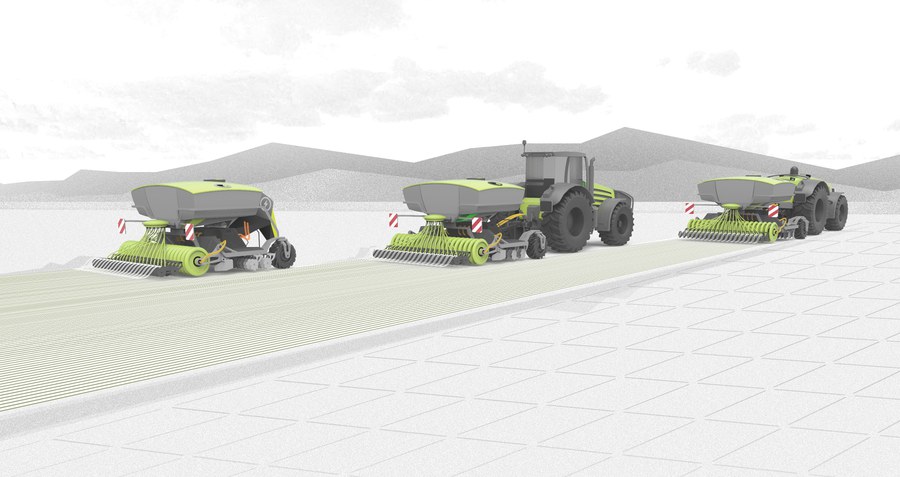
Scientists at TU Dresden, in collaboration with Fraunhofer and Saxon small and medium-sized enterprises, are developing a new machine concept for resource-efficient and sustainable agricultural technology
Bigger, faster, farther. Scientists at TU Dresden are breaking with the paradigm that has guided agricultural technology development to date. They are responding to the world’s growing demand for food with a completely new machine concept: the self-driving Feldschwarm®.
TheFeldschwarm® consists of small, intelligent machine units that can be flexibly combined to adapt perfectly to environmental conditions. Instead of the usual working width of six to twelve meters, researchers at the Chair of Agricultural Systems Technology couple one, two, or three technical units ofthe Feldschwarm®, thereby making agricultural productivity scalable. This new field cultivation technology is thus not only highly flexible and automated but also protects the soil while maintaining the same yield, improves food quality, and relies on renewable energy sources.
Because all process steps must be planned inthe Feldschwarm®, production becomes transparent and sustainability in agriculture is verifiable for the first time: “We can say for every loaf of bread which field the grain for it came from. TheFeldschwarm® can demonstrate sustainability in agriculture for the first time, so that consumers can finally trust their food again,” says Prof. Thomas Herlitzius, holder of the Chair of Agricultural Systems Technology. “Our Feldschwarm® occupies a niche between conventional and organic agriculture. People who want to shop a little more healthily and sustainably without having to pay double will, in a few years, be eating food produced usingthe Feldschwarm® system.”
On March 7, 2019, starting at 10 a.m., theFeldschwarm® project team will present the current status of the new machine concepts at an informational event at . Thomas Schmidt, Saxony’s Minister of State for the Environment and Agriculture, will be present for the opening remarks and welcome. During a subsequent tour of four stations, insights into the research results from the first phase of the project will be provided. The scientists will be available to answer questions following the event.
With theFeldschwarm® project, TU Dresden is a leader in Germany in the field of soil cultivation. For the past two years, scientists led by Prof. Thomas Herlitzius at the Chair of Agricultural Systems Technology at TU Dresden have been collaborating with seven companies and four research institutes in a regional growth cluster focused on autonomous and self-organizing field cultivation. Through the end of 2022, these foundational technologies for autonomously operating agricultural implements will be further developed under the umbrella of the Saxon simul+ InnovationHub (SIH).
Project presentation:
Station 1: Tool Module
A two-by-three-meter test model for powered and steered agricultural implements illustrates the modular design of field swarm units. Using an interchangeable frame, a wide variety of implement modules—such as a harrow, plow, or cultivator—can be attached to the implement. Coupling points on the interchangeable frame allow tools to be swapped out without any assembly tools. Station 1 features a test model with a built-in three-meter-wide tine module. A live demonstration shows how two modules are swapped out.
Station 2: Visualization of the field swarm units and the operating concept
What will the machine systems look like that will drive autonomously across fields and cultivate the land in the future? How will they be operated? At Station 2, tomorrow’s technology can be controlled live via a tablet. A simulation game allows visitors to virtually experience and explore the machine concepts. Insights into the operating concept of future field swarm units are provided, and a scale model (1:15) of a field swarm unit is on display.
Station 3: Traction Concept and Power Supply
The field swarm units are electrically powered. Depending on which attachment is used, a large or small drive module is mounted in front of the field swarm unit as a chassis. The large module, equipped with track belts similar to those on an excavator, delivers high power and traction but has a limited range of motion due to its size. It will primarily be used with attachments that require more power, such as deep soil tillage with cultivators. The small traction module has a significantly lower mass-to-power ratio, is equipped with tires, and is steerable. A 3 × 2.50 m prototype of the electric powertrain has been assembled. Screens display visualizations of the future vehicle technology in conjunction with the attachments.
Station 4: Environment Recognition, Localization, and Swarm Control
The individual field swarm units communicate via GPS and radio. They maintain constant contact with one another and provide real-time feedback to the control system regarding their location, the progress of their task, and the quality of the work results. The field swarm unit detects its surroundings and reacts in real time to obstacles or other machines. At Station 4, you can test live how quickly the unit reacts and provides feedback to the control system.
The sensors on the smart tools provide feedback on soil quality to the farm management information system. Furthermore, it is possible to analyze soil quality during tillage and actively respond to it—for example, to optimally prepare the soil for seeding. The farmer processes this information and uses it to plan how the field should be worked, then creates the work process to be carried out by the field swarm units. In the next step, the defined tasks are transferred to the field swarm control system, helyOS, and the individual routes are planned. Within this software, the individual work processes are translated into specific work steps for each unit. The graphical interface for controlling and monitoring the field swarm will also be demonstrated at Station 4.
The event on March 7, 2019, at 10:00 a.m. is particularly well-suited for photo coverage. We ask members of the press to register in advance at by March 5. The event will take place at TUD Dresden University of Technology, Center for Integrated Natural Product Technology (ZINT), Bergstraße 120, Hall A (floor channel facility).
Contact for journalists:
TU Dresden, Faculty of Mechanical Science and Engineering
Prof. Thomas Herlitzius
Phone: +49(0) 351 463 32777
Email: