
Mar 02, 2026
Textile research sewing to new heights: Talented team of schoolgirls from DLR_School_Lab of TU Dresden develops sustainable mini-satellite for German CanSat competition
When the CanSat model rockets lift off into the sky from the Rotenburg/Wümme airfield near Bremen at the beginning of March, they will be carrying a satellite unlike any that has flown in the German CanSat competition before: textile-based, optimized for performance and sustainability, and designed and built by Team GRACE at the DLR_School_Lab from TU Dresden.
Team GRACE and the hurdles of the competition
GRACE (Green Research and CanSat Exploration) - that's Friederike (16), Marie (15), Anna (14) and Wiebke (15), four pupils from Dresden who have been working together on their "can" satellite since fall 2025. What drives them is not only their enthusiasm for science and technology, but also their desire to independently carry out a project that will reach outer space. This includes the development of an idea that will achieve a scientific goal, as well as the design, construction and programming of the CanSat, extensive test campaigns including public relations, sponsoring, documentation and project management. All of these tasks must be completed independently by the 10 teams participating in the German CanSat competition. Strict design specifications also apply to the mini-satellites.
The CanSat has two missions to fulfill. The primary mission is identical for all teams and involves measuring air pressure and temperature during the flight, all the while transmitting the data to a ground station via a radio link. From the data obtained, the team is tasked with developing an altitude and temperature profile, and determining the rate of fall. The specifications of the secondary mission is left up to the teams. During the launch campaign in Bremen, the completed CanSat is transported to an altitude of around 700 meters by a solid-fuel rocket, then descends to the ground on a parachute, performing its primary and secondary missions in the process.
Mission sustainability - supported by the ITM
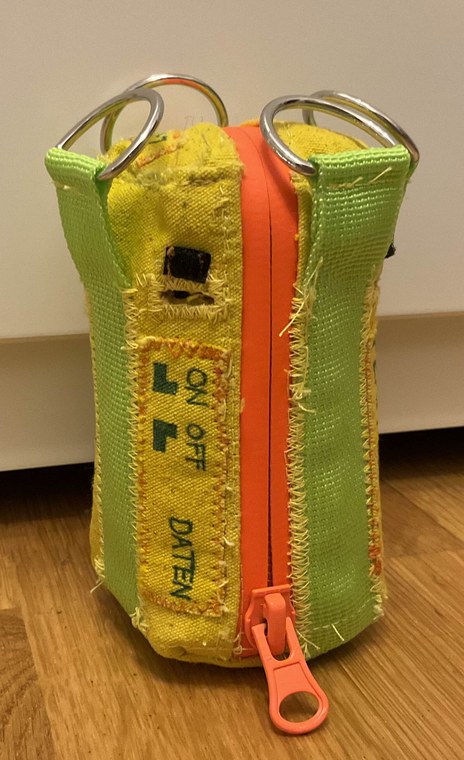
Ready-made CanSat fabric cover with parachute mount and camera cut-outs; the felt roll containing the electronic components is easily accessible via the zip fastener.
Team GRACE's secondary mission has three objectives: a sustainable concept, an optimized CanSat design with functional integration into the parachute, and position detection during the flight. To achieve these goals, the team developed an innovative approach for constructing their mini-satellite: It consists mainly of textile materials, and all electronic components such as the microcontrollers, sensors and cameras can be sewn together. This means that they are not mounted on a rigid board, but rather on two pieces of polyester felt, which are then rolled up and stowed in a sleeve. The realization of this concept is made possible by the cooperation with the Institute of Textile Machinery and High Performance Material Technology (ITM) at TU Dresden. There, the conductive tracks for the electronic components are embroidered directly onto the felt pieces according to the team's specifications. This not only eliminates the need to sew on individual cables, but also makes the entire system significantly more robust. While loosely laid cables can easily slip or tear off when put under pressure or if they vibrate, stitched conducting tracks are firmly anchored in the carrier material and withstand the mechanical stresses of a rocket launch much better.
The other components also follow suit with a view to sustainability: The cover is made of robust teepee cotton fabric, reinforced with polyester straps, which had previously been examined for its ability to withstand tension by the team. The parachute made from balloon silk also contains sensors and cameras sewn onto the felt in an integrated pocket. Its design was revised several times until its opening characteristics and stability achieved the desired level.
Sustainability catalog for evaluating all components
In order to systematically evaluate the sustainability of its satellite, the team developed its own sustainability catalog. Each component and material was assessed on the basis of defined criteria, including re-usability, use of renewable raw materials, regional availability, durability, reparability, amongst other aspects. The catalog was not only used for documentation, but also to guide their decision-making during the development process. This enabled the team to make informed choices about which materials to use and which alternatives could be deemed more sustainable. However, it quickly became apparent that sustainable components are often significantly more expensive or technically unsuitable. Many sensors also require rare earth elements, without which they simply would not work. Sustainable alternatives are not readily available here. The team therefore focused on the sustainability of the remaining components and reusing existing parts. The sustainability catalog helped to make these decisions transparent and comprehensible.
Organization, communication and financing are the backbone of the project
In addition to the technical work, the pupils assume all the organizational and communicative tasks that a real space project would entail. They write press releases, conduct interviews, run the Instagram account @grace.cansat, create scientific reports for the jury and deal with budget planning, material procurement and sponsoring. They are supported by student assistants and the head of the DLR_School_Lab; this lab is taking part in the CanSat competition with a team for the sixth time.
As the construction of the CanSat and participation in the launch campaign in Bremen comprise a number of costs, the team has launched a crowdfunding campaign at 99funken.de. The funding threshold is set at EUR 1,000, with the target being EUR 3,000. Supporters can look forward to a range of thank-you packages - from signed team cards to bookmarks made from original parts of the satellite.
Crowdfunding information and video:
www.99funken.de/grace-cansat
Information about the competition:
www.cansat.de
Contact:
Dr. Janina Hahn
DLR_School_Lab TU Dresden
Tel.: +49 351 4887207
Email: