Dec 17, 2025
HPC system "Deneb" combines AI and sustainability
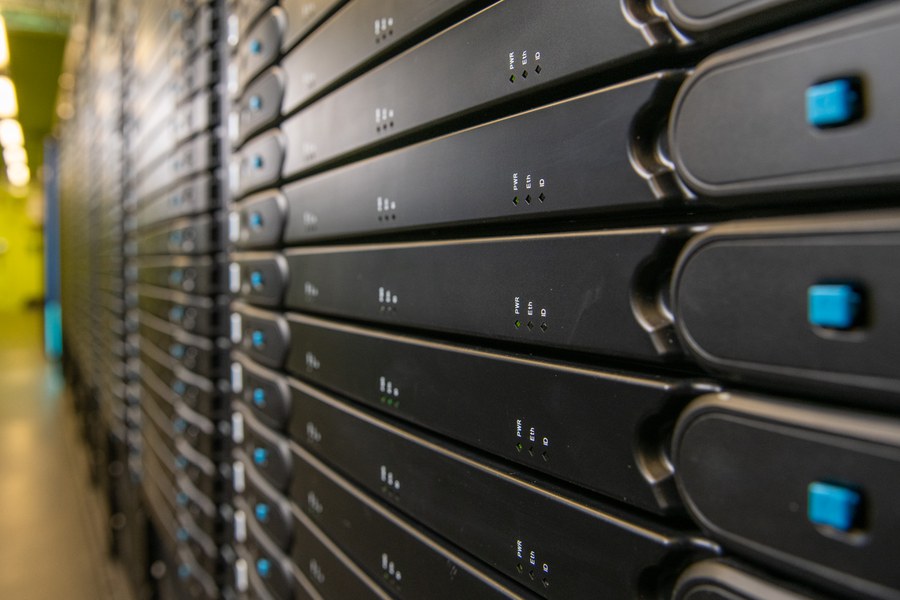
HPC system in the Data center (LZR) of TUD
The Center for Information Services and High-Performance Computing (ZIH) at TUD Dresden University of Technology is planning to install a new supercomputing system. Named "Deneb", this system is designed to meet the growing demands of machine learning research. This will further enhance TUD’s status as a National Center for High-Performance Computing (NHR) and strengthen ZIH’s reputation as a provider of cutting-edge HPC capacities for artificial intelligence in science and research. In addition to high performance, the system will also focus on energy efficiency. Bull GmbH was awarded the contract to build the high-performance computing system. The new system is expected to go into operation in the fourth quarter of 2026.
Designed for advanced AI research
"Deneb" is powered by NVIDIA’s Grace Blackwell superchip, which integrates two state-of-the-art B200 accelerators with a Grace CPU (Central Processing Unit). Each of the 46 computing nodes contains two of these superchips, providing a total of four high-performance graphics processor accelerators per node, each with 186 GB of HBM3e memory. Altogether, it will feature 184 state-of-the-art GPUs, specifically optimized for AI workloads.
The computing nodes are connected via a high-performance Infiniband network to form a tightly coupled HPC system. This enables fast data exchange and supports the scalable training of large AI models in particular - a key requirement of modern data-intensive research.
The system is complemented by a 2-petabyte storage system, which is specially designed for AI applications with high speed and reliability requirements.
A special feature of Deneb is the architecture of the CPUs: for the first time, a high-performance computing system with Arm technology is being used at TU Dresden. In addition to optimized performance, this also promises greater energy efficiency.
High energy efficiency
With "Deneb", the ZIH remains true to its proven strategy of combining high-performance computing with maximum energy efficiency. The water-cooling system achieves remarkable efficiency: 97% of the heat generated is directly dissipated and can be reused to heat nearby buildings or feed into the district heating network – as was the case with the "Capella" and "Barnard" systems previously commissioned at TUD.
The energy efficiency of the systems is also an important core research area for the ZIH: as with "Capella", "Deneb" is also used for measurements for energy efficiency research and performance optimization. This research will help to further improve the efficiency of the system itself and at the same time develop new, sustainable technologies for supercomputing. This makes the new HPC system not only a powerful tool for demanding AI applications, but also an important building block for the further development of energy-efficient data centers.
Key data on "Deneb"
- Architecture: 46 compute nodes powered by NVIDIA Grace Blackwell superchips, totaling 184 B200 GPUs, with 4x NDR400 Infiniband per node
- Memory: 2 PB DDN memory system for AI workloads
- Energy efficiency: BullSequana XH3500 with 97 % hot water cooling
- Installation: Lehmann Center (LZR), user operation from Q4/2026
- Costs: approx. 9.4 million euros
Financing
This new high-performance computing resource is funded by the National High-Performance Computing (NHR) initiative and the AI Competence Center ScaDS.AI Dresden/Leipzig. As part of the NHR program, funding is equally shared between the Free State of Saxony and the federal government.