
Jan 27, 2026
Evaluation of the Ethics of Digital Touch

In 1997, Nintendo released a product that was intended merely as an add-on for the existing controllers of the Nintendo 64 console: the Rumble Pak. This small attachable accessory could be plugged into the back of a controller to create haptic feedback in the form of vibrations of varying intensity. While mobile phones were becoming more common during the 1990s, their alerts were mostly auditory until the early 2000s. The Motorola StarTAC, released in 1996, included a vibrational alarm and was sold around 60 million times worldwide (Wikipedia contributors, n.d., List of best-selling mobile phones), making it far more common than the Nintendo 64, of which around 32 million units were sold (Wikipedia contributors, n.d., Nintendo 64), and not every owner purchased or had access to the Rumble Pak. Despite this, the Rumble Pak may have been the first time millions of children experienced programmable, context-dependent haptic feedback, raising ethical concerns and questions about the introduction of digital touch to participants without full agency.
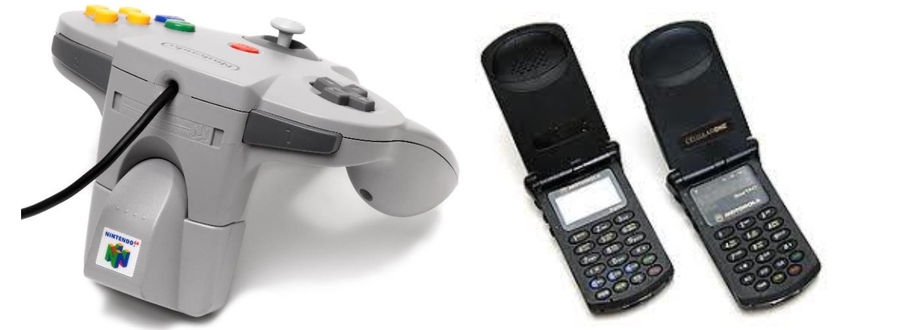
Figure 1: The Nintendo Rumble Pak (left) and the Motorola StarTAC (right) were among the first devices to include vibrational haptic feedback.
Now, almost 30 years later, haptic feedback is a common feature of mobile phones, console controllers, and smartwatches. Much more sophisticated forms of haptic feedback in the entertainment industry are found in wearable devices designed to enhance the virtual reality (VR) experience of headsets such as the Meta Quest 3. Haptic vests like the Tactsuit series from bHaptics feature vibrotactile motors across the chest, back, and arms that can deliver vibrations almost instantaneously across these areas, while devices such as the OWO Skin from OWO use electrical muscle stimulation (EMS) to simulate impact, pain, or even temperature. At present, these technologies are mainly used in gaming within the private sector or are found in haptic-focused research laboratories. The increasing sophistication of these devices creates a need for deeper discussion in the area of digital touch in order to avoid harmful experiences for both consumers and research participants.

Figure 2: The Tactsuit from bHaptics (left) and the OWO Skin from OWO (right).
Barrow et al. (2025) have proposed a foundational framework addressing the questions that need to be asked about current and future haptic technologies, including key guidelines for developers and lawmakers to ensure ethical experiences. This framework is largely grounded in deontological ethics rather than utilitarian perspectives, focusing on duties, rights, and the protection of bodily autonomy—particularly the safeguarding of sensory autonomy, informed consent, and transparency in situations where individuals may be passively touched by digital systems.
The term passively touched is crucial for the first important distinction in how we perceive digital touch: am I actively reaching out and participating in a haptic experience—for example, by touching a vibrating object while knowing that stimulation will be transferred back to my body—or am I wearing a device that may elicit digital touch experiences at times I cannot accurately predict or control? The paper focuses primarily on the latter scenario, as the ethical implications of passive touch are more far-reaching and concerning.
Passive digital touch can be vibrotactile, EMS-based, or thermal, as seen in the aforementioned products, but it can also be force-based or illusory (pseudo-haptics). Crucially, digital touch always involves direct physical stimulation of the body, unlike experiences such as music, which may evoke bodily responses indirectly (e.g., goosebumps through auditory stimulation). The authors identify four categorical distinctions that differentiate haptic experiences from visual or olfactory stimulation and derive key considerations and functional requirements specific to digital touch devices.
These categories are:
-
Directness
-
Epistemic privateness
-
Self-awareness
-
Emotional significance through affective touch
-
Directness refers to the fact that touch is an always-on sensation, unlike vision, hearing, taste, or smell, which can be partially or fully blocked (e.g., by closing the eyes or ears).
-
Epistemic privateness refers to the non-shared nature of touch experiences. If you offer me your hand for a handshake, only the two of us know how that handshake felt, whereas visual or olfactory experiences can be simultaneously accessed by bystanders.
-
This is closely linked to self-awareness, as “the skin forms the boundary of our body, [and] these cutaneous experiences play a crucial role in constructing our sense of bodily self,” as noted in the text.
-
Emotional significance through affective touch refers to touch’s capacity to convey emotion, intimacy, and care, playing a central role in social bonding and emotional regulation. This makes affective touch especially sensitive to ethical concerns when digitally mediated.
Together, these categories explain why touch must be treated differently from other sensory modalities. The next step is to differentiate levels of digital touch itself, which the article presents as a hierarchy encompassing the physical events produced by haptic systems, the resulting tactile experiences, and the beliefs users form about their bodies and the world. Ethical concerns intensify as digital touch moves from simple physical stimulation toward shaping perception and belief, particularly in cases of passive touch, where sensations are initiated and controlled by external agents rather than the user.
To address these ethical challenges, the authors draw on questions relevant to ordinary human touch interactions:
-
Who is being touched?
-
Who or what is doing the touching?
-
Can the person being touched control or stop it?
-
What beliefs or experiences does this touch create?
The primary safeguard against harmful digital touch experiences is informed consent. This raises further questions about whether users are fully capable of providing informed consent, particularly in the case of children or individuals with certain mental disabilities. Closely related is the question of how consent is presented and agreed to, especially given the prevalence of lengthy terms-of-service agreements. One study suggests that 98% of mobile app users do not read their terms and agreements (Nemmaoui et al., 2023), while another survey among students found that over 60% did not read what they agreed to (Moallem, 2018). These findings call into question the effectiveness of informed consent in digital contexts. This does not imply that informed consent should be abandoned, but rather that we must develop better principles to ensure that consent is truly informed.
Consent must also be ongoing, revocable, and specific. Users should be repeatedly asked for consent, be able to withdraw it at any time, and grant consent for specific haptic experiences rather than for haptic input in general. While these concerns are reasonable, their implementation may be impractical in certain entertainment contexts. For example, in first-person shooter games—played by at least a billion people worldwide, based on conservative estimates from the 3.32 billion gamers globally (Priori Data, 2025)—haptic vests are used to signal the direction of incoming shots through vibrotactile stimulation. Requiring ongoing consent before each such stimulus would be incompatible with gameplay and user expectations.
The ethical debate surrounding simulated violence in such games is distinct from that of digital touch and has been ongoing for decades. Because participation in these games and the use of haptic vests are voluntary and not required for societal functioning, informed consent that is revocable may be sufficient.
The challenge of ongoing consent also applies to essential technologies such as mobile phones. While vibration alerts can be turned on or off—and should ideally be adjustable in intensity—it is unrealistic to expect users to respond to repeated consent prompts. Instead, what is crucial, as the authors emphasize, is that all haptic devices provide an easy and immediate option to disable haptic features entirely. Combined with settings that allow users to specify and limit types of haptic stimulation, this offers a more feasible and user-friendly foundation for consent.
Transparency is another key requirement for ethical digital touch. Users should know who is doing the touching, for what purpose, and under what conditions. A lack of transparency creates risks of deception, coercion, and abuse. In both entertainment and research contexts, these requirements depend on informed consent, although in some research designs transparency may conflict with experimental goals, such as studies examining whether users can infer who is controlling the touch.
Ultimately, sensory autonomy, consent, and transparency all rely on robust informed consent. Context is therefore critical: is the touch part of voluntary entertainment, research, work, medical treatment, or state intervention? These situations involve what the authors describe as asymmetrical power dynamics, which increase the risk of abuse. In such cases, lawmakers and institutions must demonstrate that specific forms of digital touch are not harmful. Only through ongoing evaluation and oversight can ethical digital touch be ensured.
Another major risk identified by the authors concerns the increasing realism and immersiveness of digital touch technologies. Touch traditionally serves as one of our most reliable cues for determining what is real, grounding our perception of both the world and our bodies. As a result, highly realistic digitally mediated touch can blur the boundary between physical reality and artificial simulation—an effect amplified when combined with immersive technologies such as VR.
Convincing haptic feedback may lead users to form beliefs about objects, environments, or bodily states that do not correspond to the physical world. While this may be acceptable or even desirable in entertainment contexts, it raises ethical concerns when users cannot clearly distinguish simulated sensations from real ones. For example, haptic feedback might confirm the presence of a virtual object that does not exist or obscure contact with real-world obstacles, increasing the risk of physical harm. Prolonged exposure may also alter how users relate to their bodies and surroundings outside virtual environments.
The authors further highlight risks related to bodily self-awareness and ownership. Because touch plays a central role in maintaining a coherent sense of the body, disruptions or contradictions in tactile feedback can lead to experiences of disownership or dissociation. While such effects may be useful in therapeutic or experimental contexts, their unintended occurrence in consumer technologies could be disturbing or harmful—particularly with frequent or prolonged use or among vulnerable users.
Crucially, the ethical implications of realism and immersion are context-dependent. A haptic illusion that is acceptable within a clearly framed virtual experience may become problematic if it is persistent, unavoidable, or insufficiently transparent. As digital touch technologies approach globally convincing tactile realism, the responsibility to manage their epistemic and psychological effects increases. This supports the authors’ call for anticipatory ethical design—ensuring that realism enhances user experience without undermining bodily autonomy, trust in perception, or long-term well-being.
Digital touch technologies enable powerful new forms of embodied interaction, but because touch is always-on, intimate, and deeply connected to the self, they pose unique ethical challenges. As haptic systems become more immersive and widespread, safeguarding sensory autonomy, informed consent, and transparency is essential to prevent harm—particularly in contexts involving passive touch or asymmetrical power relations. A sustained ethical debate on digital touch is therefore necessary to assess whether these technologies may cause physical or psychological harm as they continue to evolve.
Literary Sources:
Barrow, N. A., Georgiou, O., & Haggard, P. N. (2025). The Ethics of Digital Touch. IEEE
Transactions on Haptics, 18(4), 1003–1019. https://doi.org/10.1109/TOH.2025.3623531
Moallem, A. (2018). Do You Really Trust “Privacy Policy” or “Terms of Use” Agreements Without Reading Them? Advances in Intelligent Systems and Computing, 593, 290–295. https://doi.org/10.1007/978-3-319-60585-2_27
Nemmaoui, S., Baslam, M., & Bouikhalene, B. (2023). Privacy conditions changes’ effects on users’ choices and service providers’ incomes. International Journal of Information Management Data Insights, 3(1), 100173. https://doi.org/10.1016/j.jjimei.2023.100173
Online Sources:
Priori Data. (2025, January 26). How many gamers are there in 2025? Latest stats. Priori Data. https://prioridata.com/number-of-gamers/
Wikipedia contributors. (n.d.). Nintendo 64. In Wikipedia. Retrieved January 20, 2026, from https://en.wikipedia.org/wiki/Nintendo_64
Wikipedia contributors. (n.d.). List of best-selling mobile phones. In Wikipedia. Retrieved January 20,
2026, from https://en.wikipedia.org/wiki/List_of_best-selling_mobile_phones