
May 07, 2026
Presence, Trust, and Social Bonds in VR
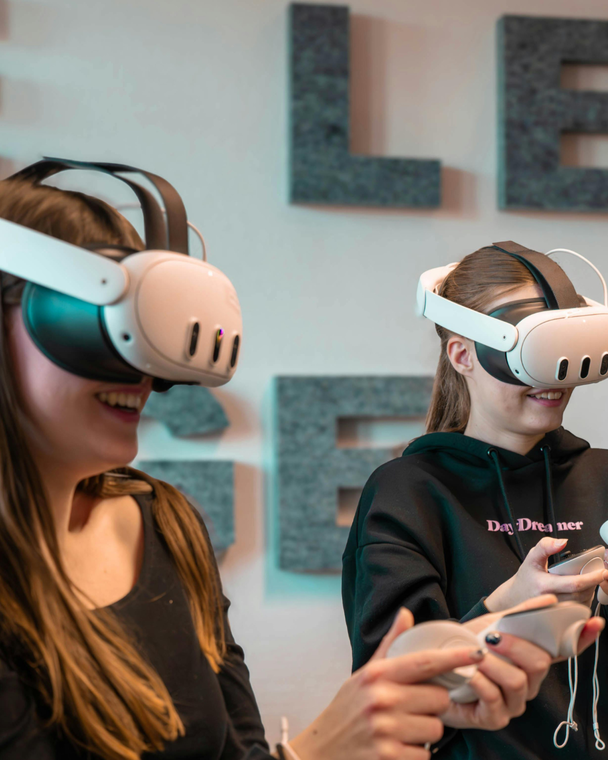
One of the most significant possibilities of virtual reality does not lie in immersion itself, but in its ability to generate connections. Beyond technological innovation, virtual reality takes shape as a space in which relationships can develop through presence, attention, and shared experience.
With the project Cyberball, the focus is on how social bonds can emerge in virtual environments. The project aims to analyze the dynamics of social inclusion and exclusion, highlighting how simple interactions can generate emotional responses of considerable intensity. Participants have often reported the feeling of being truly seen or, conversely, intentionally ignored, despite being fully aware of the virtual nature of the experience.
A different but complementary perspective was developed in a virtual reality project conceived for the exhibition “Mensch Roboter!” at COSMO Wissenschaftsforum. In this context, attention shifted to the possibility that trust toward a robotic entity could emerge through nonverbal signals and shared presence. In the absence of dialogue or explicit instructions, users were asked to spend time with a robot in a virtual space, where the robot initially offered a flower to create a sense of trust and later offered its hand to go for a walk together. This investigation continues in the musical project, in which connection is mediated by sound rather than by image or language. In this case, participants, now in pairs in a multiplayer experience, are placed in a musical virtual reality environment, where a real-time activity takes place.
Taken together, these works show virtual reality as an eminently relational medium. When designed with care and awareness, it enables the construction of bonds not only through words or representations, but also through presence, behavior, and shared experience, opening new perspectives on ways of being together in virtual space.
With this in mind, we must ask: How can virtual reality create genuine feelings of social connection despite artificial settings? How does shared presence shape human relationships in VR?