
Nov 10, 2025
The Evolutionary Roots of Soothing Behaviours
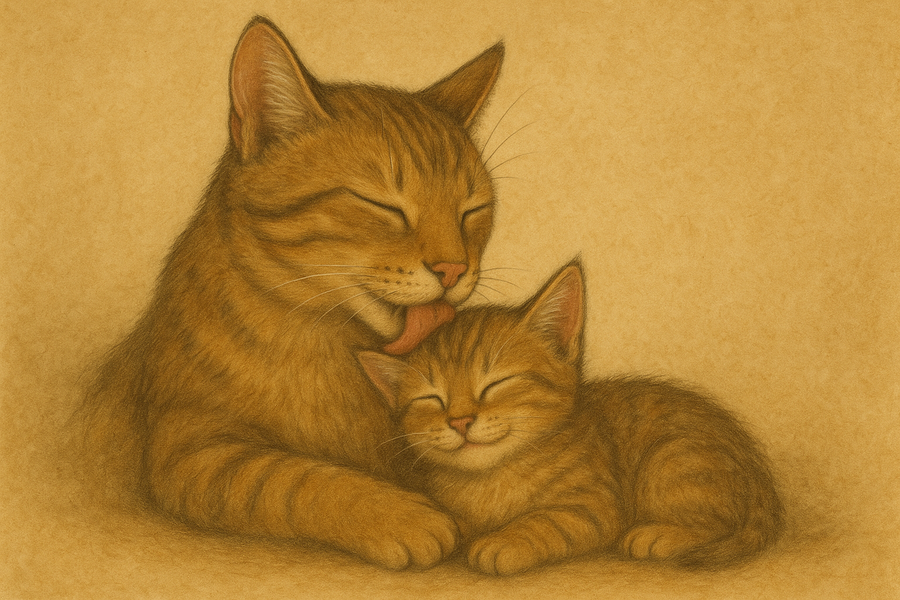
The origins of soothing behaviours (those comforting actions that calm and connect us) are written deep in our evolutionary history. Scientists believe that these behaviours, mediated by hormones such as oxytocin and vasopressin, emerged at least 200 million years ago with the rise of the first mammals (Carter, 2014; Sartorius et al., 2024). These early creatures didn’t just keep their offspring warm and safe; over time, they developed rich, multifaceted ways of caring that shaped the emotional fabric of mammalian life.
Comparative studies show that soothing behaviours in humans and other mammals are far from random. They follow structured, deeply ingrained patterns (Burkett et al., 2016; Nagasawa et al., 2012). Knowing when, why, and how to soothe is hardwired into our nervous systems—because survival once depended on it. Humans and other apes can use their hands to deliver gentle touch, while most other mammals rely on licking or close bodily contact to comfort and bond.
Research on rodents suggests that the act of grooming through licking activates the same neural pathways from the skin to the brain as soothing touch does in humans (Brooks et al., 2022; Nagasawa et al., 2012). The key players here are CT-tactile fibres, or special nerve fibres tuned to gentle, rhythmic touch in the tempo range of about 1–10 cm per second (Cascio et al., 2019; Gordon et al., 2013). Interestingly, these fibres were first discovered in cats, helping explain why so many cats seem to melt under slow, steady strokes but recoil from abrupt ones (Schirmer et al., 2023).
The same principle (tempo) appears to resonate far beyond touch. Across cultures, lullabies often share similar rhythmic qualities, suggesting that humans instinctively use pace and repetition as tools for soothing and connection (Mehr et al., 2018; Unyk et al., 1992). Even the soft purr of a cat may serve as a form of self-soothing and healing, much like the calming hum of a lullaby (von Muggenthaler, 2001).
Taken together, these findings reveal something beautiful: soothing behaviours, whether expressed through touch, rhythm, or voice, are part of an ancient survival strategy. From a mother cat’s gentle lick to a parent’s lullaby, these acts form a shared repertoire of care—a language of comfort that transcends time and species.
As we continue to explore the role of rhythm and tempo in these interactions, one question lingers: Could understanding the tempo of soothing help us reconnect more deeply with ourselves, with others, and with the natural world that shaped us?
And perhaps more personally: What rhythms of care do you instinctively turn to when you seek comfort, or offer it?
References
Brooks, J., Kano, F., Yeow, H., Morimura, N., & Yamamoto, S. (2022). Testing the effect of oxytocin on social grooming in bonobos. American Journal of Primatology, 84(12), e23444. https://doi.org/10.1002/AJP.23444
Burkett, J. P., Andari, E., Johnson, Z. V., Curry, D. C., De Waal, F. B. M., & Young, L. J. (2016). Oxytocin-dependent consolation behavior in rodents. Science, 351(6271), 375–378. https://doi.org/10.1126/SCIENCE.AAC4785/SUPPL_FILE/BURKETT-SM.PDF
Carter, C. S. (2014). Oxytocin pathways and the evolution of human behavior. Annual Review of Psychology, 65(Volume 65, 2014), 17–39. https://doi.org/10.1146/ANNUREV-PSYCH-010213-115110/CITE/REFWORKS
Cascio, C. J., Moore, D., & McGlone, F. (2019). Social touch and human development. Developmental Cognitive Neuroscience, 35, 5–11. https://doi.org/10.1016/j.dcn.2018.04.009
Gordon, I., Voos, A. C., Bennett, R. H., Bolling, D. Z., Pelphrey, K. A., & Kaiser, M. D. (2013). Brain mechanisms for processing affective touch. Human Brain Mapping, 34(4), 914–922. https://doi.org/10.1002/hbm.21480
Mehr, S. A., Singh, M., York, H., Glowacki, L., & Krasnow, M. M. (2018). Form and Function in Human Song. Current Biology, 28(3), 356-368.e5. https://doi.org/10.1016/J.CUB.2017.12.042
Nagasawa, M., Okabe, S., Mogi, K., & Kikusui, T. (2012). Oxytocin and mutual communication in mother-infant bonding. Frontiers in Human Neuroscience, 6(February), 1–10. https://doi.org/10.3389/fnhum.2012.00031
Sartorius, A. M., Rokicki, J., Birkeland, S., Bettella, F., Barth, C., de Lange, A. M. G., Haram, M., Shadrin, A., Winterton, A., Steen, N. E., Schwarz, E., Stein, D. J., Andreassen, O. A., van der Meer, D., Westlye, L. T., Theofanopoulou, C., & Quintana, D. S. (2024). An evolutionary timeline of the oxytocin signaling pathway. Communications Biology, 7(1). https://doi.org/10.1038/s42003-024-06094-9
Schirmer, A., Croy, I., & Ackerley, R. (2023). What are C-tactile afferents and how do they relate to “affective touch”? Neuroscience and Biobehavioral Reviews, 151(March). https://doi.org/10.1016/j.neubiorev.2023.105236
Unyk, A. M., Trehub, S. E., Trainor, L. J., & Schellenberg, E. G. (1992). Lullabies and Simplicity: A Cross-Cultural Perspective. Psychology of Music, 20(1), 15–28. https://doi.org/10.1177/0305735692201002
von Muggenthaler, E. (2001). The felid purr: A healing mechanism? The Journal of the Acoustical Society of America, 110(5_Supplement), 2666–2666. https://doi.org/10.1121/1.4777098