
Feb 23, 2026
New digital platform of the DIGITECHNETZ project makes low-voltage grids fit for the energy transition
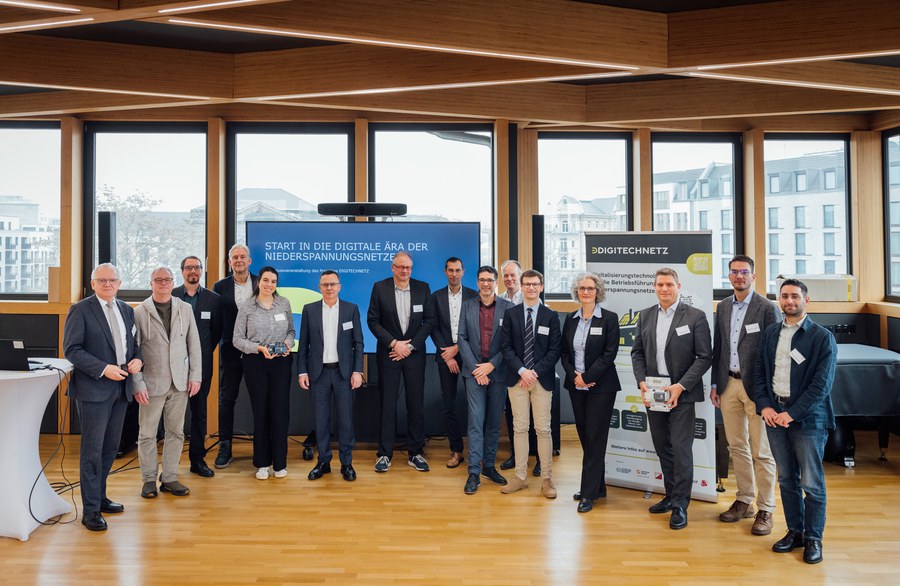
From left to right: Prof. Peter Schegner, Dr. Uwe Schmidt, Thomas Wagner, Holger Hänchen, Lea Braun, Dr. Steffen Heine, Ulf Heinemann, Christian Hofmann, Sven Reichardt, Detlef Kuhfal, Christian Behnken, Dr. Anja Fröhner, Prof. Dominik Möst, Dr. Maximilian Schmidt, Dimitrios Glynos
Low-voltage electrical grids are becoming increasingly important in the course of the energy
increasing use of photovoltaic systems, electric vehicles and heat pumps.
are under greater strain. In order to be able to continue to operate them safely in the future and
overload, the research project "DIGITECHNETZ - Digitalization technologies for
Digitalization technologies for the operational management of low-voltage grids"
innovative technologies for active and automated grid management
developed, tested in laboratory and real-life environments and thus gained important insights for the
for the grid control of the future.
The project was coordinated by the Chair of Electrical Power Supply at TU
Dresden in collaboration with the Chair of Business Administration, in particular Energy Economics. The
SachsenNetze GmbH, Robotron Datenbanken-Software GmbH, F&S
Prozessautomation GmbH, DigSILENT GmbH and emsys grid services GmbH
were involved as practice partners and contributed their requirements and knowledge to the project.
knowledge into the project.
Over the past three and a half years, a modular digital service platform has been
service platform that provides comprehensive support for the operation of low-voltage grids.
It determines the capacity utilization of the low-voltage grids so that the grid can be
the grid can be protected against overload and controlled.
At the heart of the platform is a digital twin of the low-voltage grid,
fed by measurement data from smart metering systems and a local network station.
Robotron developed a powerful database solution for this purpose. New algorithms
from TU Dresden and DigSILENT enable precise identification of the grid status,
while a high-performance forecasting process from emsys grid services predicts future
loads, especially for low-voltage grids. In the event of impending bottlenecks
an automated, non-discriminatory congestion management system developed by TU Dresden intervenes.
congestion management system developed by TU Dresden.
In addition to automation, the grid operator can also benefit operationally from the developed
service platform: A new graphical user interface, developed by
project partner F&S, helps to localize faults more quickly. The platform also makes it easier
the platform makes it easier to keep track of the actual network utilization - this makes it possible to
This makes it possible to design the necessary grid expansion cost-efficiently. DigSILENT developed a process for this
procedure that integrates the new information into existing planning processes.
The functions of the service platform were successfully tested in simulations, laboratory environments and
real network areas. The DIGITECHNETZ project thus lays an important
important foundation stone for future-proof low-voltage grid operation and shows
shows what the control of this grid level could look like in the future.
A particular success of DIGITECHNETZ is the implementation of the platform under the
high IT security requirements of the KRITIS environment of grid operators. In the
three local network stations of SachsenNetze were equipped with modern measurement
measuring technology and integrated into the service platform - this technology is now being
technology is now used as standard for new local network stations.
"DIGITECHNETZ has shown how digital solutions can be used to meet the challenges of the
energy transition, particularly in low-voltage grids. Now
now is to introduce the knowledge gained and tools developed into grid operation on a
on a larger scale," says project coordinator Prof. Peter Schegner.
The project has a total volume of 4.7 million euros and was funded with 2.5 million euros by the
Federal Ministry for Economic Affairs and Energy on the basis of a decision by the
German Bundestag.