
19.10.2026
Neue Publikation in Wiley Advanced Materials
https://doi.org/10.1002/adma.75393
Neue Publikation:
https://doi.org/10.1002/adma.75393
ABSTRACT
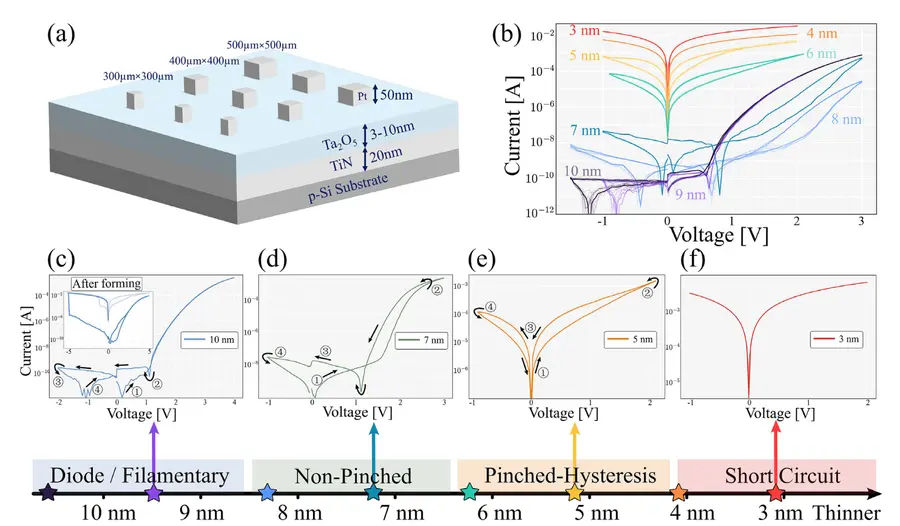
Area-type memristors are attractive for analog in-memory computing, but their use is often limited by parasitic charge storage, causing readout drift, non-pinched hysteresis, and degraded readout fidelity. We show that near-ideal area-type switching emerges within a tunneling-governed transport regime in ultrathin layers that suppresses charging-related readout artifacts. By varying the thickness in TiN/Ta2O5/Pt in a range of 3–10 nm, we reveal the transition from filamentary switching to near-short-circuit transport with two gradual-switching modes with different readout stability. The 5–6 nm thickness window suppresses non-pinched hysteresis and short-time drift while preserving analog switching, yielding nearly polarity-symmetric hysteresis and readout, clear area scaling, and continuous near-linear conductance modulation. Our analysis indicates that trap-assisted tunneling dominates the stabilized-state response, whereas ionic redistribution governs pristine-state reconstruction and the stability boundaries. A compact model is derived for the 5 nm device which reproduces the quasi-static I–V behavior and the dynamic resistance evolution based on pulse-width-dependent characteristics. The verified model is provided as Verilog-A code enabling simulation in circuit design tools. Our results demonstrate that ultrathin scaling is a regime-defining design rule for near-ideal area-type operation in oxide memristors, implying a fundamental approach to fabricating robust multi-state memristors for in-memory computing applications.