
08.01.2026
Neue Publikation in Advanced Electronic Materials
https://doi.org/10.1002/aelm.202500644
Neue Publikation:
https://doi.org/10.1002/aelm.202500644
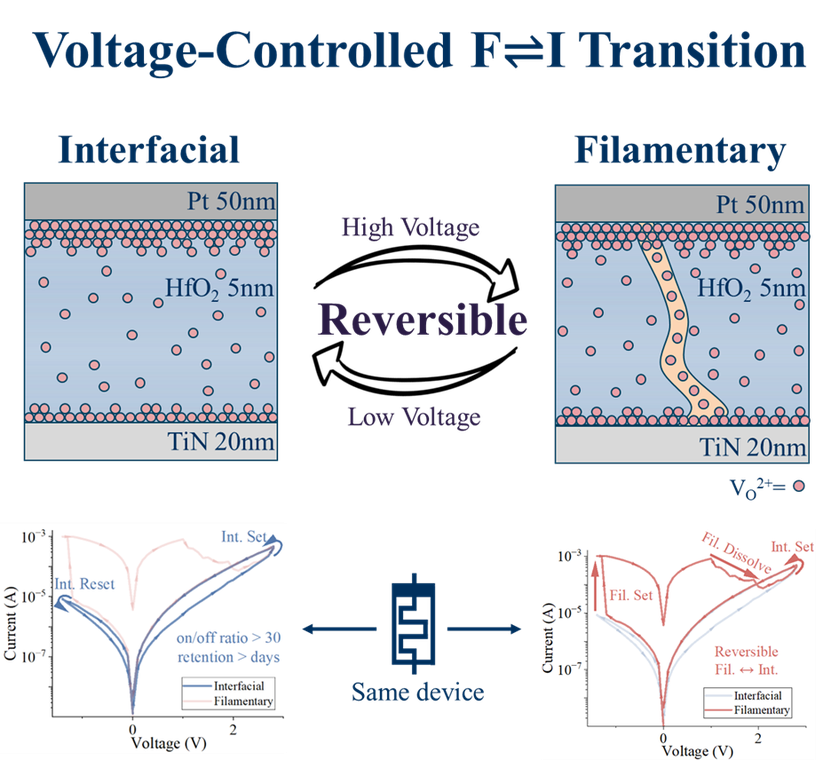
ABSTRACT
Reversible weight tuning is critical for edge AI chips, enabling online learning and local inference. Conventionally, the transition from analog interfacial switching to abrupt filamentary switching in memristors is commonly considered irreversible, as high electric fields induce conductive filaments, locking devices in the filamentary state. Here, we report that TiN/HfO2/Pt memristors exhibit stable interfacial switching and achieve voltage-driven, repeatable interfacial-to-filamentary-to-interfacial (I-F-I) transitions. Systematic electrical characterization demonstrates more than 10 stable I-F-I transition sequences, controllable I-F-I transition yield exceeding 40%, a preserved resistance window, and an ON/OFF ratio of about 30. High bias activates a fast digital filamentary mode, while low bias restores a linearly tunable analog interfacial mode. Two defect migration models—soft filament and Schottky emission—elucidate this phenomenon. This analog-digital switching could in the future, enable single-chip training and inference and support reconfigurable logic-in-memory architectures, advancing low-power artificial neural networks as well as neuromorphic computing for edge AI applications.