Summer semester 2026
This page provides information about the Institute's courses in the summer semester 2026. The courses start on 13.04.2026.
Important information on the compulsory transfer to the new study regulations 2024

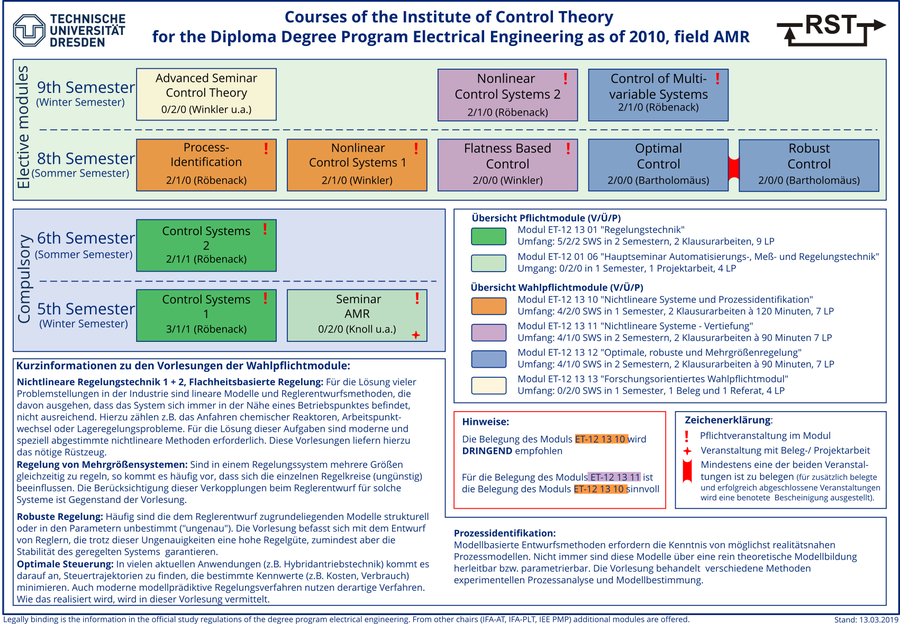
Students in the 6th semester of the degree program Electrical Engineering, specialization AMR please already take the module ET 12 13 10 Nonlinear Systems and Process Identification with the courses
- Nonlinear control engineering
- Process identification.
These courses are assigned to compulsory modules in the new study regulations. The courses are scheduled without collisions in the timetable; the foundations were laid in Control Engineering 1.
Courses
Target group:
- A compulsory course of the compulsory module ET-12 13 01 "Control Theory" in the 6th semester of the degree program Electrical Engineering (Diplom, specialization area automation, measurement and control
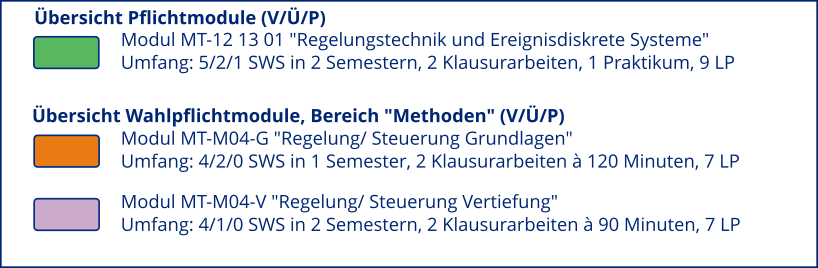
- A compulsorycourse of the elective module MT-M04-G "Control Systems - Basics" in the 8th semester of the degree program Mechatronics (specialization area macro-mechatronics)
Scope and dates:
- Lec./Ex./Lab.: 2/1/1 (EE), 2/1/0 (MT)
- Lecture: Tuesday, 3rd block (11:10 AM - 12:40 PM), room GÖR 226
- Exercise: Wednesday, 2nd block (09:20 AM - 10:50 AM), even weeks, room TOE 317
- Start: April 14th 2026
- EE students have to take the second part of the lab course!
Information on mandatory transfer to the new 2024 study regulations
- This course is assigned to the elective module EuI-ET-E-RTV Regelungstechnik Vertiefung in the new 2024 study regulations.
- If you are not interested in having this course credited, you do not need to attend this course.
Completion:
- Examination (written, duration: 120 minutes)
Lecturer:
- Prof. Dr.-Ing. habil. Dipl. Math. Klaus Röbenack
Enrollment/ materials for the course:
- The enrollment is done on the OPAL learning platform.
- There, you will also find materials for the exercises and lectures.
Content of the course:
Target Group:
- A compulsory course of the compulsory module ET-12 13 01 "Control Theory" in the 6th semester of the degree program Electrical Engineering (Diplom, specialization area automation, measurement and control
Requirements:
- Participation in the course Control Systems 1 of the previous semester.
Dates:
- on Wednesday in the 2nd and 3rd block (09:20 AM to12:40 AM), odd weeks, Institutsgebäude S7a, room 305
Test benches:
- V2 - Mesched control systems (Vermaschte Regelungen)
- V3 - Multivariable control (Mehrgrößenregelung)
- V15 - Phase locked loop control (Phasenregelkreis)
Remarks on conduct:
- The lab course is conducted in groups of three students. Groups are created at enrollment
- Enrollment and conduct are managed on the OPAL learning platform (see below)
- Are no more appointments available for whole groups, the group has to split and enroll in the remaining groups.
- Reschedules of appointments are NOT possible.
- The documentation of the test benches can be found on the OPAL learning platform.
- Detailed information on conduct and remarks can be found in the Praktikumsordnung. Please have a look at these documents and their content!
Enrollment:
The enrollment takes place in the following period: 9th March 2026 until 17th April 2026 on the learning platform OPAL.
Target group:
- Compulsory subject in the compulsory module MT-12 13 01 "Control Engineering and Discrete Event Systems" in the 6th semester of the diploma course in Mechatronics
Prerequisite:
- Attendance of the courses Control Engineering and Discrete Event Systems in the 5th semester
Practical course dates:
- weekly on Tuesdays in the 4th and 5th double period (13.00 to 16.20)
- ATTENTION: There are also course dates before the start of the actual lecture period. You can then have completed the practical course before the actual lecture period begins. See information in the OPAL course.
Experiments to be carried out:
- Experiment S1 ("Door control"), room BAR E63
- Experiment V1 ("PID controller in a single-loop control"), room S7a 305
- Experiment V2 ("Speed control"), room S7a 305
Notes on implementation:
- The practical course is carried out in groups of three students. These groups can be formed as desired during enrollment.
- Enrolment and completion of the practical course is managed via the OPAL learning platform.
- If there are no more free dates for entire groups at the time of enrolment, the group must break up and divide into the remaining individual places.
- It is NOT possible to change the dates for the experiments!
- You can find the instructions, protocol templates and detailed information on the implementation on the OPAL learning platform. Please note these documents and their contents!
Enrollment:
The enrollment takes place
- from 01.03.2026 until 24.03.2026 for early implementation,
- from 31.03.2026 to 21.04.2026 for the implementation during the courses
in the course "Praktikum Regelung und Steuerung (MT)" on the OPAL learning platform.
Target group:
- Compulsory subject in the compulsory module RES-H07 "Control Engineering" in the 6th semester of the Renewable Energy Systems degree program
Prerequisite:
- Attendance of the Control Engineering course in the previous semester
Practical course dates:
- Weekly on Fridays in the 3rd and 4th double period (11.10 am to 2.30 pm), Institute building S7a, room 305
- ATTENTION: There are also practical course dates that are before the start of the actual lecture period. You can then complete the practical course before the course period begins. See information in the OPAL course.
Experiments to be carried out:
- Experiment V1 ("Single-loop control circuit")
- Experiment V2 ("Speed control")
- Experiment V3 ("Position control of a float")
Notes on implementation:
- The practical course is carried out in groups of three students. These groups can be formed as desired during enrollment.
- Enrolment and completion of the practical course is managed via the OPAL learning platform.
- If there are no more free dates for entire groups at the time of enrolment, the group must break up and divide into the remaining individual places.
- It is NOT possible to change the dates for the experiments!
- You can find the instructions, protocol templates and detailed information on the implementation on the OPAL learning platform. Please note these documents and their contents!
Enrollment:
The enrollment takes place
- from 01.03.2026 until 24.03.2026 for early implementation,
- from 01.04.2026 until 17.04.2026 for the implementation during the lecture period
in the course "Praktikum Regelungstechnik (RES)" on the OPAL learning platform.
Zielgruppe:
- A compulsory course of the elective module ET-12 13 10 "Nichtlineare Systeme und Prozessidentifikation" in the 8th semester of the degree program Electrical Engineering (Diplom, specialization area automation, measurement and control
- A compulsory course of the elective module MT-M04-G "Regelung/Steuerung Grundlagen" in the 8th semester of the degree program Mechatronics (specialization area macro-mechatronics)
Umfang und Durchführungstermine:
- Lec./Ex./Lab.: 2/1/0
- Lecture: Tue, 2nd block (09:20 AM - 10:50 AM), room Raum SCH A118
- Exercise: Tue, 4th block (01:00 PM - 02:30 PM), even weeks, room Raum SCH A118
- Start: Tue, Apr 14th 2026
Completion:
- Examination, written (written, duration: 120 minutes)
Lecturer:
- Dr.-Ing. J. Winkler
Enrollment/ materials for the course:
- The enrollment is done on OPAL learning platform.
- There, you will also find materials for the exercises and lectures.
Content of the course:
- Typical phenomena of nonlinear systems
- Basic concepts: dynamical system, solution, flow, ...
- Analysis of nonlinear systems near equilibria, phase portraits
- Frequency domain methods for analyzing nonlinear systems: harmonic balance, Popov criterion
- Stability and stability criteria based on Lyapunov
- Controller design: integrator backstepping, sliding mode control, feedback-linearization, and normal forms
- Flatness based control
Target group:
- A compulsory course of the elective module ET-12 13 10 "Nonlinear Systems and Process Identification" in the 8th semester of the degree program Electrical Engineering (Diplom, specialization area automation, measurement and control
- A compulsory course of the elective module MT-M04-V "Control Theory - Advanced" in the 8th semester of the degree program Mechatronics (specialization area macro-mechatronics)
Scope and dates:
- Lec./Ex./Lab.: 2/1/0 (EE), 2/0/0 (MT)
- Lecture: Thu, 3rd block (11:10 - 12:40), room TOE 317
- Exercise: Tue, 4th block (13:00 - 14:30), odd weeks, room GÖR 229
- Start (Lecture): Thu, Apr 16th 2026
Completion:
Examination (written, duration: 120 minutes (EE), 90 minutes (MT))
Lecturer:
Prof. Dr.-Ing. habil. Dipl. Math. Klaus Röbenack
Enrollment/ materials for the course:
The enrollment is done on OPAL learning platform.
There, you will also find materials for the exercises and lectures.
Content of the course:
Parameter identification for static and dynamic models:
- Method of least squares
- Discrete-time models (ARX, FIR filter,...)
- Estimation of continous-time models
- Derivative estimation
- Test signal generation
- Parameter identification using correlation functions
- deterministic Kalman filter
Target group:
- An elective course of the elective module ET-12 13 11 "Nonlinear Systems- Advanced" in the 8th semester of the degree program Electrical Engineering (Diplom, specialization area automation, measurement and control
- An elective course of the elective module MT-M04-V "Control Systems - Advanced" in the 8th semester of the degree program Mechatronics (specialization area macro-mechatronics)
Scope and dates:
- Lec./Ex./Lab.: 2/0/0
- Lecture: Thu, 1st block (7:30 AM to 9:00 AM), Room S7a 304
- Start: April 16th 2026
Completion:
- Examination (written, duration: 90 minutes)
Lecturer:
- Dr.-Ing. Klemens Fritzsche, B.Sc.
Enrollment/ materials for the course:
- The enrollment is done on OPAL learning platform
- There, you will also find materials for the exercises and lectures.
Content of the lecture
The course deals with the basics of feedforward and feedback control of two important classes of systems: flat and distributed parameter systems. Flat systems have the property that all variables of these systems can be parameterized depending on a so-called flat output without having to solve an integral. This allows for a very simple feedforward and feedback control design. In linear terms, this system class corresponds to the class of fully state-controllable systems. Many technical systems are flat, so that flatness-based control design has now become firmly established in industry.
Distributed parameter systems are characterized by the fact that their system quantities depend not only on time, but also on location. For example, the temperature in a steel beam or the deformation of a body. The mathematical description is carried out using partial differential equations. There exist also efficient methods for control design for such systems (sometimes using a generalized concept of flatness), which will be discussed in this lecture.