
Jul 28, 2026
CfA: Interdisciplinary Spring School "From Petromodernity to Care-fu(e)l Futures: Rethinking Energy Transition"
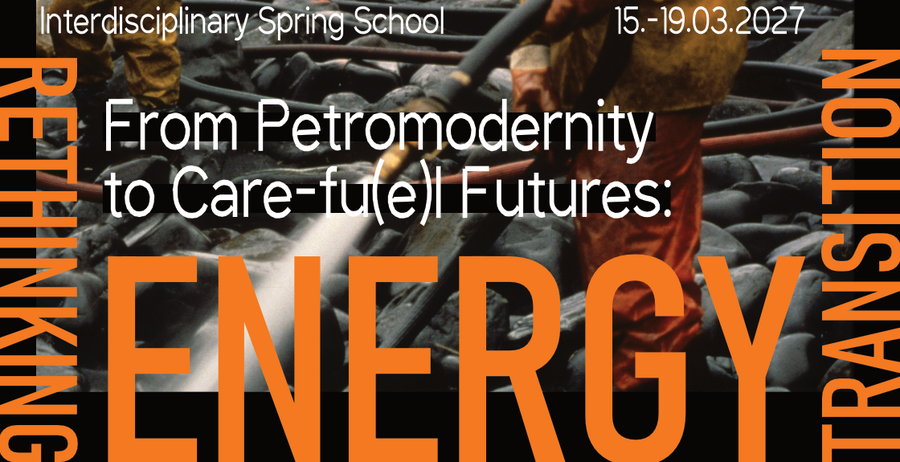
CfA: Interdisciplinary Spring School
From Petromodernity to Care-fu(e)l Futures: Rethinking Energy Transition
Date: 15–19 March 2027 (Monday–Friday)
Venue: Technische Universität Dresden, Merkel-Bau, Helmholtzstraße 14
Format: Interdisciplinary Spring School for doctoral researchers, postdoctoral scholars, students, and researchers
Language: English and German
Energy shapes our lives and our societies. Fossil fuels have powered industrialisation, economic growth, and technological progress. At the same time, they are among the main drivers of the climate crisis and are deeply intertwined with ecological degradation and social inequalities. The question is therefore not only how we produce energy, but also: for whom, at what cost, and whose interests does it ultimately serve?
The energy transition is often framed as a technological challenge. It is, however, also a profound process of social transformation, shaped by power relations, inequalities, and political struggles. A socially just energy transition therefore requires not only technological innovation but also fundamental changes in lifestyles, understandings of progress, and approaches to science and research.
The Spring School "From Petromodernity to Care-fu(e)l Futures: Rethinking Energy Transition" brings together perspectives from the Energy Humanities, Science and Technology Studies (STS), gender and technology studies, as well as sustainability and transformation research. Together, these approaches examine energy and its transformations—from fossil-fuelled presents towards more just, sustainable, and care-oriented energy futures.
Students, doctoral researchers, postdoctoral scholars, and researchers from engineering, the humanities, the social sciences, and environmental sciences are warmly invited to spend five days exploring the multiple dimensions of energy systems and discussing new pathways and scenarios for a socially just energy transition.
The first part of the Spring School focuses on petromodernity—the deep entanglement of modern societies with fossil fuels, extractive economies, and promises of unlimited growth. Together, we will explore how alternative energy futures might emerge beyond the logic of petromodernity.
The second part turns to care-fu(e)l futures, asking how the energy transition can be reimagined through a care-oriented perspective that places care, responsibility, and social justice at its centre. Rather than understanding energy transitions primarily in terms of technological optimisation, efficiency, and economic growth, we ask how future energy systems can become more socially just, inclusive, and responsible.
The five-day programme combines keynote lectures, interactive workshops, and discussions led by inspiring invited speakers:
-
Monday – Welcome and Registration: Introduction to thermodynamic foundations and first reflections on energy, science, and society
-
Tuesday – Understanding the Past: Historical perspectives on fossil fuels and the emergence of fossil-fuelled societies
-
Wednesday – Understanding the Present: Petromodernity, global power relations, and green extractivism
-
Thursday – Reflecting through the Lens of Care: Feminist and care-oriented perspectives on energy transitions
-
Friday – Imagining the Future: Futures and scenario analysis, artistic perspectives, and just energy futures
Participation in the Spring School is free of charge. The event is organised within the ESF Plus-funded project "SustainING: Socially and Environmentally Sound Engineering" and generously supported by the Meyer-Struckmann Foundation.
Who Can Participate?
-
Students, doctoral researchers, postdoctoral scholars, and researchers associates from engineering, the humanities, the social sciences, environmental sciences, and related disciplines participants
-
From TU Dresden as well as other national and international institutions
Application and Deadline
As the number of participants is limited, please send an email to including the following information:
-
First name, last name, pronouns
-
Academic discipline or field
-
Current career stage (student, doctoral researcher, postdoctoral scholar, researcher, etc.)
-
A short statement of motivation (150–200 words)
-
Childcare required: yes/no
-
If yes: age of the child(ren) and expected childcare times
-
Accessibility requirements or other support needs: We are committed to providing an inclusive, accessible, and welcoming environment for all participants. Please let us know if there is anything we can do to support your participation.
We are also able to offer small travel grants for participants with limited financial resources (for example, doctoral researchers or early-career researchers in precarious employment, without institutional affiliation, or with restricted funding opportunities). If you wish to apply for travel support, please include a brief statement (maximum 60 words) explaining your circumstances.
Application deadline: 15 November 2026
Download: Invitation (PDF)
Organisers and Contact
