
Isotropic and Anisotropic Viscoelasticity Under Finite Deformations: Modeling Using Neural Networks and Calibration Based on Experimental Data
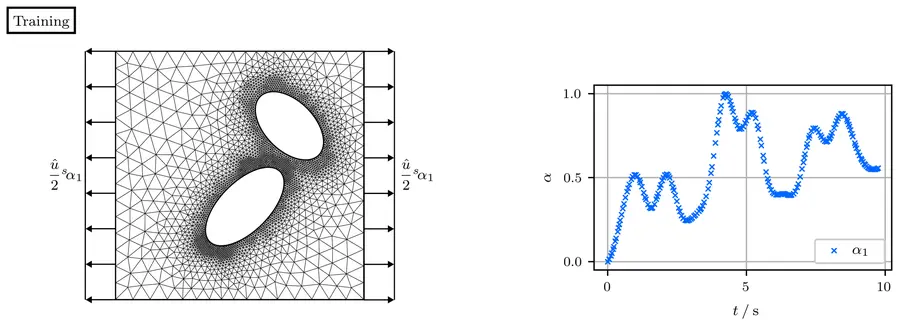
Many polymers and biological tissues exhibit pronounced rate-dependent behavior under large deformations. Biomaterials and 3D-printed polymers are also anisotropic. Describing them therefore requires accurate models of (an)isotropic viscoelasticity at finite strains. Since formulating and calibrating classical constitutive equations for such complex material behavior is laborious, data-driven methods are becoming increasingly important, particularly those embedded in a strict physical framework. A key obstacle, however, remains the availability of a sufficiently extensive experimental database.
The goal is to develop an end-to-end data-driven framework for modeling the (an)isotropic viscoelastic behavior of soft materials. At its core is a Physics-Augmented Neural Network (PANN) whose architecture explicitly incorporates physical and thermodynamic principles. Calibration is performed based on full-field displacement data from Digital Image Correlation (DIC) combined with the Virtual Fields Method (VFM). The methodology is first validated on synthetic data and then transferred to real experimental data for polymers, thus enabling physically sound, partially automated material modeling.
Cooperations
- Dr.-Ing. Eric Euchler, Research division elastomers, Leibniz Institute of Polymer Research Dresden (IPF)
 © TUD/NEFM
Dipl.-Ing. Brain Marko Riemer
Send encrypted email via the SecureMail portal (for TUD external users only).
Chair of Computational and Experimental Solid Mechanics
Visiting address:
Zeunerbau, Room 355 George-Bähr-Straße 3c
01069 Dresden
 © TUD/NEFM
Dr.-Ing. Karl Kalina
Send encrypted email via the SecureMail portal (for TUD external users only).
Chair of Computational and Experimental Solid Mechanics
Visiting address:
Zeunerbau, Room 356 George-Bähr-Straße 3c
01069 Dresden