
Nov 11, 2026
Congratulations to Stephan F. Beitlich on successfully defending his thesis
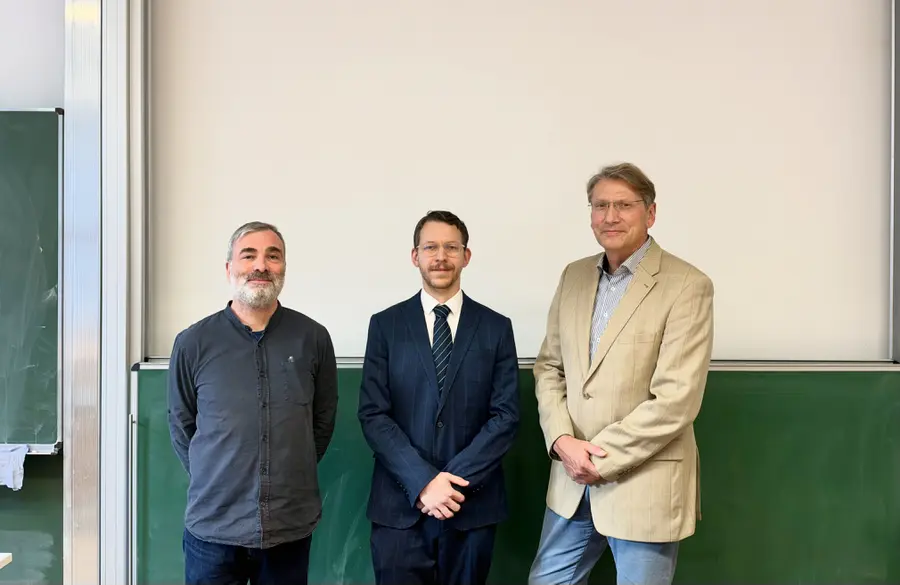
From left to right: Dr.-Ing. Simon Unz (TU Dresden), master's student Stephan Franz Beitlich, and Prof. Dr.-Ing. Michael Beckmann (TU Dresden).
On November 9, 2026, Stephan Franz Beitlich defended his thesis titled “Increasing the Thermal Process Stability of an Experimental Winding Machine for Air Coils/Cylindrical Coils.” The thesis was completed in collaboration with Maxon Motor AG and was supervised by Nico Steinert (Maxon Motor AG) and Dr.-Ing. Simon Unz (TU Dresden). The faculty advisor was Prof. Dr.-Ing. Michael Beckmann (TU Dresden).
The thesis focused on optimizing the manufacturing process for cantilever air coils, which are used in customer-specific electric drive solutions in fields such as medical technology, industry, and active braking systems. During their manufacture, plastic-coated wire is heated convectively during the winding process, causing the individual turns to fuse together. A particular challenge here is the thermal ramp-up of the winding machine: If the system has not yet been sufficiently heated, the first turns may not bond properly and remain loose.
Modeling Thermal Behavior and Investigating Process Parameters
The goal of this work was to investigate the transient heating behavior of the wire, coating, winding, and relevant system components and to derive possibilities for process optimization from these findings. To this end, Mr. Beitlich developed a simplified heat transfer model and conducted extensive experiments on the winding machine. A total of 103 coils from 13 test series, as well as numerous temperature and resistance measurements, were evaluated.
The focus was on various strategies for improving the production startup. Among other things, the study examined external preheating of the winding mandrel, separate heating programs, and an extended heating phase integrated directly into the winding process. In addition, the study analyzed the influence of process parameters such as heating temperature and wire feed rate on the quality of the coil structure.
Integrated Preheating Shows Significant Improvements
The test results show that, in particular , thermally continuous preheating integrated into the process can improve the quality of the coils during production startup. For a wire diameter of 0.10 mm, the number of coils with insufficient coil bond decreased significantly over the course of the test series. In a test with integrated preheating, all five coils examined—including the first coil produced—ultimately met the specified bond limit.
The developed thermal model also provided important insights into the system’s heating behavior. However, supplementary numerical analyses made it clear that the calculation results depend heavily on the thermal boundary conditions and that further validation is required.
Integrated preheating and an adjustment of the exposure time in a targeted manner during the production ramp-up were identified as key optimization measures. It became apparent that no universally applicable temperature threshold can be defined . Rather, the decisive factor is the interplay between the temperature profile, process time, and the respective manufacturing conditions.
This work thus lays the foundation for a more reliable and flexible manufacturing process. In the future, the insights gained can help to adjust suitable process parameters in a targeted manner, even for different coil geometries and wire materials.
We warmly congratulate Mr. Beitlich on his success and wish him all the best in his future endeavors.