
Sep 17, 2026
We congratulate Justin Grolik on successfully defending his thesis.
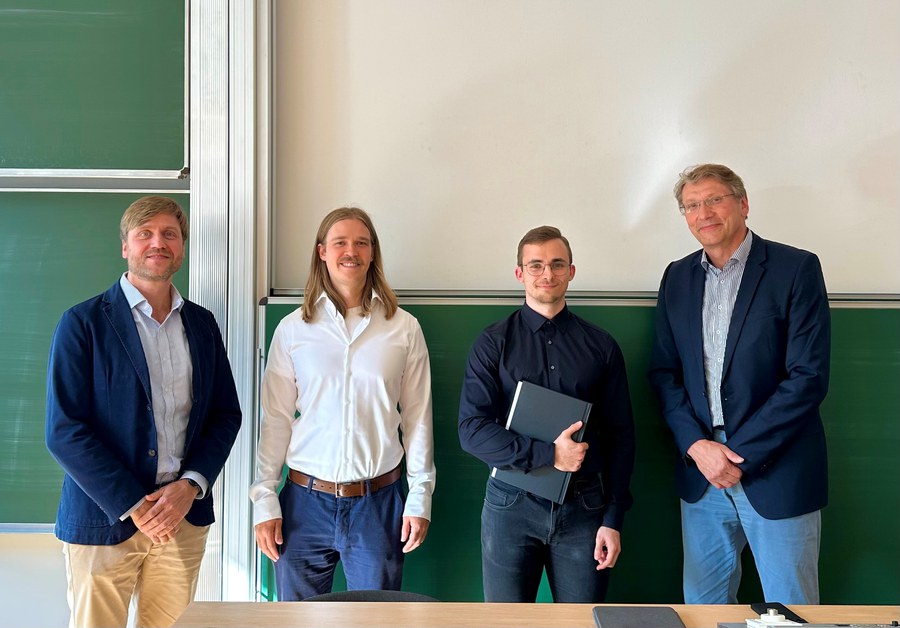
From left to right: Felix Marschallek (DAS Environmental Expert GmbH), Dipl.-Ing. Valentin Scheffel (TU Dresden), graduate student Justin Grolik, and Prof. Dr.-Ing. Michael Beckmann (TU Dresden).
On September 14, 2026, Justin Grolik successfully defended his master’s thesis on the topic “Experimental and Numerical Investigation of Backflow Formation in the Reactor Inlet Region Due to the Pulsating Outlet Flow of a Vacuum Pump.” The thesis was supervised by Dr.-Ing. Felix Marschallek (DAS EE GmbH) and Dipl.-Ing. Valentin Scheffel (TU Dresden). The faculty advisor was Prof. Dr.-Ing. Michael Beckmann.
The manufacture of semiconductors produces environmentally harmful process gases, which are treated using exhaust gas purification systems . High availability of these systems is crucial. However, particle deposits in the reactor inlet area can lead to blockages, increased maintenance costs, and downtime .
Mr. Grolik investigated the pulsating outlet flow of vacuum pumps as a possible cause. The resulting pressure pulsations can propagate through the exhaust line to the purification system and cause backflow there.
For his investigations, he combined experiments with computational fluid dynamics (CFD) simulations. Among other things, the pressure pulsation was examined on a specially constructed test bench equipped with a rotary vane vacuum pump. This revealed a fundamental frequency of approximately 466 Hz. The pulsation can be reduced, among other things, by appropriately adjusting the pipe length or installing sound-absorbing components.
The CFD simulations showed that the pulsation occasionally generates backflow and vortices at the reactor inlet. As a result, particles with an aerodynamic diameter of less than 30 µm, in particular, can strike the inner wall and contribute to blockages. Chamfering the inlet edge can reduce vortex formation and thus particle deposits. In addition, Mr. Grolik developed a proposal for a silencer that can be integrated directly into the pipeline, combining the reflection and Helmholtz resonator principles.
The results thus provide concrete approaches for reducing particle deposits and increasing plant availability. Further investigations are required for industrial application.
We warmly congratulate Mr. Grolik on this outstanding achievement and wish him all the best in his future endeavors.