
Sep 03, 2026
H2-Basis-Tank – A Reference Tank for High-Pressure Hydrogen Storage
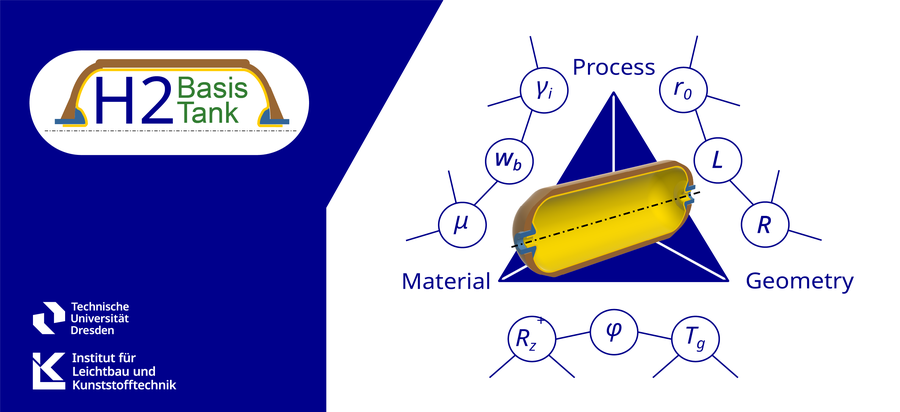
Schematic representation of parameter interactions in the development of hydrogen pressure vessels.
The Institute of Lightweight Engineering and Polymer Technology (ILK) at TU Dresden is developing a reference tank for high-pressure hydrogen storage as part of the “H2-Basis-Tank” research project. Funded under the “EFRE/JTF Research InfraProNet 2021–2027” program by the Saxon Development Bank, the project aims to systematically investigate the interactions between materials, design, and manufacturing processes to improve gravimetric storage density.
Lightweight Hydrogen Storage as a Key to Sustainable Aviation
Hydrogen-based propulsion systems can play a crucial role in reducing climate-relevant emissions in mobility. In aviation, however, the storage of gaseous hydrogen presents significant technical challenges. To store sufficient amounts of energy in limited spaces, hydrogen is typically stored at pressures of up to 700 bar.
Fiber-reinforced pressure vessels are commonly used for this purpose. Their load-bearing structure is primarily made of high-strength carbon fibers, which can withstand high internal pressures while maintaining a low weight. However, carbon fibers are high-performance materials that are costly and energy-intensive to produce. Efficient use of fibers is therefore critical from both an economic and ecological perspective.
In aviation applications, achieving a high gravimetric storage density is particularly important. Reducing the tank’s weight increases payload capacity, improves range, and reduces the overall energy demand of the system. At the same time, high standards for strength, durability, safety, and reproducibility must be met.
The development of such storage systems is complex, as material properties, component geometry, and manufacturing influence each other. Changes to individual parameters can directly affect the structural behavior and achievable storage density.
Digital Modeling and Experimental Validation
To systematically study and evaluate these dependencies, the project is developing a uniformly defined and reproducible reference configuration: the “H2-Basis-Tank”.
Based on parameterized modeling and numerical finite element analyses, the structural behavior of the tank is first examined virtually. Variables such as material properties, wall thicknesses, component geometries, and selected manufacturing parameters are adjusted to quantitatively evaluate their influences and interactions.
In parallel, experimental implementation is carried out at the ILK. Prototypes of the “H2-Basis-Tank” are manufactured on the institute’s winding systems and then tested under defined load cases. The measurement data obtained is used to validate and further refine the numerical models.
By closely linking simulation, manufacturing, and testing, a robust foundation for predicting tank behavior is created. Sensitivity analyses subsequently identify the most relevant influencing factors, such as the properties of high-strength carbon fibers, the arrangement of the fiber layers, and geometric or process-specific boundary conditions.
“H2-Basis-Tank” thus establishes a reproducible reference for future scientific investigations and enables the systematic comparison of different material, design, and manufacturing approaches. The results aim to contribute to the development of lighter, more resource-efficient, and safer high-pressure hydrogen storage systems for aviation applications.
Funding
The “H2-Basis-Tank” research and development project is co-financed by the European Union under the EFRE/JTF Directive Research InfraProNet 2021–2027, part of EFRE. Additionally, the project is supported by tax funds based on the budget approved by the Saxon State Parliament.
Project Duration: 01.06.2025–31.12.2027
Contact:
Dipl.-Ing. Alexander Koepp
Phone: +49 351 463-38527
E-Mail: