
May 18, 2026
KaNaf - Cascade use of natural fiber-reinforced plastics
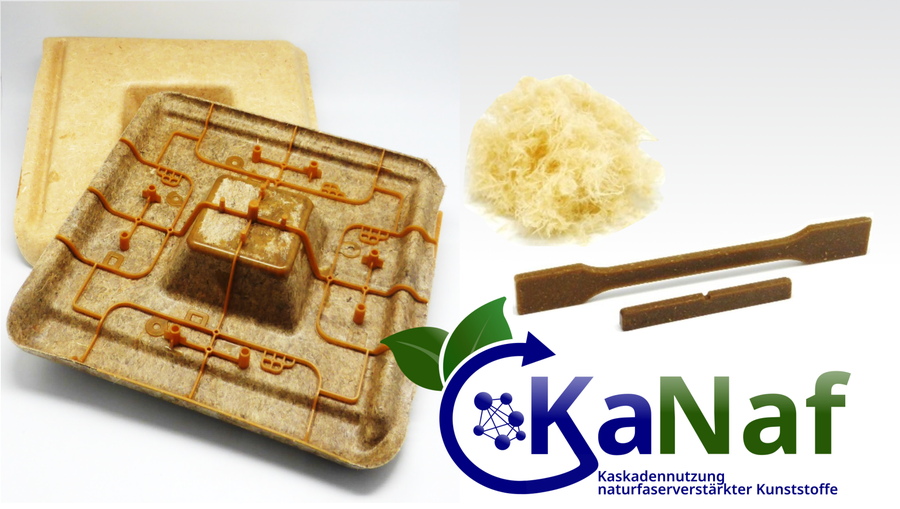
Natural fibers are already widely used in the automotive industry in the form of natural fiber-reinforced plastics (NFRPs), with an annual production volume of around 90,000 metric tons. In recent years, hybrid manufacturing approaches combining pressed NFRP mats or nonwovens with injection-molded compounds have increasingly been adopted. Typical applications include door interior panels, dashboards, and wheel arch liners.
The energy required to manufacture NFRPs is significantly lower than that needed for comparable glass fiber-reinforced components. From a sustainability perspective, replacing conventional materials with NFRPs is therefore considered a key objective for future product development. However, no dedicated end-of-life (EOL) strategy for NFRPs in automotive applications currently exists, resulting in the loss of valuable material potential. At the same time, pressure on the automotive industry to increase the use of recycled materials continues to grow. Under the future EU End-of-Life Vehicles Directive, new vehicles will be required to contain at least 20 percent recycled plastics, of which 15 percent must originate from closed-loop recycling systems.
The aim of the planned research is therefore to develop a recycling route specifically designed for NFRPs. Using a refiner process, the composite materials will be separated in a particularly fiber-preserving manner. Following processing, the resulting NFRP material streams will be evaluated according to their specific properties and prepared for reuse in hybrid components. This approach is intended to enable high-quality long-fiber fractions to be directly reprocessed into NFRP mats within a closed material loop. Shorter fibers will be converted into injection-molding granulates as part of a cascading reuse approach. To facilitate the development of components based on such recycled materials, machine learning-based material models will be developed to support users in component design and enable reliable property prediction.
The Institute of Lightweight Engineering and Polymer Technology (ILK) at Technische Universität Dresden focuses on analyzing the material fractions generated during processing, as well as on the mechanical testing of recycled and reference materials. In addition, ILK is responsible for developing micromechanical material models using machine learning methods.
Project Partnership
The project is being carried out jointly by the Institute of Lightweight Engineering and Polymer Technology (ILK) and the Chair of Wood Technology and Fiber Materials Technology at Technische Universität Dresden, together with the Faculty of Engineering at Technische Hochschule Rosenheim.
The project is supported by industry partners across the entire value chain. Pilot-scale trials are planned with Autefa Solutions GmbH and FRIMO Innovative Technologies GmbH. KraussMaffei Technologies GmbH is providing an adapted plastification process for the gentle processing of recycled fractions. Additional partners contribute in an advisory capacity, including GK Concept, GRAMMER AG, International Automotive Components Group, and Dr. Ing. h.c. F. Porsche AG. The BMW Group supports the project by providing a prototype tool for the demonstrator component and conducting associated emissions measurements.
Funding
The KaNaf research and development project is funded under the Sustainable Renewable Resources funding program of the Federal Ministry of Agriculture, Food and Regional Identity (BMLEH) under grant number F2224NR094A and is supervised by the Fachagentur Nachwachsende Rohstoffe e. V. (FNR).
Project Duration
01.10.2025–30.09.2028