
Oct 21, 2025
Kick-off for the BIGBOND research project: Sustainable bonding technologies for large maritime structures
 © BIGBOND
The project "BIGBOND – Life-Cycle Processes and Design Concepts for Large Bonded Maritime Structures" is an innovative joint project being launched as part of the Maritime Research Program of the Federal Ministry for Economic Affairs and Energy (BMWE). The aim is to significantly expand the use of bonding technologies in shipbuilding and thereby make large maritime structures lighter, more sustainable and more recyclable.
The project is being coordinated by Meyer Werft, which is driving forward the development and application together with a strong consortium. The consortium partners include Tamsen Maritim GmbH, the Fraunhofer Institute for Large Structures in Production Technology (IGP), the Institute of Lightweight Engineering and Polymer Technology (ILK) at TU Dresden and the Center of Maritime Technologies gGmbH. The consortium is also supported by the subcontractor Bureau Veritas Marine and Offshore.

Innovation for shipbuilding
The aim of the project is to harness the advantages of fiber-reinforced composites (FRP) and bonding technologies for large maritime structures. Bonding not only allows the use of lighter, corrosion-resistant materials, but also new design and manufacturing standards. As a result, ships can not only be built more efficiently, but also be easier to maintain, repair and recycle at the end of their service life.
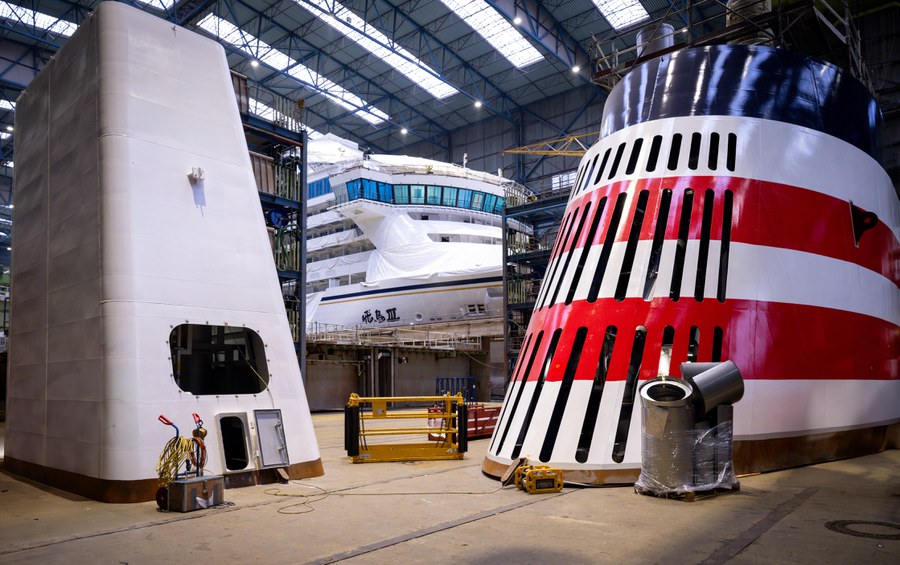
As a demonstrator, a characteristic section of a external cladding is being developed and tested on a real scale. It is an example of how lightweight engineering and standardized bonding processes can reduce weight, material usage and emissions - while at the same time improving stability and operating efficiency.
Contribution to climate neutrality
BIGBOND is making an important contribution to the decarbonization of the maritime industry. According to forecasts, the concepts developed can save more than 17,000 tons of CO₂ emissions every year. In addition, the project contributes to the circular economy by developing solutions for the dismantling and reuse of composite materials.
Cooperation and future prospects
The project consortium combines expertise from shipbuilding, lightweight engineering, materials development and certification. Together, the aim is to create new standards and processes that will pave the way for the widespread use of bonded structures in shipbuilding. In this way, BIGBOND not only contributes to sustainability, but also to strengthening Germany as a location for production and innovation.
TUD sub-project
In the BIGBOND project, the ILK is responsible for researching recyclable engineering and design concepts for large-scale bonded maritime structures. The focus is on methods for the early assessment of environmental impacts in the development process on the one hand and strategies for the recycling and reuse of fiber composite structures on the other. To this end, the ILK is developing indicators and tools that support sustainable decisions in ship design, as well as concepts and technologies for the efficient dismantling and recovery of materials. The aim is to enable the reuse of FRP structures and significantly reduce material-related emissions in shipbuilding.
The project team would like to thank the Federal Ministry for Economic Affairs and Energy and the Project Management Jülich for their financial support and coordinating assistance.