
PrintCap
Next Generation of 3D Printed Structural Supercapacitors

The integration of energy storage functions into load-bearing lightweight structures represents a key innovation approach for future mobile systems. Particularly in unmanned aerial vehicles, the functional coupling of structure and energy storage offers significant potential for reducing overall system weight and installation space. The objective of the PRINTCAP project was the development of an additively manufactured, load-bearing structural supercapacitor system based on continuous, functionalized carbon fibers and thermoplastic PVA gel polymer electrolytes. For this purpose, a continuous process chain was established, ranging from porous carbon-fiber-based electrodes and their modification with vertically aligned carbon nanotubes to continuous tape production and integration into 3D printing (Fig. 1). In addition, numerical multiscale models were developed to couple mechanical and electrochemical requirements and to enable topology-optimized component design. On this basis, an additively manufactured demonstrator was realized, combining structural load-bearing capability and energy storage within a single component. Furthermore, recyclable thermoplastic structures and sustainable electrolyte systems were investigated, establishing a holistic approach to multifunctional, resource-efficient lightweight structures.
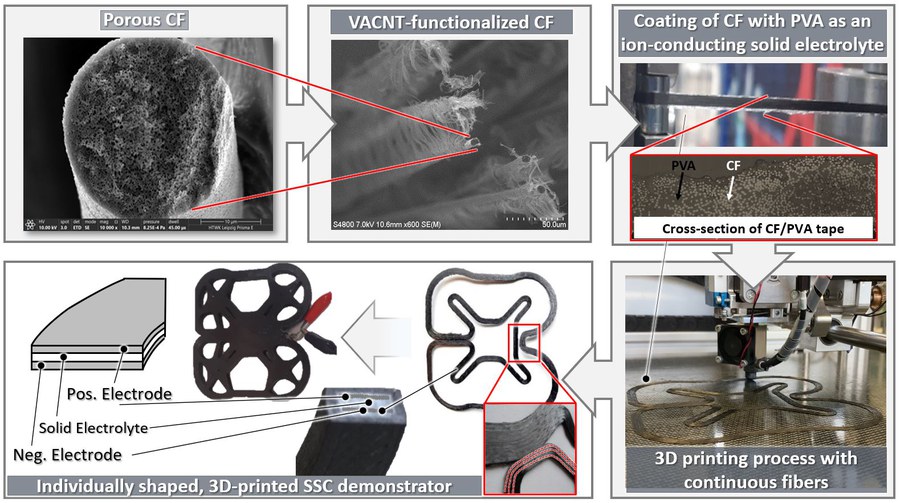
Fig. 1: Integrated manufacturing concept for 3D-printed structural supercapacitors – from porous carbon fibers to highly integrated, material-efficient structures.
01.06.2022–31.05.2025
-
NAWAH (ehem. NAWA Technologies)
-
Leipzig University of Applied Sciences (HTWK Leipzig)


 © Christian Hüller
Chair of Function-integrative Lightweight Engineering
NameProf. Dr.-Ing. Niels Modler
Send encrypted email via the SecureMail portal (for TUD external users only).
Institute of Lightweight Engineering and Polymer Technology
Visitors Address:
DÜR, Floor 0, Room 69 Holbeinstr. 3
01307 Dresden
Deutschland
- Mohsen Sadeghi Bogar (Novel Materials and Special Processes)