
May 29, 2026
Successful completion of the OBSIRVA project
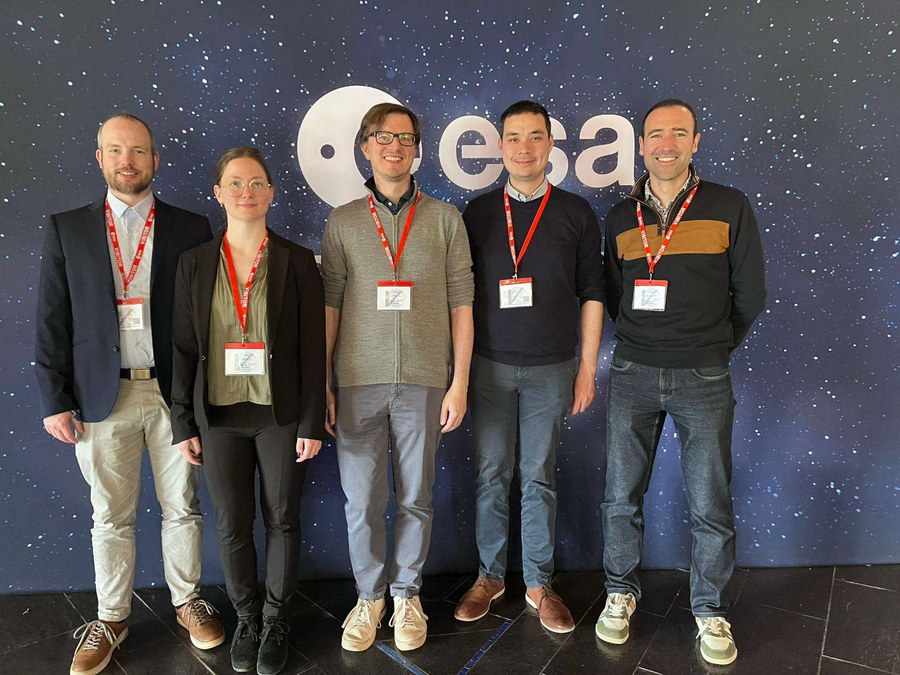
Groupfoto of the OBSIRVA-Team at ESA
Last month, the OBSIRVA (Real-Time System Identification for Complex System Modeling and Autonomy Operations) project funded by the European Space Agency (ESA) was successfully completed. In close cooperation between the Chair of Flight Mechanics and Control and Airbus Defence and Space in Toulouse, new approaches and algorithms were developed which enable mathematical models to be derived from the complex real dynamics of satellites in orbit (system identification). These models can then be used to improve the performance of the satellite, e.g. through more precise alignment for optical measuring instruments or the optimization of fuel consumption during manoeuvres. The new methods thus form an important basis for modern design procedures and new concepts for sustainable space missions. The results were presented at ESA's European Space Research and Technology Center (ESTEC) in Noordwijk, the Netherlands.
System identification is an important branch of control engineering. It deals with learning the dynamic model of a system with limited measurement data. This is of interest because theoretical models can deviate from reality, which can reduce the efficiency of control algorithms. In the project, special care was taken to ensure that the developed methods are directly applicable to real satellites, including the use of only standard available sensor signals and compatibility with on-board computing capabilities. The algorithms were tested on flight data from actual satellites and highly detailed simulations.