
Jun 03, 2026
New Collaborative Project Ref4EP2: TU Dresden Developing Reference Hall Thruster for Standardized Propulsion Testing
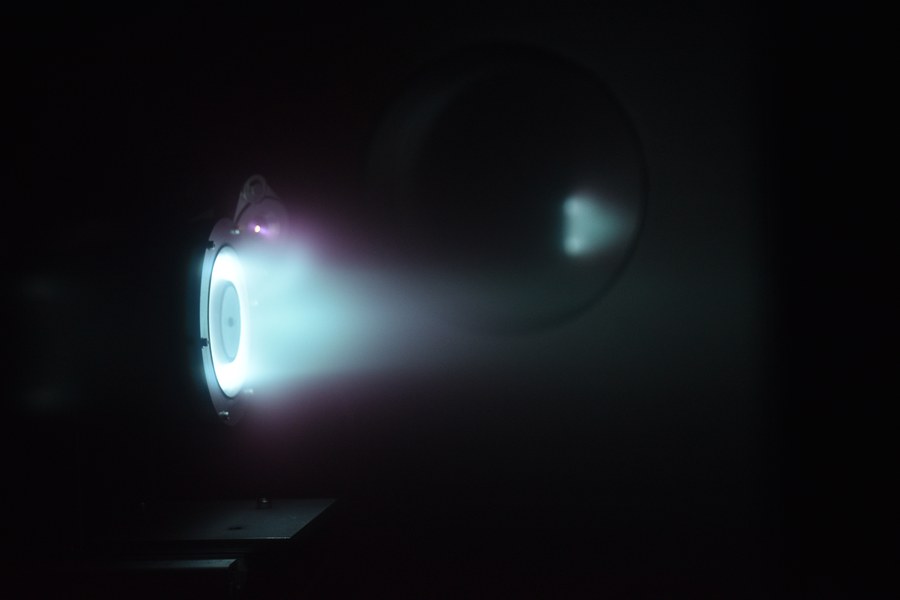
The Chair of Space Systems at TU Dresden is partnering on the new Ref4EP2 project. The project aims to improve the reliability, comparability, and long-term suitability of diagnostic and testing procedures for electric space propulsion systems.
Electric propulsion systems play a central role in modern satellite missions, including orbit and attitude control and efficient transfer maneuvers. Precise, standardized procedures are necessary to reliably develop, qualify, and compare such propulsion systems across different test facilities. This is precisely where the new collaborative project Ref4EP2 comes in.
Ref4EP2 stands for "Standardized Reference Diagnostics for Ion and Hall Thrusters: Expansion, Intercomparison, and Long-Term Validation for Electric Space Propulsion Systems and System Comparisons." Building on the results of the previous project, Ref4EP, this project will develop fundamental reference systems and diagnostic methods for electric propulsion systems. The follow-up project will further develop these approaches, verify them through comparative measurements between different test facilities, and examine them with regard to facility effects. Facility effects refer to influences caused by the respective vacuum test facility that can alter measurement results compared to real space conditions.
Dresden University of Technology is playing a central role in the project. The Chair of Space Systems is developing, building, and characterizing a reference Hall thruster. Hall thrusters are among the most commonly used electric propulsion systems for satellites and are therefore an important reference type for standardized measurement campaigns. They are used for orbit corrections, attitude control, and efficient transfer maneuvers, among other things. Hall thrusters are also well-suited for studying the effects of different vacuum test facility conditions on the plasma beam, operational behavior, and measurement results because their plasma beam interacts directly with the test environment.
The Dresden reference Hall thruster is designed to provide robust and reproducible operating conditions. This will enable it to verify measurement methods and evaluate results from different test facilities more effectively in the future. The focus is on both the individual thruster and how electric propulsion systems can be measured on the ground so that the results are consistently traceable and comparable across different laboratories.
This work builds on TU Dresden’s extensive experience developing and characterizing Hall-effect thrusters. In recent years, the Institute of Aerospace Engineering has developed several thruster concepts, hollow cathodes, and specialized measurement systems for plasma beam and thrust measurements. This preliminary work now forms the basis for the new reference system.
The consortium includes TU Dresden, Justus Liebig University Giessen, the Leibniz Institute of Surface Engineering, Christian-Albrechts University of Kiel, and the University of Applied Sciences Mittelhessen. Together, these partners aim to make ground tests of electric space propulsion systems more comparable. The results will help standardize test procedures, more accurately evaluate measurement uncertainties, and improve the transferability of ground tests to in-space operations.