
DCONFORM
Digital Construction Using Reinforced Low-Carbon Mineral Foam
| Funding: | German Research Foundation (DFG) |
| Funding code: | 533767731 |
| Partner: | Institute of Construction Materials, TU Dresden Chair and Institute of Concrete Structures, RWTH Aachen University Chair of Inorganic Chemistry I, TU Dresden Chair of Machine Learning for Computer Vision, TU Dresden |
| Duration: | 01/2026 - 12/2027 |
| Contact: | Paul Plaschnick |
The D-CONFORM project is part of the Cluster of Excellence CARE and addresses the development of digital, resource-efficient construction processes using CO₂-neutral mineral foam materials. The aim of the project is to produce material-efficient, 3D-printed load-bearing structures with a significantly reduced CO₂ footprint.
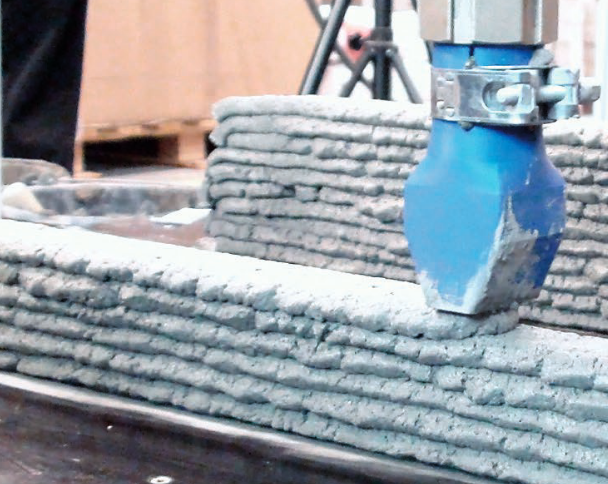
Markin, Viacheslav ; Mechtcherine, Viktor: 3D Printing With Foam Concrete. In: CPT worldwide Bd. 3 (2021), Nr. 1, S. 18–24
Mineral foams based on LC3 binders and CO₂-based foam systems offer great potential for lightweight construction. However, their processing in additive manufacturing processes places high demands on process stability, particularly with regard to foam homogeneity, material density and mixing quality.
Within D-CONFORM, the Chair of Construction Machinery is working on the work package - development of print heads and laboratory-scale validation. The focus is on the design and testing of innovative print heads with integrated inline mixing, in which the binder and CO₂ foam are combined immediately before the material is discharged. This approach avoids the transportation of sensitive mineral foams over long conveying distances and significantly improves the stability of the material during the printing process.
In addition, sensor and control concepts are integrated to monitor central process variables such as foam density, volume flow and mixing homogeneity in real time and control them in a targeted manner. The developed systems will be used to produce the first 3D-printed demonstration objects and validated in the laboratory.
With this work, the Chair of Construction Machinery is making a significant contribution to the transfer of mineral foam materials from the laboratory to scalable, digital construction processes, thereby supporting the goals of the Cluster of Excellence CARE with regard to climate neutrality, resource efficiency and productivity.