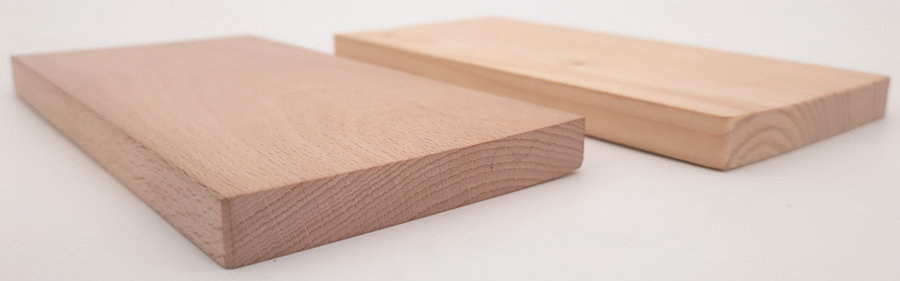
Herzlich Willkommen ...
... an der Professur für Holztechnologie und holzbasierte Bioökonomie der Technischen Universität Dresden.
Wir haben für euch Dauerpräparate angefertigt, sodass ihr euch Holz auch unter dem Mikroskop anschauen könnt.
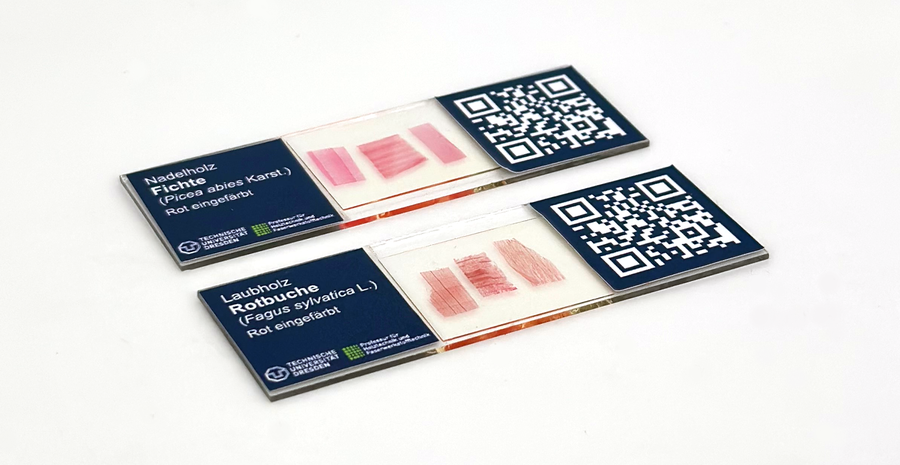
Dauerpräparate der Holzarten Rotbuche (Fagus Sylvatica L.) und Fichte (Picea abies Karst.)
Hier findet ihr die wichtigsten Fragen zu den Präparaten – wir liefern euch die Antworten!
Zu den wichtigsten Holzarten in Deutschland zählen die Buche und die Fichte. Die Fichte ist ein Nadelholz und zeichnet sich durch einen einfachen Strukturaufbau aus. Tracheiden sind hier die wichtigste Zellart. Laubhölzer wie die Buche besitzen eine zusätzliche Zellart, die Gefäße. Diese sind ein markantes Merkmal, das bei genauem Hinsehen im Querschnitt als Poren deutlich zu erkennen ist. [1]
In den Boxen findest Du genauere Erklärungen zu den beiden Holzarten.


Vereinfacht lassen sich drei Hauptrichtungen feststellen, welche sich an einem mathematischen Zylinder orientieren.
Das Holz ist nicht wie z.B. ein Metall gleichmäßig in alle Richtungen aufgebaut, sondern weißt verschiedene „Bauelemente“ mit unterschiedlichen Ausrichtungen auf. Das nennt man Anisotropie. Vereinfacht lassen sich drei Hauptrichtungen feststellen:


Die Grafik zeigt die Skalenebenen des Holzes vom Baum (Stammebene) bis zur molekularen Ebene. Hieran lässt sich gut beschreiben, was wir makroskopisch, also mit dem bloßen Auge bzw. einer Lupe sehen können und was darüber hinaus mit unterschiedlichen Mikroskopen sichtbar wird.
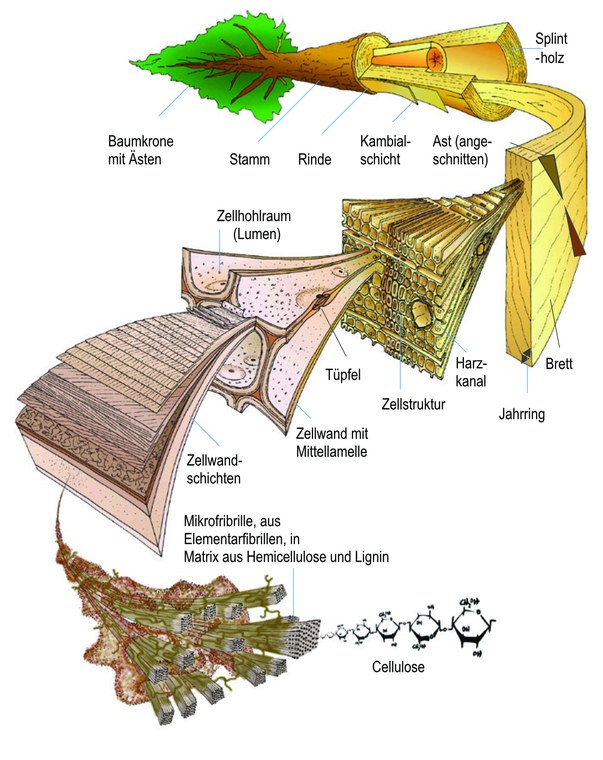
Hierarchischer Aufbau von Holz
In den nachfolgenden Bildern kannst du dir makroskopische und mikroskopische Aufnahmen von Buchen- und Fichtenholz anschauen. Dabei sind alle drei Hauptschnittrichtungen dargestellt.


In den nachfolgenden Bildern zeigen wir dir Anwendungen, für die wir Lichtmikroskope aber auch speziellere Mikroskope verwenden.


Das folgende Video wurde von Studierenden der Holztechnik für Euch erstellt und zeigt die Herstellung von Dauerpräparaten im Fach Holzanatomie.
Dresden offers a variety of degree programs related to wood.
You can choose between the Wood Technology program at the Saxony Cooperative State University, where you combine theory and hands-on experience at a company, or an engineering degree at TU Dresden. At TU Dresden, the Wood Technology and Fiber Materials Technologyprogram is a specialization within the Process Engineering and Natural Materials Technology degree program. This program is divided into two parts:
In the first two years of study, you’ll learn important theoretical fundamentals in natural sciences, technical subjects, and engineering disciplines. These include, for example, math, physics, chemistry, electrical engineering, and thermodynamics. Later, you can deepen your knowledge in specific fields of study, such as wood and fiber materials engineering.
In the main part of the program, you’ll first explore questions such as:
- Why and how does wood change when it is exposed to water, for example?
- What components does wood consist of, and what are their functions?
- What distinguishes different types of wood from one another?
- How are wood-based materials and paper manufactured and processed?
After that, you can choose exactly what interests you most and suits your strengths. Whether it’s furniture design, CNC technology, wood drying, paper chemistry, or recycled paper processing —you’ll have the opportunity to delve into exciting areas of specialization.
The theoretical knowledge, taught in small groups in a relaxed lecture hall atmosphere, is supplemented by internships and field trips to industrial sites. An annual highlight is a one-week field trip to various companies in Germany or other European countries. During the practical semester, you’ll also have the opportunity to apply what you’ve learned in an industrial setting.
With us, you’ll have the chance to actively contribute your skills to current research projects, for example through student research projects. In addition, working as a Student Assistant gives you the opportunity to engage more deeply with research topics while helping to finance your studies.
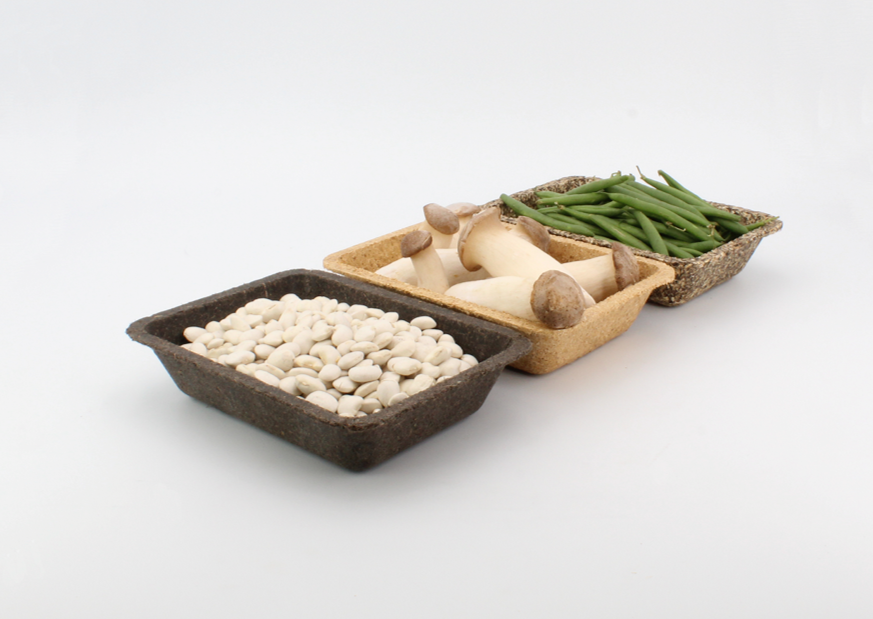
Current research focuses primarily on the development of sustainable materials for a greener future, as well as their market introduction.
Research projects addressing this topic include, for example, replacing tropical woods in musical instrument making with native wood species by appropriately modifying their properties. Another example is the development of single-use packaging ( see image) made from plant residues, such as those generated in mushroom production and agriculture.
 © J. Herold | TUD
Holztechnologie und holzbasierte Bioökonomie | MAR 39
Send encrypted email via the SecureMail portal (for TUD external users only).
Visiting address:
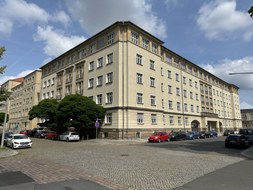
Marschnerstraße 39, Sekretariat Raum 369
01307 Dresden-Johannstadt
Postal address:
TUD Dresden University of Technology
Professur für
Holztechnologie und holzbasierte Bioökonomie
01062 Dresden
Office hours:
- Monday:
- 08:00 - 10:00
- 13:00 - 14:00
- Tuesday:
- 08:00 - 10:00
- 13:00 - 14:00
- Wednesday:
- 08:00 - 10:00
- 13:00 - 14:00
- Thursday:
- 08:00 - 10:00
- 13:00 - 14:00
- Friday:
- 08:00 - 09:00
sowie nach vorheriger Vereinbarung per E-Mail
Links:
-
Identification Guide to Native Conifers and Deciduous Trees
-
"macroHOLZdata" app ( external)