
Wrinkle-Free Compression-Drawing
Advancement of forming technology for the investigation of wrinkle-free forming of natural fibre substrates with low fibre material density

Paper-based packaging, despite limited design possibilities, is predominantly produced through folding, bending, and winding. In contrast, the innovative process of dry moulding of fiber nonwovens offers a good alternative, in which forming is achieved within very short process times by means of thermal-mechanical compression. However, the achievable degree of forming is directly related to the thickness of the fiber nonwoven, which is why a high material input is required for large packaging heights. Unlike dry moulding, deep drawing of paperboard allows high forming degrees (≥0.5) to be achieved with lower material usage. In this process, however, the lack of flowability of paper materials leads to a geometrically induced material surplus, which causes wrinkle formation. Process-related wrinkle formation results in a non-uniform surface of the formed part, which, among other things, limits the degree of forming and negatively affects subsequent processing steps (e.g., application of barriers, sealing, printing). By using materials with high pore volumes in the drawing process, the lack of flowability within the mobile network structure is compensated by fiber-to-fiber displacement, so that wrinkle formation only occurs at higher degrees of forming. On the other hand, increasing pore volume reduces the material’s load-bearing capacity.
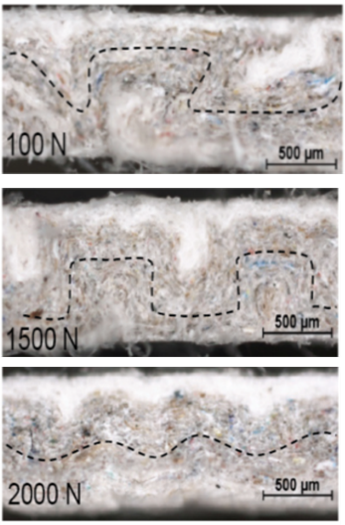
Consequently, the research objective is to determine the interactions between forming-specific network properties, pore volume, material conditioning, and the process sequence, which form the basis for the technological development of fiber nonwoven forming. The production of wrinkle-free packaging made from renewable raw materials meets the requirements for reliable surface functionalisation (e.g., application of biogenic barrier or sealing layers), thereby providing, for example, companies in the food and packaging industries with an ecological competitive advantage.
Project funding:

This research project is supported by the German Federal Ministry for Economic Affairs and Energy thorugh the funding scheme "Industrielle Gemeinschaftsforschung" (nr. 01IF23551N) , based on a resolution of the German Bundestag.
Project duration:
07.2025-06.2027
Project management and contact:
Project leader: Prof. Jens-Peter Majschak
Project manager: Lena Berthold
 © Nils Eisfeld
Processing Systems
NameDipl.-Ing. Lena Berthold
Forming of Fiber-based Materials
Send encrypted email via the SecureMail portal (for TUD external users only).