
O3Ster
Use of Ozone Generators in Combination with High Humidity for the Sterilization of the Sterilization of the Machine Interior of Hygienic Filling Systems
The research project O3Ster investigates an alternative approach for sterilizing the interior of aseptic filling machines. The approach is based on the use of ozone generated by dielectric barrier discharge (DBD) and applied in combination with high humidity. The aim is to evaluate the suitability of this method for hygienic filling processes in the food industry and to develop an energy-efficient and chemical-free sterilization concept.
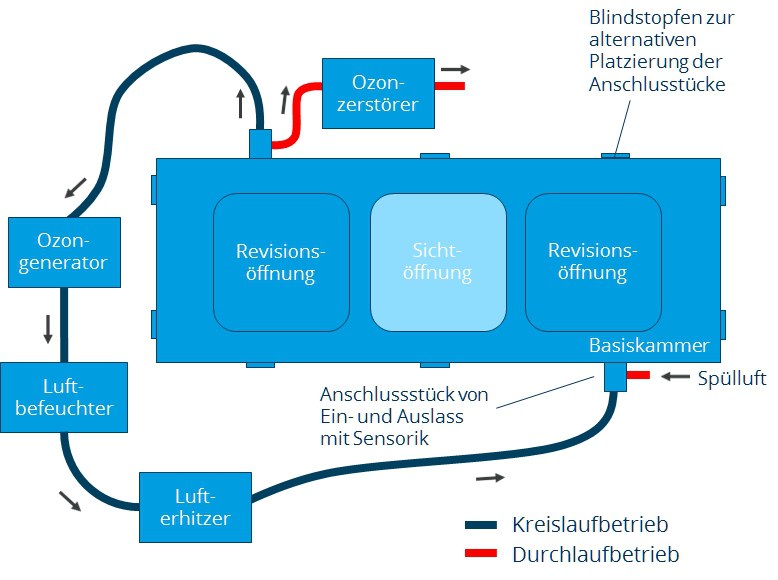
Schematische Darstellung des Teststands
The main focus lies on the systematic investigation of key process parameters such as ozone concentration, humidity, and temperature, as well as their influence on sporicidal effectiveness. In addition, material compatibility and possible residue formation are analyzed. A specially developed test rig realistically simulates the sterile zone of aseptic filling machines, allowing both experimental studies and validation through flow simulations. This enables targeted process optimization and ensures the transferability of the results to real industrial systems.
The work is structured into seven work packages, jointly carried out by TU Dresden and Fraunhofer IVV Freising. TU Dresden is responsible for the design and construction of the test rig, the execution of flow simulations, and the investigation of material compatibility. Fraunhofer IVV analyzes the sporicidal effectiveness of ozone treatment at laboratory and test rig scale, conducts microbiological test series, and compares DBD-based ozone generators with commercially available systems. Furthermore, the formation and removal of potential residues are investigated.
It is expected that the application of ozone under humid conditions will achieve a high sterilization performance while significantly reducing energy and chemical consumption. Due to the compact design and simple integration of DBD-based ozone generators, a practical implementation in existing filling systems appears feasible. The findings of the O3Ster project contribute to the advancement of hygienic filling technologies and enhance the competitiveness of the German mechanical and plant engineering sector through innovative and sustainable solutions.
Scientific Partner:
Project funding:

This research project is supported by the German Federal Ministry for Economic Affairs and Energy thorugh the funding scheme "Industrielle Gemeinschaftsforschung" (nr. 01IF24401N) , based on a resolution of the German Bundestag.
Project duration:
10.2025 - 09.2027
Project management and contact:
Project leader: Prof. Jens-Peter Majschak
Project manager: Dr.-Ing. Hannes Köhler
 © Köhler
Cleaning Technologies
NameDr.-Ing. Hannes Köhler
Research Field Coordinator
Send encrypted email via the SecureMail portal (for TUD external users only).