
Oct 22, 2026
AMPEL Project Meeting in Dresden: Advancing Clinical Decision Support Across Sites Together
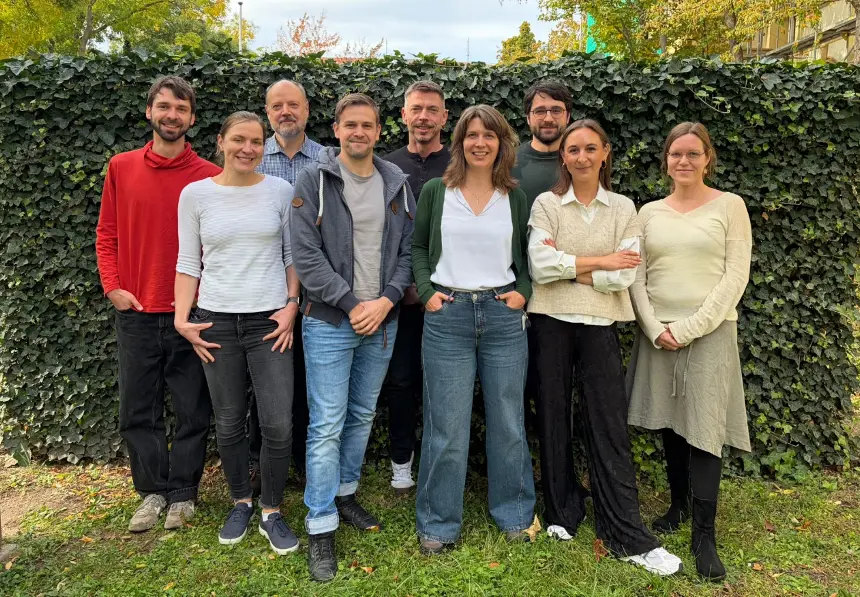
Fourth AMPEL partner meeting in Dresden (from left to right: Clemens Malkawi, Sandra Waske, Toralf Kirsten, Alexander Twrdik, Mario Menk, Miriam Goldammer, Martin Federbusch, Katharina Schuler, Katja Hoffmann).
Adapting clinical decision support to different healthcare settings was the central theme of the fourth AMPEL project meeting, held in Dresden on 15 October 2026. Project partners from Leipzig and Dresden presented their latest findings and discussed priorities for the project’s final year.
The AMPEL project aims to implement the clinical decision support system developed in Leipzig, which provides real-time alerts, at Dresden University Hospital and to further develop its technical capabilities. The project also explores innovative AI models for use in routine clinical practice. Together, these efforts aim to provide physicians with more targeted support when making diagnostic and treatment decisions.
The meeting opened with progress reports and an overview of the next steps from the four working groups:
- Technical and organizational plans are in place for implementing the system at Dresden University Hospital. Lessons learned during this process will inform an implementation guide.
- The redesigned user interface will be evaluated with healthcare professionals, alongside an assessment of their training needs.
- Ethics approval and authorization to use the relevant data mark important steps towards the planned prospective study evaluating the sepsis model using data from Dresden.
- In parallel, the project is assessing the requirements and local conditions at other hospitals to explore how the system could be used beyond university hospital settings.
Another key topic was the planned open-source release of the AMPEL platform developed at Leipzig University Hospital. Making the source code, technical documentation and regulatory guidance available is intended to facilitate knowledge sharing and help other institutions implement the platform locally.
Following the progress reports, the project partners agreed on priorities and the remaining milestones for the final project year. The focus will be on analyzing the project’s findings and developing implementation approaches that can be adapted to other hospitals. The discussions highlighted that successful implementation across sites depends on the close coordination of technical integration, clinical validation and user-centered design.
Funding
This project is co-financed through tax revenues on the basis of the budget adopted by the Saxon State Parliament.

Grant number: 100730967