
Nov 06, 2026
ZMI at EFMI STC 2026 in Athens

How can context factors be systematically incorporated into the design of clinical decision support systems? This question is at the heart of our research associate Katharina Schuler’s doctoral research.
At the EFMI Special Topic Conference (STC) 2026 in Athens, she presented recent research findings developed in collaboration with Katja Hoffmann, Brita Sedlmayr, and Martin Sedlmayr. Under the theme “AI in Clinical Decision Making and Education” the conference of the European Federation for Medical Informatics (EFMI) brought together researchers, clinicians, and other professionals from various countries. It focused on current developments in artificial intelligence, clinical decision-making, and education and training in healthcare.
Her presentation, entitled „Translating Clinical Context into Traceable CDSS Design Decisions” was based on work conducted within the AMPEL research project.
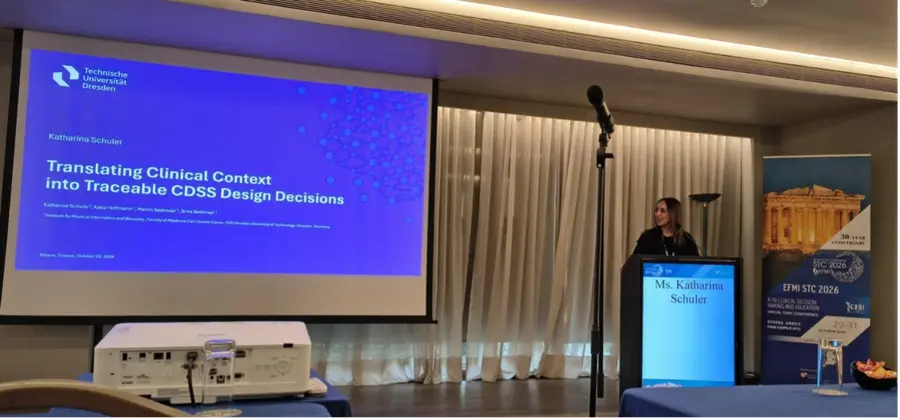
Using the AMPEL system for detecting acute kidney injury as a case study, Katharina Schuler demonstrated how clinical context factors can be systematically translated into requirements and concrete design decisions. Making these links explicit helps explain why particular features and ways of presenting information are needed and supports the assessment of whether they remain suitable when conditions of use change.
Alongside the opportunity to present her research, the conference offered valuable insights into the use of AI in clinical practice, ethical issues, and the human-centred design of digital health technologies. Personal exchanges and discussions with researchers from different disciplines and countries were particularly enriching.
The insights gained will inform further research into the context-sensitive development of clinical decision support systems.
Founding
This project is co-financed through tax revenues on the basis of the budget adopted by the Saxon State Parliament.


Grant number: 100730967