
Nov 06, 2026
From PRO visualization to patient-centered precision oncology
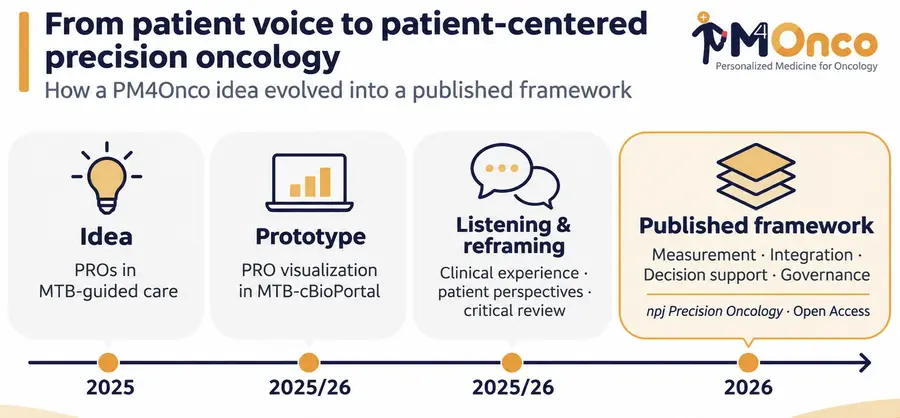
How can the patient perspective in precision oncology not only be collected, but meaningfully integrated into clinical workflows?
This question is at the heart of a new Perspective from the PM4Onco environment, now published Open Access in npj Precision Oncology.
The work directly builds on an earlier publication by the team from 2025. At that time, the main focus was on how Patient-Reported Outcomes (PROs) could be visualized within MTB-cBioPortal in a way that is understandable and useful for physicians working in the context of Molecular Tumor Boards.
From this initially very concrete design and implementation question, a broader consideration gradually emerged:
What does it actually take for patient-reported information to become clinically meaningful in precision oncology?
The new Perspective proposes a framework consisting of four interconnected domains:
- Measurement: Which information should be collected, when, and using which instruments?
- Data integration: How can PROs be meaningfully linked with clinical and molecular information?
- Decision support: How can this information be presented and interpreted in a way that supports care and longitudinal follow-up?
- Governance: How should issues such as consent, data access, secondary use, autonomy, and trust be addressed?
A central conclusion of the work is that collecting PROs alone is not sufficient. Their value emerges when they are embedded in existing clinical workflows, followed longitudinally, and linked to meaningful feedback and response pathways.
What could this mean in clinical practice?
The fictional case example “Maria” used in the article helps illustrate this concept. Even when an individualized treatment recommendation has been made following discussion in a Molecular Tumor Board, this does not yet answer the question of how a patient actually experiences the treatment over time.
Repeated PRO assessments can make changes in symptoms, functioning, quality of life, or treatment burden visible over time. These data can complement molecular and clinical information and provide additional context for clinical conversations, follow-up assessments, or supportive interventions.
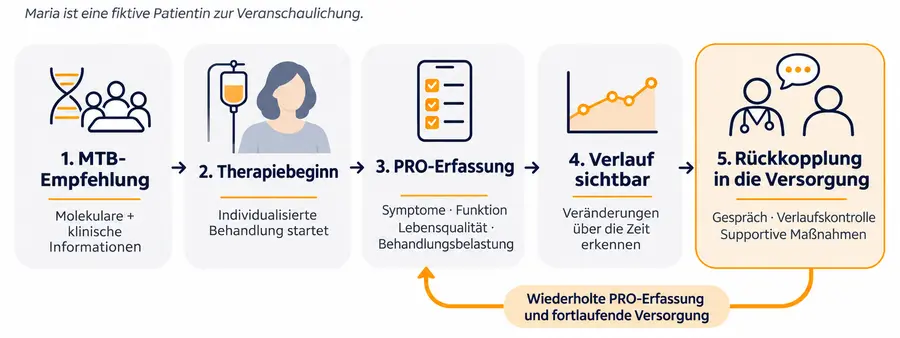
Figure 1: Fictional case example “Maria”. Patient-Reported Outcomes can complement molecular and clinical information by adding the direct patient perspective. Repeated assessments make changes over time visible and can provide additional information that feeds back into ongoing care.
“The original idea was relatively simple: we wanted to make the patient perspective more visible in the Molecular Tumor Board context. Over the course of the work, however, it became increasingly clear that this is not simply about adding another visualization. The key question is how this information can be collected, integrated, interpreted, and ultimately translated into actual care.” Markus Wolfien
This development has also been accompanied by continued exchange with patients and patient representatives. Members of the IMB team participated in the 2026 National Conference “Patients as Partners in Cancer Research” organized by the National Center for Tumor Diseases (NCT) in Essen. There, approaches for collecting and visualizing PROs were presented and discussed together with patients and patient representatives.
For the team, this exchange provided an important complement to the technical and clinical perspectives: Which information is genuinely relevant to patients? What kind of feedback do they expect? And how understandable are visualizations that were originally developed for clinical users?
This creates a coherent line from the user-centered development of PRO visualization, through the conceptual framework presented in the newly published Perspective, to the next practical questions of implementation.
MTB-cBioPortal is now in use at multiple sites, albeit at different stages of implementation maturity. These range from prototype deployments and systems still under development, through use for Molecular Tumor Board preparation, to solutions that are largely or fully integrated into existing clinical workflows. A current focus is therefore on understanding which technical, organizational, and local conditions shape these different levels of implementation and how transferable strategies for sustainable integration can be derived from them. Key factors include data integration, responsibilities, local workflows, governance, and long-term operational models.
The newly published Perspective therefore represents an important conceptual building block for the continued work within PM4Onco and beyond.
Publication
Gräßel L, Yacob S, Strantz C, et al.
The promise and limits of patient-reported outcomes in molecular tumor board-guided care: toward a framework for patient-centered precision oncology.
npj Precision Oncology. 2026.