
Feb 02, 2026
MiHUB launches second funding phase: Kick-off marks the start of a cross-sectoral data space in Eastern Germany
With the Medical Informatics Hub – MiHUB (https://mihubx.de/mihub), a central hub is being established in Eastern Germany that brings together researchers, healthcare providers, and patients via a cross-sectoral data space. The project is led by TU Dresden and the Chair of Medical Informatics at the Institute for Medical Informatics and Biometry (IMB) under Prof. Dr. Martin Sedlmayr. MiHUB is funded by the Federal Ministry of Research, Technology and Space (BMFTR) with approximately €11 million and will run from January 1, 2026, to December 31, 2029.
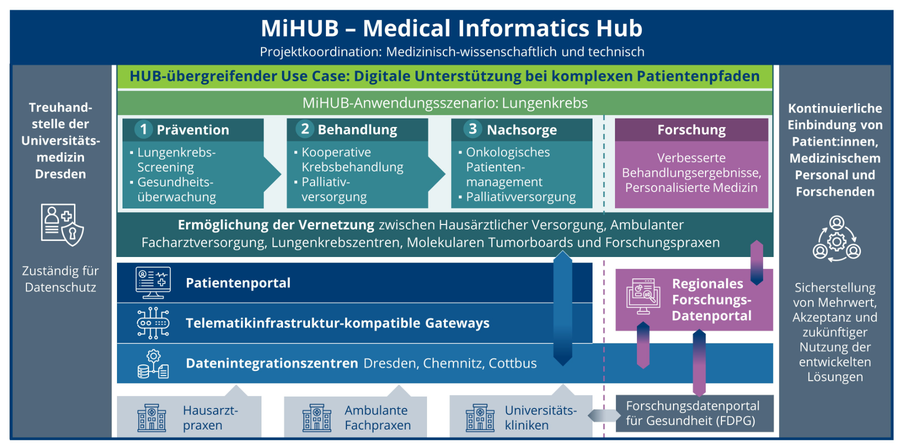
At the core of the project is the development of a cross-sectoral data space supported by a high-performance communication, data, and research network. This network connects regional data integration centers, strengthens collaboration across sector boundaries, and creates the foundation for scientifically accompanying and further developing care-oriented networks along real-world care pathways. The goal is to more closely integrate medical research and healthcare delivery and to sustainably strengthen regional structures.
A key element of MiHUB is the further development of the patient portal established during the first funding phase. In the second funding phase, this portal will be specifically expanded to support interprofessional and intersectoral collaboration across the entire continuum of care. In addition, modules from cooperating Digital Health Innovation Hubs (DigiHUBs) (https://www.medizininformatik-initiative.de/de/use-cases-und-projekte/digitale-fortschrittshubs-gesundheit) are to be integrated. A decentralized, modular architecture ensures efficient implementation, high interoperability, and the transferability of the developed solutions to other DigiHUBs and national infrastructures.
In terms of content, MiHUB focuses on a shared “patient journey” approach to achieve maximum collective impact, demonstrate concrete benefits for care delivery, and provide sustainable, scalable technical solutions. The work is structured around three strategic use cases: prevention and cancer screening, collaborative cancer treatment, and follow-up care and long-term survival. These cover different phases of the patient pathway and enable a longitudinal perspective on at-risk individuals and care trajectories.
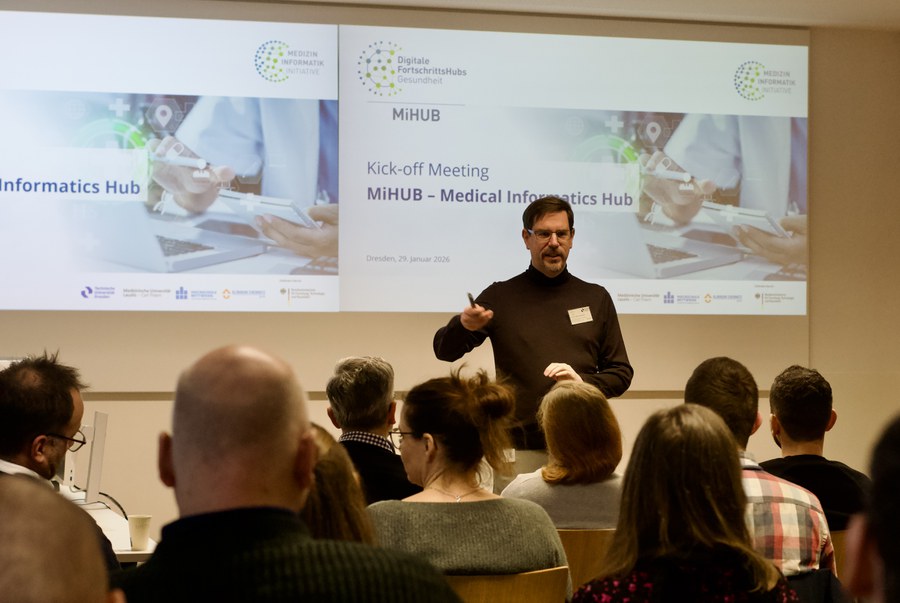
The start of the second funding phase was marked by the kick-off meeting on January 29, 2026, at the University Hospital Carl Gustav Carus Dresden. Around 30 participants from a total of 15 clinics, working groups, and partner networks—Technische Universität Dresden, Medical University of Lausitz, Mittweida University of Applied Sciences, and Chemnitz Hospital—came together to jointly launch the implementation of MiHUB. The focus was on shared alignment and the concrete start of the project: the consortium refined its target vision and adopted a joint roadmap with prioritized steps and clear responsibilities to structure the work in the coming weeks. This laid the foundation for coordinated collaboration, with the aim of rapidly operationalizing the planned components and making initial added value along the patient journey visible.

Auditorium zum Kick-off MiHUB

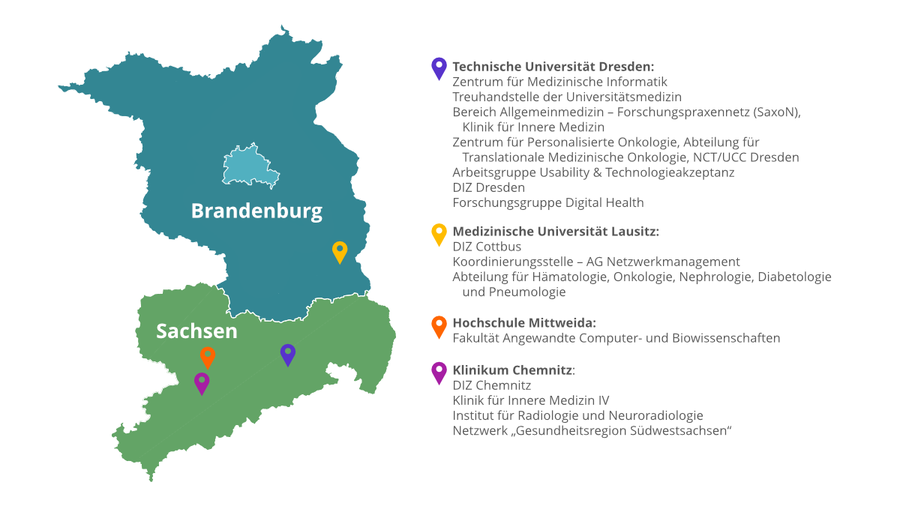
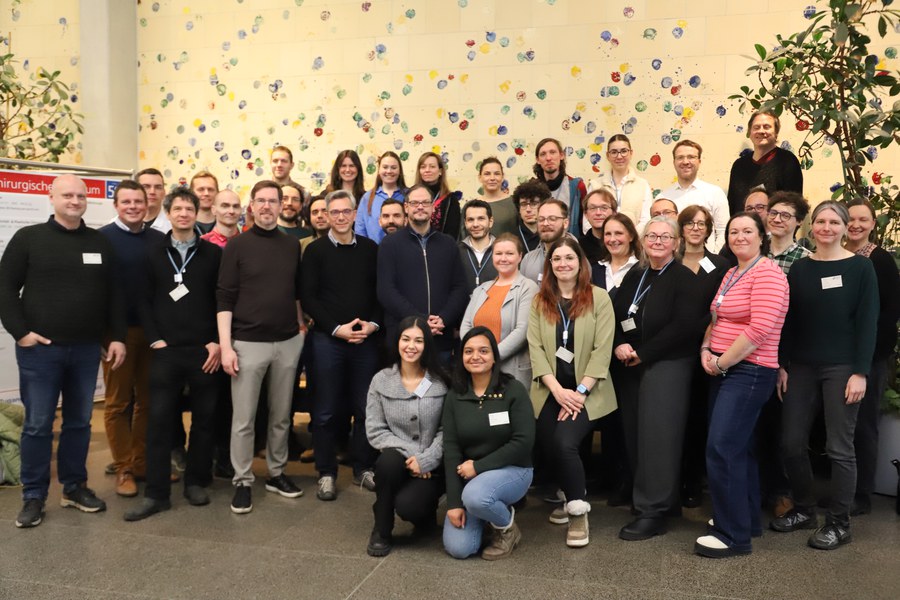
Teammitglieder des MiHUB