
Research programme
Within the IRTG we aim to provide a foundation for interdisciplinary neuropsychiatric and translational research and training to elaborate and combine research methods and innovative treatment approaches for these disorders. The IRTG is embedded in the environment of the transCampus®, a unique partnership of two excellent European academic institutions – Technische Universität Dresden and King’s College London. Both institutions are leading centres in both basic research and innovative treatment of affective disorders and have pioneered the translation of results from basic science into clinical application. This expertise is combined within the overarching aims of the IRTG to promote our key research goals and multi-method approach in the examination of risk factors and pathomechanisms to improve early identification, understanding and treatment of affective disorders.
Research goals of the IRTG 2773:
- Investigation of risk factors and pathomechanisms of affective disorders to improve prevention, early identification and treatment
- Further development of the translational approach bringing basic research into clinical application and vice versa
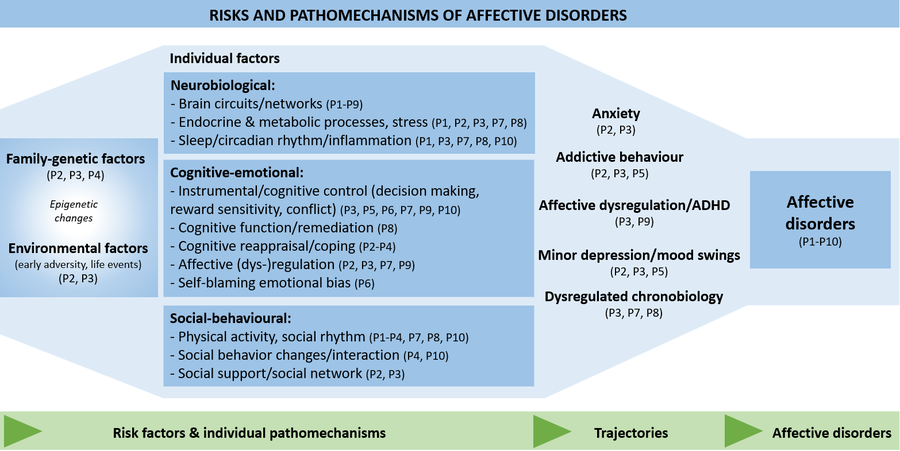
Research projects within the IRTG 2773:
P1: Mapping trajectories & brain correlates of affective symptomatology in animal models (TUD: Nadine Bernhardt – King’s: Anthony Vernon)
P2: Early risk factors and trajectories of affective disorders: A multimodal approach to developmental epidemiology (TUD: Eva Mennigen, Katja Beesdo-Baum – King’s: Paola Dazzan, Carmine Pariante)
P3: Early detection of young at-risk individuals for bipolar disorders (TUD: Andrea Pfennig, Julia Martini – King’s: Paolo Fusar-Poli)
P4: Neural correlates of social cognitive risk factors for depression and bipolar disorder (TUD: Philipp Kanske – King’s: Roland Zahn)
P5: Learning, motivation, and cognitive control as trans-diagnostic mechanisms in addiction and depression (TUD: Michael Smolka, Thomas Goschke – King’s: Robert Leech)
P6: Probing the causal role of fronto-temporal networks in self-blame and emotional conflicts using tDCS (TUD: Christian Beste – King’s: Roland Zahn, Katya Rubia)
P7: The impact of physical activity on hormonal, metabolic, inflammatory mediators and the regulation of affective states (TUD: Stefan Ehrlich, Stefan Bornstein – King’s: Carmine Pariante)
P8: Towards understanding and enhancement of cognitive function in patients with bipolar disorders (TUD: Philipp Ritter, Clemens Kirschbaum – King’s: Rebecca Strawbridge, Allan H. Young)
P9: EEG-Neurofeedback and fMRI brain function of novel ADHD treatments in children and adolescents with ADHD and affective dysregulation (TUD: Veit Roessner, Annet Bluschke – King’s: Katya Rubia)
P10: Early intervention in the prophylactic treatment of bipolar disorder using smartphone-based ambulatory assessment (TUD: Emanuel Severus, Michael Bauer – King’s: Anthony Cleare, Allan H. Young, Sameer Jauhar)