
CellEncap – Implant for Diabetes Therapy
Project overview
CellEncap is a preclinical validation project developing a patent-protected platform for cell-based treatment approaches in type 1 diabetes. The project combines two complementary technologies: an immunoisolating macroencapsulation device for transplanted cells and a method for generating homogeneous, size-defined porcine pseudo-islets.
The CellEncap system is designed to provide a protected microenvironment for insulin-producing islet cell clusters. Its immunoisolating membrane allows the exchange of oxygen, nutrients, glucose, insulin and metabolic products, while shielding the transplanted cells from direct immune attack. This concept aims to preserve endocrine cell function without the need for systemic immunosuppressive therapy.
A central focus of the project is the use of porcine pseudo-islets as an alternative and potentially scalable cell source. This approach addresses one of the major limitations of current islet transplantation strategies: the restricted availability of human donor islets. By combining a defined cell product with an implant architecture optimized for immune protection, diffusion and oxygen support, CellEncap aims to advance a translational platform for future diabetes therapy.
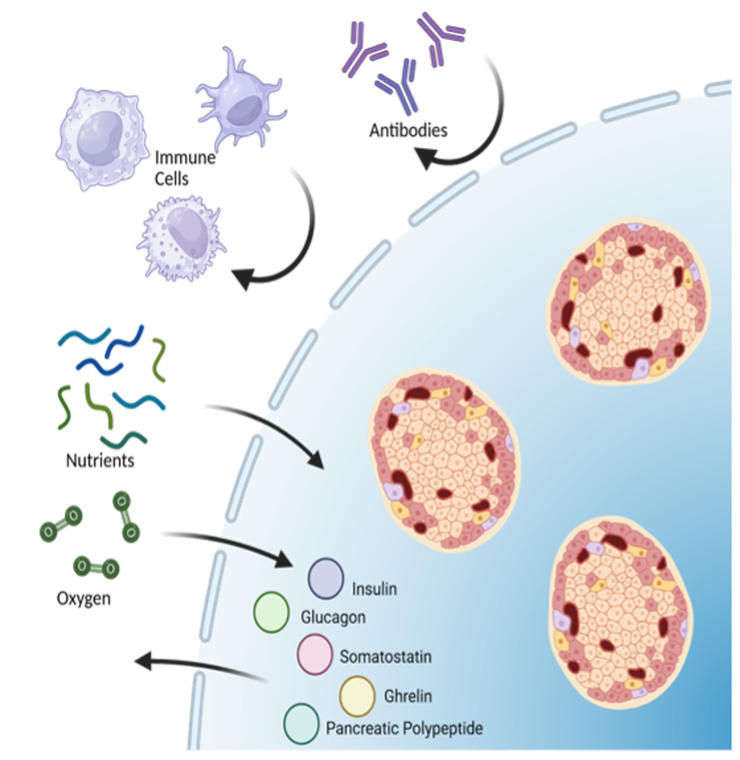
Principle of immune isolation
Schematic representation of the immunoisolating CellEncap implant. The system is designed to allow the exchange of oxygen, nutrients, glucose, hormones and metabolic products while preventing direct contact between transplanted islet cell clusters and immune cells or antibodies. The encapsulated endocrine cell clusters can release key pancreatic hormones, including insulin, glucagon, somatostatin, ghrelin and pancreatic polypeptide ensuring a physiological control of blood glucose levels and protecting the patients against hypoglycemic attacks.
Project objectives
The project focuses on the further development and systematic preclinical validation of the CellEncap technology for porcine pseudo-islets. Key objectives include assessing endocrine cell functionality, evaluating the suitability of the implant platform, optimizing the interaction between the cell product and the device, and generating essential data for future translational development.
Technology
The CellEncap approach integrates several complementary design features: an immunoisolating membrane to protect transplanted cells from immune-mediated damage, a surface coating intended to support anti-inflammatory and vascularisation-promoting effects, homogeneously sized and spatially arranged pseudo-islets to improve diffusion conditions, and an oxygen-supporting core to reduce early post-transplantation hypoxia.
Together, these features are intended to support cell survival and function during the critical early phase after implantation and to provide a foundation for long-term endocrine activity.
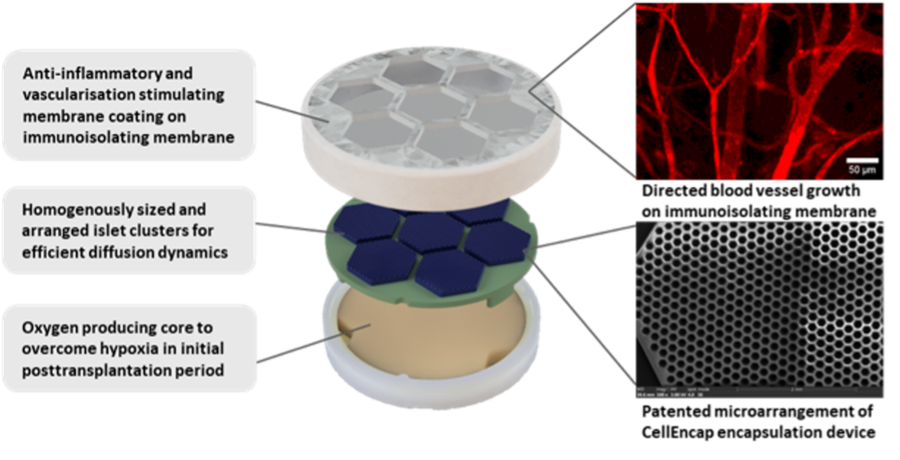
Technical design of the CellEncap device
Schematic overview of the CellEncap device architecture. The implant combines an immunoisolating membrane, an anti-inflammatory and vascularisation-stimulating membrane coating, homogeneously sized and arranged islet clusters for improved diffusion dynamics, and an oxygen-producing core to support cell survival during the initial post-transplantation period. The microscopy images illustrate vascular structures and the membrane architecture of the system.
Potential impact
CellEncap could contribute to new therapeutic strategies for people with type 1 diabetes. A functional implant containing islet hormons-producing cells could help reduce acute glucose fluctuations, lower the burden of daily insulin therapy and support a more physiological regulation of blood glucose levels.
The technology is currently in the preclinical development phase and is not yet available for clinical use.
Project leader

Project workers



Patent references
The CellEncap project builds on patent-protected and patent-pending technologies developed at Technische Universität Dresden and collaborating institutions:
- WO2023117849A1 – Modular implantable device for the macroencapsulation of cells.
- WO2025088022A1 – Method for generating homogenous, size-defined pseudo-islets of porcine origin by Rho/ROCK pathway inhibition.
