
Dr. Clara von Randow
 © Sven Ellger
wissenschaftliche Mitarbeiterin
NameFrau Dr. Clara von Randow
Eine verschlüsselte E-Mail über das SecureMail-Portal versenden (nur für TUD-externe Personen).
Besuchsadresse:
Chemie/Hydrowissenschaften, CHE 451 (Büro), CHE 397 (Labor) Bergstraße 66
01069 Dresden
Research Interest
Highly Reducing Systems in Liquid Ammonia
My research interests lie in the field of highly reducing chemistry in liquefied gases, in particular in ammonia. Reducing conditions are achieved via an electride solution either through the addition of alkali metals, or electrochemically. Electride solutions were established by E. Zintl for the reduction of elemental metals and have found wide application in organic syntheses such as the Birch reduction.
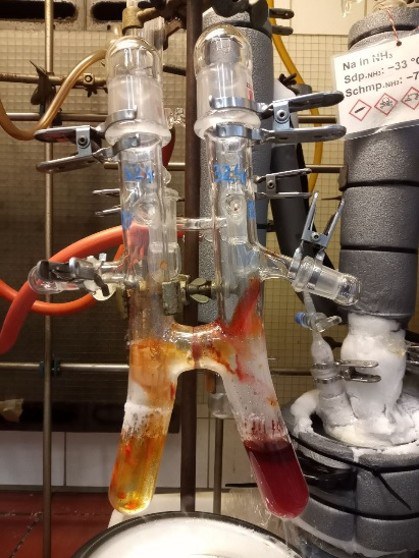
Experimental set-up for the synthesis of tetramethylammonium hydronaphthalide.
Isolation of reactive intermediates
Working temperatures of −60 °C and the addition of tetraalkylammonium salts has proven a viable path to accessing intermediates from the reaction mixtures in liquid ammonia.
One example is the isolation of an organic salt of the monoanion hydronaphthalide, a transient species within the Birch-mechanism stemming from the two-fold reduction and protonation of naphthalene. This salt can be synthesised from the reaction of an electride solution with naphthalene and tetramethylammonium chloride.

Reaction equation for the synthesis of tetramethylammonium hydronaphthalide.
Behaviour of chalcogenides in liquid ammonia
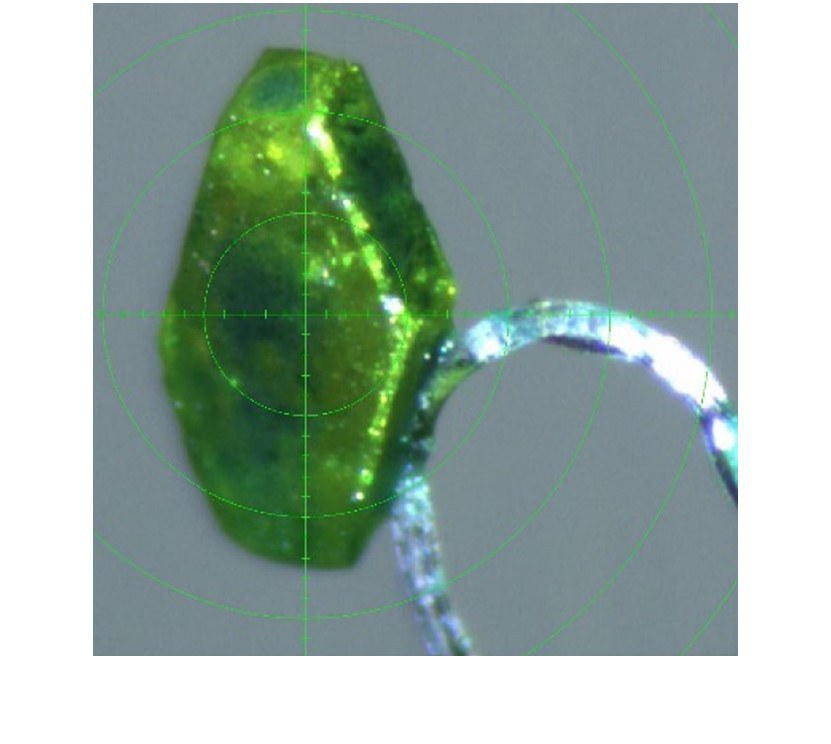
Crystal of tetraethylammonium aminopentasulphide ammoniate.
Sulphur reacts in liquid ammonia to form a cascade of coloured solutions and anionic sulphurous and sulphur–nitrogen species. We were recently able to isolate the organic salt NEt4(S5NH2) from a sulphur in ammonia solution – an anionic motif which had previously been postulated but not isolated.
Selenium and tellurium do not dissolve in liquid ammonia. However, increasing the basicity of these reaction mixtures leads to intriguing behaviour which we are currently investigating.
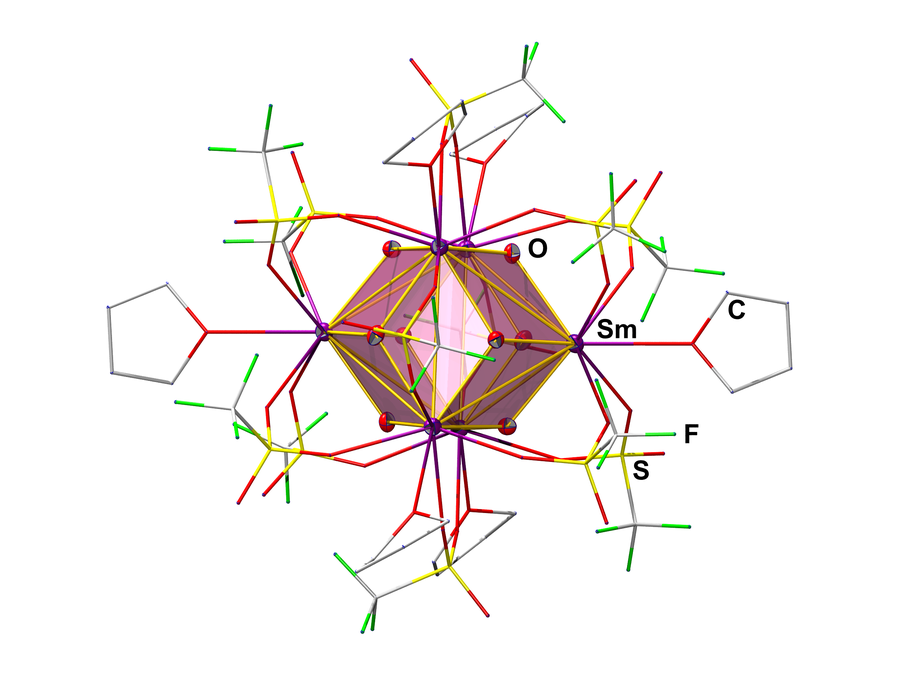
Novel samarium-hydroxido-cluster from the reaction of tetraethylammonium aminopentasulphide and samarium(III) triflate.
Values
Fundamental research is defined as “the discovery of truth and understanding of nature” (A. T. Waterman, C. I. Barnard, Natl. Sci. Found. 1953, 38–48.). This is best achieved with a diverse and motivated team coming together across physical and societal borders. I aim at fostering a research community rich of respect and collaboration which celebrates diversity, and values scientists independent of their origin, sex, gender, ability, socioeconomic background or religion. I am very passionate about systemic challenges in academia related to equity, as well as physical and mental health in a resilient global scientific community and strive to contribute to the visibility of underrepresented groups in STEM.
Motivated students who are intrigued to work under the strict exclusion of air and moisture, to learn more about the handling of liquefied gases at low temperatures, and to be inspired by the beautiful blue of electride solutions are encouraged to reach out for internships!
Curriculum Vitae
| Since 2026 | TUD Dresden University of Technology, Habilitation Candidate |
| 2025 | Albert-Ludwigs-Universität Freiburg, Postdoctoral Research in the work group of Dr Günther Thiele: Highly Reducing Chemistry |
| 2024–2025 | Freie Universität Berlin, Leverhulme Fellowship for Postdoctoral Research in the work group of Dr Günther Thiele: Highly Reducing Chemistry |
| 2019–2024 | Freie Universität Berlin, Guest Scientist in the work group of Dr Günther Thiele: Synthesis and Crystallisation of Metal-free Electrides |
| 2019–2024 | University of Oxford, UK, EPSRC Centre for Doctoral Training in Inorganic Chemistry for Future Manufacturing, Doctor of Philosophy (Oxon) under the supervision of Prof. Stephen Faulkner, Prof. Simon Aldridge and Prof. Jose Goicoechea: Synthesis of Multi-modal Metallodrugs as Anti-cancer Agents |
| 2014–2019 |
Freie Universität Berlin |
| Since 2025 | Reviewer for the ACS journal Inorganic Chemistry |
| 2021–2024 | President of the graduate students in the Middle Common Room, Magdalen College Oxford, UK |
| 2021–2024 | Student Advisory Board for the EPSRC Centre for Doctoral Training in Inorganic Chemistry for Future Manufacturing, University of Oxford, UK |
| 2019–2021 | Graduate committee of the Middle Common Room, Magdalen College Oxford, UK |
| 2013–2019 | Project Development and Supervision of elementary and senior school class courses such as the ‘Uni auf Probe ’ at the student science learning laboratory NatLab of the Freie Universität Berlin, Germany |
| 2026–2027 | Charlotte-Bühler Programme for Habilitation Candidates – Women in Science |
|
2025–2026 |
ZEIT für X Fellowship Zia – Visible Women in Science |
| 2025 | GSO Fellowship for the Leadership Academy 9 |
| 2025 | 74th Lindauer Nobel Laureate Meeting in Chemistry, Scholarship for Participation and Accommodation |
| 2024 | Poster Prize at the Conference Terrae Rarae 2024 |
| 2024–2025 | Leverhulme Fellowship for Postdoctoral Research |
| 2023, 2025 | Royal Society of Chemistry Researcher Development and Travel Grant |
| 2023 | University of Oxford Chemistry Department Travel Funds |
| 2022, 2023 | Herbert Warren Memorial Benefaction, Magdalen College Oxford |
| 2022, 2023 | Magdalen College Oxford Travel and Research Scholarship |
| 2021, 2023, 2024 | Magdalen College Oxford Graduate Scholarship |
| 2019–2024 | Engineering and Physical Sciences Research Council Course Fees and Maintenance Grant, Doctorate Degree |
| 2019 | Dahlem Research School Maintenance Grant, Freie Universität Berlin |
| 2018 | DAAD Travel Allowance, Internship Abroad |
Publications
Isolation and Structural Characterization of the Postulated [S5NH2]− Anion in Sulphur Ammonia Solutions.
C. A. von Randow, G. Thiele, Inorg. Chem. 2026. (Under Revision)
Platinum-Gold Multi-modal Anti-cancer Agents Exhibiting Enhanced Cytotoxicity.
C. A. von Randow, R. Puliyadi, G. Rodriguez Berriguete, N. J. Farrer, G. Higgins, S. Faulkner, Dalton Trans. 2025. (Under Revision)
Exploring 3D Models via Extended Reality Tools using common Smart Devices.
C. A. von Randow, G. Thiele, in: Dempski, R.E. (eds) Transforming Molecular Biology with Emerging Technologies. Methods in Molecular Biology, vol 3043. Humana, New York, NY. , Springer Nature, 2026. DOI: 10.1007/978-1-0716-5320-3_16
Liquid Ammonia – Revisiting an Old Friend with New Purpose.
C. A. von Randow, G. Thiele, Eur. J. Inorg. Chem. 2025, e202500301. DOI: 10.1002/ejic.202500301
The Hydronaphthalide Monoanion: Isolation of the “red transient” Birch Intermediate from liquid Ammonia.
C. A. von Randow, G. Thiele, Chem. Eur. J. 2024, e202401098. DOI: 10.1002/chem.202401098
Remarkable Infrared Nonlinear Optical, Dielectric, and Strong Diamagnetic Characteristics of Semiconducting K3[BiS3].
M. R. Ghazanfari, L. Vittadello, D. Al-Sabbagh, A. Santhosh, C. Frankcom, F. Fuß, C. A. von Randow, K. Siemensmeyer, J. Vrijmoed, F. Emmerling, P. Jerabek, M. Imlau, G. Thiele, J. Phys. Chem. Lett. 2022, 13, 6987. DOI: 10.1021/acs.jpclett.2c01689
Synthesis of Heavy N‐Heterocyclic Tetrylenes: Influence of Ligand Sterics on Structure.
R. J. Schwamm, C. A. von Randow, A. Mouchfiq, M. J. Evans, M. P. Coles, J. R. Fulton, Eur. J. Inorg. Chem. 2021, 34, 3466. DOI: 10.1002/ejic.202100447
Ino-Chloridolithates from Ionothermal Synthesis.
D. F. Bekiş, T. Küllmey, M. R. Ghazanfari, R. Burda, E. Voloshina, C. A. von Randow, F. Fuß, M.Liesegang, B. Paulus, A.-C. Pöppler, G. Thiele, Inorg. Chem. 2021, 60, 19145. DOI: 10.1021/acs.inorgchem.1c02943
Tuning the Lewis acidity of difluorido gold(III) complexes: the synthesis of [AuClF2(SIMes)] and [AuF2(OTeF5)(SIMes)].
M. A. Ellwanger, C. von Randow, S. Steinhauer, Y. Zhou, A. Wiesner, H. Beckers, T. Braun, S. Riedel, Chem. Commun. 2018, 54, 9304. DOI: 10.1039/C8CC05233
Ich druck mir die Welt, wie sie mir gefällt.
C. A. von Randow, G. Thiele, Nachr. Chem. 2022, 70, 68. DOI: 10.1002/nadc.20224119955
Nackte Elektronen mit Potenzial.
C. A. von Randow, G. Thiele, Nachr. Chem. 2021, 69, 60. DOI: 10.1002/nadc.20214110509
Keine Kosten, viel Spaß.
J. R. Schmid, C. A. von Randow, G. Thiele, Nachr. Chem. 2021, 69, 10. DOI: 10.1002/nadc.20214110213