
17.06.2026
Closed-Loop Recyclable Two-Dimensional Conjugated Metal Organic Frameworks
On-Demand Linkage Cleavage in Two-Dimensional Conjugated Metal Organic Frameworks for Closed-Loop Recyclable Electronics
Summary: We demonstrate the closed-loop recycling of emerging multifunctional two-dimensional conjugated metal-organic frameworks (2D c-MOFs) through a mechanochemistry-induced on-demand degradation strategy. Exemplified with 2,3,6,7,10,11-hexahydroxytriphenylene (HHTP)-based 2D c-MOFs, we show that ultrasonic cavitation facilitates selective cleavage of metal-ligand linkages in alkaline solutions enabling rapid material degradation (up to 92.4% within 30 min). The HHTP monomers and metal species are subsequently recovered with high purity and yield of 96.3% and 93.5%, and reused to regenerate new 2D c-MOFs, establishing a complete circular material lifecycle. Moreover, we demonstrate the practical utility of these recyclable 2D c-MOFs in several applications, including hydrogen gas sensors, supercapacitor electrodes, and degradable printed electronic devices. These results highlight the potential of 2D c-MOFs to advance circular electronics, laying the groundwork for a sustainable transformation within the electronics industry.
The rapid growth of modern electronics has intensified concerns about electronic waste management at the end of a product's life. Integrating closed-loop recyclability, where electronic materials can be efficiently recovered, reprocessed, and reused in new products, is essential for achieving sustainable development, minimizing environmental impact, and realizing long-term economic benefits. However, achieving closed-loop recycling remains particularly challenging for complex electronic materials. Recently, two-dimensional conjugated metal-organic frameworks (2D c-MOFs), unique layer stacked organic 2D crystals with in-plane extended π-conjugation and out-of-plane electronic couplings, display distinct characteristics of well-defined porosity, structural precision, accessible active sites, high stability, superior charge transport, versatile stimulus-responsive activity. These attributes make 2D c-MOFs promising candidates for a wide range of electronic applications, including field-effect transistors, force and gas sensors, ion conductors, and energy storage devices. The basic metal-coordination bonds exhibit both reversibility and robustness, conferring excellent stability under typical device-operating conditions while simultaneously permitting selective bond cleavage in response to specific stimulus. While the theoretical framework for on-demand degradation can be conceived, the experimental realization of efficient closed-loop recycling for 2D c-MOFs remains unrealized.
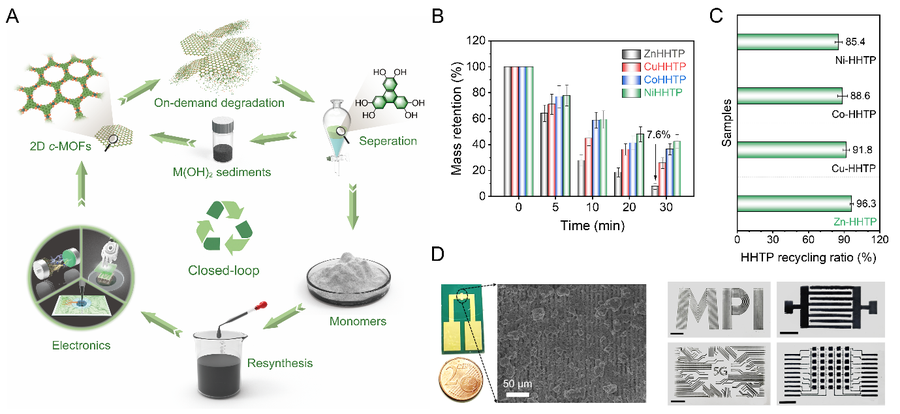
In this work, we present a facial mechanochemical linkage cleavage approach that enables efficient, on-demand degradation and closed-loop recycling of 2D c-MOFs. Our approach specifically targets 2,3,6,7,10,11-hexahydroxytriphenylene (HHTP)-based 2D c-MOFs coordinated with various metal centers (Co, Ni, Cu, and Zn), leveraging the inherent reversibility of their MO4 coordination bonds. We reveal that alkaline conditions significantly weaken the coordination bonds through hydroxylation of the metal center. When combined with ultrasonic cavitation, this effect promotes efficient and selective cleavage of metal-ligand linkages, leading to rapid material degradation into sodium hexahydroxytriphenylene (Na-HHTP) and corresponding metal hydroxide. It is notable that the HHTP-based 2D c-MOFs demonstrate exceptional degradation kinetics. The resultant Zn-HHTP, Cu-HHTP, Co-HHTP, and Ni-HHTP achieve degradation rates of 92.3%, 74.2%, 63.5%, and 57.6%, respectively, within 30 minutes. The subsequent ligand regeneration process yields high-purity HHTP monomers suitable for resynthesizing fresh 2D c-MOFs, completing a fully circular materials lifecycle. The recycling approach exhibits remarkable consistency across different metal systems, with ligand recovery yields of 96.3% for Zn-HHTP, 91.8% for Cu-HHTP, 88.6% for Co-HHTP, and 85.4% for Ni-HHTP. Our cradle-to-cradle life-cycle assessment (LCA) using industrial-scale models reveals that the regenerated HHTP-based 2D c-MOFs using this closed-loop recycling approach not only present much decreased total energy consumption (52 vs. 358 MJ kg−1) and greenhouse gas (CO2) emission (4.8 vs. 27.4 kg CO2 -eq) compared to direct synthesized ones, but also substantially reduce their overall environmental impact relative to conventional electronic materials, such as copper, gold, silver, carbon nanotube, graphene, polyaniline, and polypyrrole. The developed closed-loop recycling protocol presents a promising pathway toward realizing sustainable and recyclable electronic components. As proof of concept, we demonstrate recyclable and regenerative hydrogen gas sensors and supercapacitor electrodes based on Cu-HHTP, both of which retain their original performance after material regeneration. Additionally, we validate the feasibility of using Zn-HHTP to formulate degradable printed electronic devices, highlighting the practical potential of HHTP-based 2D c-MOFs for advancing circular electronics.
Picture: Conceptual diagram showing the closed-loop recycling of 2D c-MOFs. (B) Mass retention of different HHTP-based 2D c-MOFs at different degradation times in 0.05 M NaOH. (C) The HHTP recycling ration of different HHTP-based 2D c-MOF after fully degradation. (D) The electronic application of electronics.
Copyright picture: Quanquan Guo
Contact: quanquan.guo@mpi-halle.mpg.de