
17.06.2026
Cyclophane-Based Shielding Strategy for Singly Dispersed Graphene Nanoribbons
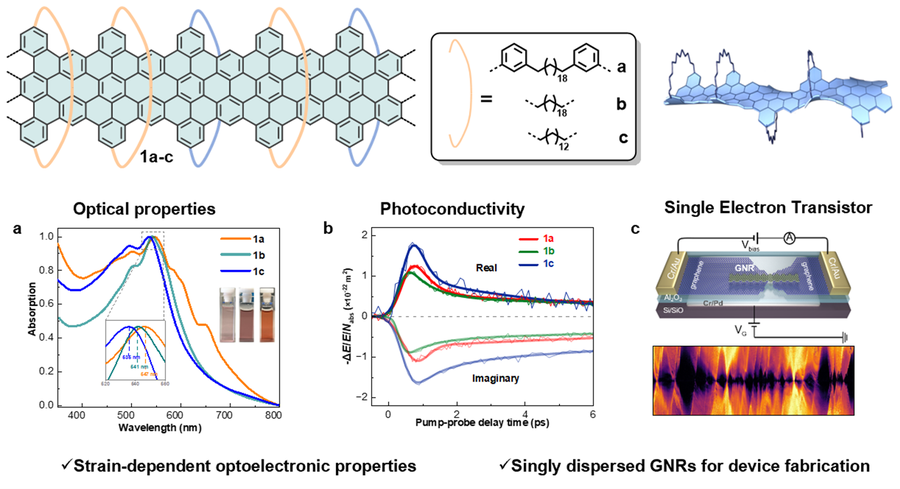
In a recent article published in Nature Chemistry, an international team of researchers successfully applied cyclophane chemistry, for the first time, to graphene nanoribbons (GNRs) system. Their study demonstrates that this cyclophane-based shielding strategy not only sterically shields the π-conjugated surface of GNR but also imparts internal strain, enabling singly dispersed GNRs while simultaneously modulating their optoelectronic properties, thereby providing a generalizable strategy for engineering solution-processable GNRs compatible with quantum device applications.
Structurally precise GNRs hold great promise for nanoelectronics owing to their tunable bandgaps and unique electronic properties. However, their practical integration into single-ribbon devices remains impeded by strong inter-ribbon aggregation.
In order to overcome this limitation, researchers from the group of Prof. Xinliang Feng and collaborators have demonstrated that shielding the π-conjugated backbone by cyclophane-type bridges represents an efficient approach to achieve singly dispersed GNRs, enabling their successful integration into SET device fabrication. Three types of cyclophane-shielded GNRs (1a-c) and corresponding model nanographenes with varying tethered chain lengths have been successfully synthesized. The efficient steric shielding effect provided by the cyclic chains, particularly for 1c bearing the shortest chain length, is clearly elaborated by the NMR measurements and single-crystal analysis of its model nanographene compound, thus bestowing it with single dispersibility by efficient suppression of π-π aggregation. As a consequence of the most pronounced bending strain, singly dispersed 1c exhibits a blue-shifted absorption maximum band compared to 1a and 1b with longer bridges, along with an increased optical bandgap of 2.0 eV and concentration-dependent emission behavior. In addition, the increased bending strain, as the cyclic chain length shortens, leads to a notable reduction in effective mass and a substantial increase in charge carrier mobility up to 74% from 1b to 1c. Moreover, singly dispersed 1c enables the fabrication of SET devices with moderate efficiency, which exhibit the characteristic single-electron transport behavior at cryogenic temperatures.
Fig 1. (a) UV-vis absorption spectra of GNR 1a-c in NMP (C ~ 0.1 g/L). (b) Time-dependent complex (real and imaginary) terahertz photoconductivity of CsGNRs 1a, 1b, and 1c at a concentration of 0.5 g/L. (c) Scheme of the electronic devices and single-electron charging behavior.
The cyclophane-based shielding strategy presented in this work not only provides new insights into modulating the optoelectronic properties of GNRs, but also enables the formation of singly dispersed GNRs with well-defined structures and supports scalable solution-phase synthesis, both essential for the practical development of quantum electronic applications.
The paper entitled “Cyclophane-Based Shielding Strategy for Singly Dispersed Graphene Nanoribbons” by Jin-Jiang Zhang, Jian Zhang, Guanzhao Wen, Silvio Osella, Zhenlin Qiu, Steffen Böckmann, Xu Wang, Britta Maib, Yubin Fu, Xiuling Yu, Michael Ryan Hansen, Janina Maultzsch, Michel Calame, Mickael L. Perrin, Hai I. Wang, Mischa Bonn, Ji Ma, Klaus Müllen, Xinliang Feng can be found at: https://www.nature.com/articles/s41557-026-02172-z