
Sep 23, 2026
Programmable lattice engineering of organic two-dimensional van der Waals heterostructures
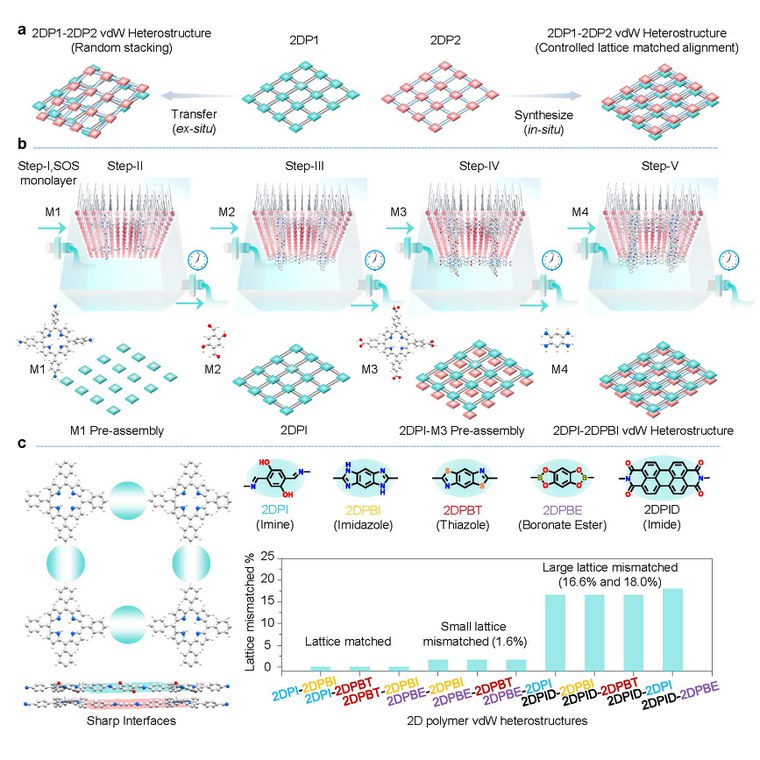
Design and synthesis of lattice-matched and mismatched 2DP vdW heterostructures with sharp interfaces.
Van der Waals (vdW) heterostructures based on inorganic two-dimensional materials enable precise control over interlayer coupling and emergent electronic and optical phenomena. Extending this concept to organic 2D crystals has remained challenging because weak, non-directional interlayer interactions make defined lattice registry, particularly at or near zero twist, difficult to achieve. In a study published in Nature, researchers from the groups of Prof. Xinliang Feng at the Max Planck Institute of Microstructure Physics, Prof. Thomas Heine and Prof. Stefan Mannsfeld at Technische Universität Dresden, together with collaborators, report a bottom-up strategy for programmable lattice engineering of organic 2D vdW heterostructures. Sequential assembly using on-water surface chemistry and synthesis enables layer-by-layer stacking of chemically distinct 2D polymers with defined lattice registry, stacking sequence and thickness.
The researchers combined five structurally and electronically distinct 2D polymers—polyimine, polyimide, polybenzimidazole, polybenzothiazole and polyboronate ester—to realize ten 2D vdW heterostructures with programmable lattice mismatch from 0% to 18%. This introduces a new lattice-control knob, spanning fully lattice-matched, small-mismatch and strongly mismatched systems. Lattice-matched 2D vdW heterostructures exhibit commensurate epitaxy and chemically sharp interfaces, whereas large lattice mismatch gives rise to moiré features and strain-relief distortions.
The defined interfaces further enable designed interfacial electronic coupling, band alignment and dipole formation at a chemically sharp vdW interface. Ultrafast spectroscopy reveals efficient interfacial charge separation and photoluminescence quenching of up to 90%, while first-principles calculations show type-II band alignment, built-in electric fields and interfacial potential steps of approximately 0.3–2.1 V arising from interfacial dipole alignment. These interfacial effects translate directly into vertical electronic transport, with lattice-matched 2D vdW heterostructures exhibiting record vertical current rectification with rectification ratios exceeding 107, which systematically decrease with increasing lattice mismatch.
This breakthrough opens the door to programmable organic 2D vdW heterostructures in which lattice registry and interfacial design can be used to control electronic functionality. By linking molecular design and lattice matching or mismatching with interfacial coupling, charge separation and vertical transport, this synthetic platform enables access to quantum and electronic functionalities in organic 2D crystal based vdW heterostructures and offers opportunities to explore emergent physical phenomena, including moiré superlattices and interfacial spin physics.
Contact:
Anupam Prasoon
MPI Halle, Synthetic Materials and Functional Devices
anupam.prasoon@mpi-halle.mpg.de
+49 345 5582 420
Further information: The press news will also be published on the websites of:
1. Technische Universität Dresden
https://tu-dresden.de/
2. Collaborative Research Centre 1415 (CRC 1415)
https://tu-dresden.de/mn/chemie/sfb1415
Publication:
Prasoon, A., Nguyen, N. N., Hambsch, M., Singhvi, P., Terres, S., Xiao, Z., Goyal, N., Qi, H., Mücke, D., Auras, F., Wang, Z., Chung, S., Položij, M., Wang, H. I., Cho, K., Kaiser, U., Chernikov, A., Bonn, M., Mannsfeld, S. C. B., Heine, T. & Feng, X. Organic two-dimensional van der Waals heterostructures. Nature (2026). https://doi.org/10.1038/s41586-026-11074-6