
Sep 25, 2026
Programming Organic Two-Dimensional Crystals through Anisotropic Reticular Chemistry
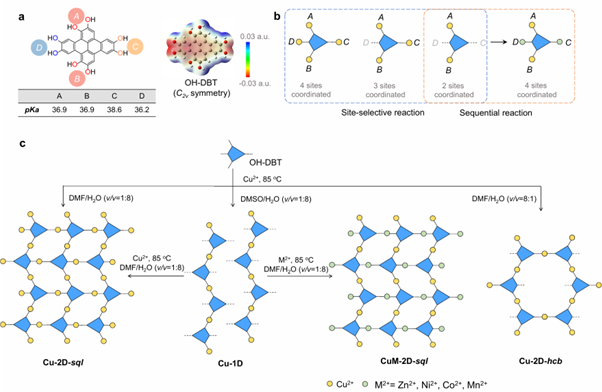
Design principle for constructing c-MOFs with programmable topologies and bimetal nodes.
Electrically conductive two-dimensional conjugated metal–organic frameworks (2D c-MOFs) are emerging organic 2D crystal materials with tunable structures and properties. However, conventional high-symmetry ligands usually contain equivalent coordination sites and therefore follow uniform assembly pathways, limiting the structural diversity accessible from a single building block. Researchers have now developed an anisotropic reticular chemistry (ARC) strategy based on a low-symmetry ligand containing chemically inequivalent coordination sites. Their distinct reactivities enable selective and sequential metal coordination, allowing the same ligand to follow multiple assembly pathways. This approach produced seven crystalline c-MOFs, including one-dimensional and two-dimensional copper frameworks with different topologies, as well as four ordered bimetallic frameworks incorporating Cu together with Ni, Co, Zn, or Mn. Structural analysis, theoretical calculations and single-crystal electrical measurements further demonstrate that such framework programmability translates directly into tunable electronic structures and charge-transport properties. This work establishes ARC as a new route for constructing programmable organic 2D crystals in which topology, dimensionality, and metal composition can be independently controlled, opening new possibilities for crystalline electronic materials.
Contact: xinliang.feng@mpi-halle.mpg.de
The paper entitled “Programming Semiconducting Two-Dimensional Conjugated Metal-Organic Frameworks via Anisotropic Reticular Chemistry” by Jianjun Zhang, Guojun Zhou, Hio-Ieng Un, Jianbo Song, Petko St. Petkov, Rashid Iqbal, Shuai Fu, Xing Huang, Geping Zhang, Yang Lu, Darius Pohl, Renxiang Liu, Yubin Fu, Xiaodong Li, Wenjie Zhang, Bernd Rellinghaus, Alexey Alfonsov, Volodymyr Bon, Jie Ding, Stuart SP Parkin, Thomas Heine, Zhiyong Wang, Zhehao Huang, Henning Sirringhaus, Xinliang Feng, Renhao Dong can be found at: https://www.nature.com/articles/s41557-026-02251-1