
Feb 05, 2026
Towards single crystalline two-dimensional poly(arylene vinylene) covalent organic frameworks
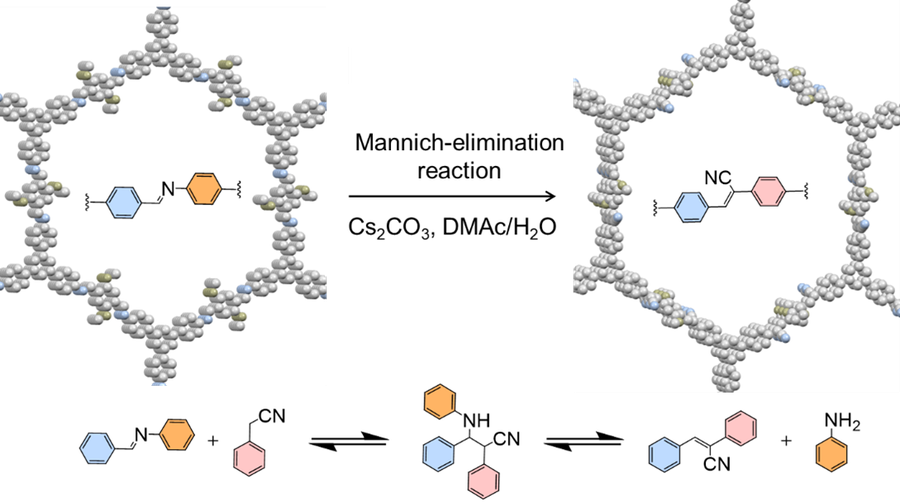
In a recent study published in Nature Chemistry, an international team of researchers has developed a new synthetic methodology, Mannich-elimination, towards single-crystalline two-dimensional poly(arylene vinylene) covalent organic frameworks. This work also showcases the synthesis of eleven highly crystalline 2D PAVs derived from corresponding 2D imine-COF (or 2D polyimine) precursors. Theoretical calculations and model reactions elucidate the reversible C=C bond formation driven by the Mannich-elimination reaction mechanism and its feasibility for developing crystalline 2D PAVs, further demonstrated crystallinity has a large impact on the charge transport properties, as exemplified by benzotrithiophene-based honeycomb 2D PAVs exhibiting charge mobilities 10 times greater than the amorphous 2D PAVs or their 2D polyimine counterparts.
Vinylene- or sp²-carbon-linked two-dimensional (2D) conjugated covalent organic frameworks (COFs), i.e. layered 2D poly(arylene vinylene)s (2D PAVs), are emerging as promising polymer semiconductors for applications in (opto-)electronics, photocatalysis, and electrochemistry. However, numerous 2D PAVs are inaccessible via conventional solvothermal synthesis methods or suffer from limited crystalline domain sizes (e.g., below 20 nm). In order to overcome this limitation, researchers from the group of Prof. Xinliang Feng and collaborators have demonstrated a Mannich-elimination synthetic strategy and showcase the synthesis of eleven highly crystalline 2D PAVs derived from corresponding 2D imine-COF (or 2D polyimine) precursors. Theoretical calculations and model reactions elucidate the reversible C=C bond formation driven by the Mannich-elimination reaction mechanism and its feasibility for developing crystalline 2D PAVs. This method is versatile, enabling the synthesis of robust, porous 2D PAVs with various lattice structures, featuring a surface area of approximately 2000 m²/g. High-resolution transmission electron microscopy and continuous rotation electron diffraction reveal the molecular-level structure of a 2 µm-sized triphenylbenzene-based honeycomb single-crystalline 2D PAV. Crystallinity has a large impact on the charge transport properties, as exemplified by benzotrithiophene-based honeycomb 2D PAVs exhibiting charge mobilities 10 times greater than the amorphous 2D PAVs or their 2D polyimine counterparts. This work paves the way for the efficient synthesis of highly crystalline 2D conjugated polymer materials suitable for robust applications.
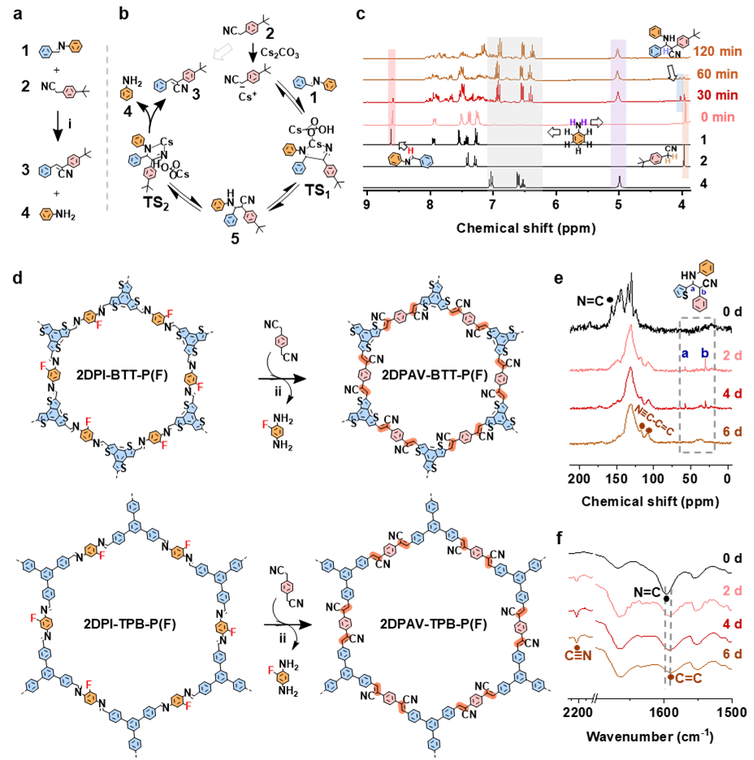
Model compounds and 2D PAVs by Mannich-elimination reaction. a, Schematic synthesis of model compound 3. i: Cs2CO3, DMAc/H2O (10/1), 120 ̊C, 8 h. b, Proposed reaction mechanism for the Mannich-elimination pathway. c, In-situ NMR analysis of model reaction performed in DMAc. The spectra of compounds 1, 2, and 4 measured in DMSO-d6 are shown for comparison. The in-situ spectra are recorded in DMAc with trace DMSO-d6 for calibration. d, Schematic synthesis of 2DPAV-BTT-P(F) and 2DPAV-TPB-P(F) from the F-labelled 2D PIs. ii: Cs2CO3, DMAc/H2O (7/3), 120 ̊C, 5-6 days. e,f, Time-dependent solid-state 13C CP NMR and FT-IR spectra, respectively, during the synthesis of 2DPAV-BTT-P(F) (lines for 6 d) from 2DPI-BTT-P(F) (lines for 0 d).
The paper entitled “Towards single crystalline two-dimensional poly(arylene vinylene) covalent organic frameworks” by Shaik Ghouse, Ziang Guo, Sergio Gámez-Valenzuela, David Mücke, Bowen Zhang, Lei Gao, Silvia Paasch, Yubin Fu, Chuanhui Huang, Chandrashekar Naisa, Eike Brunner, Mischa Bonn, M. Carmen Ruiz Delgado, Junliang Sun, Ruqiang Zou, Ute Kaiser, Mingchao Wang, Xinliang Feng can be found at: https://www.nature.com/articles/s41557-025-02048-8