
07.09.2026
Suppressed excitonic effects enable high mobility and high-yield photoconductivity in a pyridine-coordinated two-dimensional polymer crystal
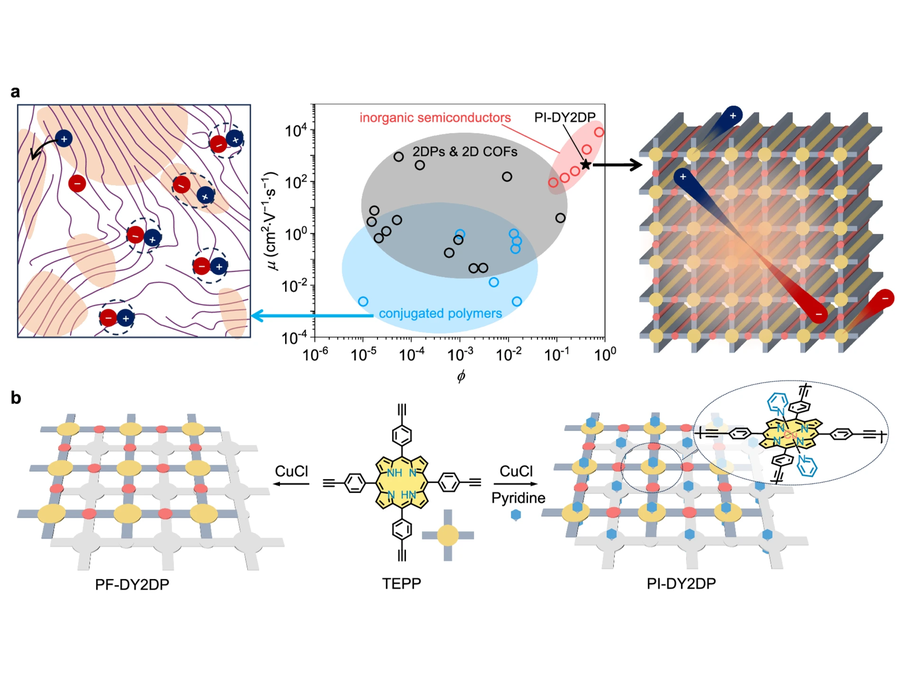
Comparison of charge mobility and free-carrier yield across material classes. (b) Synthetic routes to pyridine-free and pyridine-coordinated diyne-linked two-dimensional polymers.
In a recent article published in Nature Communications, researchers from Technische Universität Dresden, the Max Planck Institute for Polymer Research, the Max Planck Institute of Microstructure Physics, Beijing Institute of Technology, and collaborating institutions report a pyridine-coordinated two-dimensional polymer crystal that combines efficient free-carrier generation with band-like transport. By bridging adjacent Cu–porphyrin layers with pyridine, the team suppresses exciton binding below room-temperature thermal energy, enabling charge mobilities approaching 500 cm2 V⁻1 s⁻1 and a photon-to-free-carrier conversion ratio of approximately 0.4.
Organic semiconductors combine strong light absorption with synthetic versatility and mechanical flexibility, making them attractive for emerging optoelectronic technologies. However, efficient light-to-electricity conversion requires more than rapid charge transport. In most organic semiconductors, photoexcitation initially produces tightly bound electron–hole pairs, known as excitons, and only a small fraction of these excitons dissociate into mobile charge carriers. This exciton bottleneck has continued to limit photoconductivity even in highly ordered two-dimensional polymers and covalent organic frameworks.
To address this challenge, researchers from the group of Prof. Xinliang Feng and collaborators developed a diyne-linked, AB-stacked copper–porphyrin two-dimensional polymer in which pyridine molecules coordinate axially to copper centers in adjacent layers. The pyridine ligands act as periodic molecular bridges, transforming weak van der Waals interactions between the layers into a three-dimensionally connected electronic architecture. Using an on-liquid surface synthesis strategy, the researchers prepared both the pyridine-coordinated polymer, termed PI-DY2DP, and a pyridine-free reference material, PF-DY2DP, enabling the effects of interlayer coordination to be directly compared.
Structural characterization and theoretical calculations revealed that the pyridine bridges strongly enhance electronic delocalization along the stacking direction while preserving the conjugated in-plane framework. Compared with PF-DY2DP, the coordinated material exhibits substantially greater interlayer band dispersion and markedly lower carrier effective masses. Its calculated exciton binding energy falls below the thermal energy available at room temperature, whereas the pyridine-free material retains an exciton binding energy of approximately 130 meV. Optical excitation can therefore directly populate delocalized electronic states in PI-DY2DP instead of predominantly generating tightly bound excitons.
Time-resolved terahertz spectroscopy confirmed that PI-DY2DP supports Drude-type, band-like photoconductivity. The room-temperature charge-carrier mobility reaches 480 ± 50 cm2 V⁻1 s⁻1, while the photon-to-free-carrier conversion ratio reaches 42%. Together, these effects produce a photoconductive response approximately four orders of magnitude greater than that of the pyridine-free reference. The results demonstrate the rare coexistence of efficient free-carrier generation and high-mobility transport within a single-component organic material.
This study establishes interlayer coordination as a molecular design strategy for controlling excitonic effects independently of the polymer backbone. By extending electronic coupling beyond individual two-dimensional sheets, organic crystals can acquire photoconductive characteristics commonly associated with inorganic semiconductors. The concept offers a pathway towards more efficient organic materials for photovoltaics, photodetectors, photoelectrochemical devices, and photocatalytic systems.
Contact: Xinliang Feng (+49 345 5582 763; xinliang.feng@mpi-halle.mpg.de)
Publication: Fu, S., Yang, Y., Gao, G. et al. Suppressed excitonic effects enable high mobility and high-yield photoconductivity in a pyridine-coordinated two-dimensional polymer crystal. Nat Commun 17, 8815 (2026).