
Feb 26, 2026
Tailoring Electronic Properties of Precision Graphene Nanoribbons via Nanopore Engineering
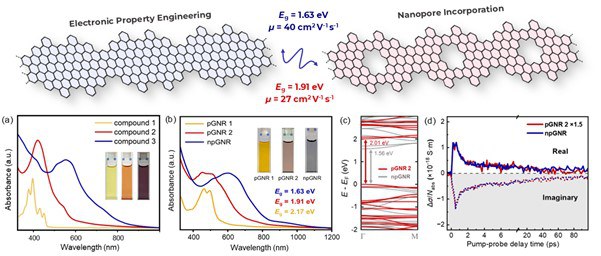
In a recent article published in Angewandte Chemie International Edition, researchers from TU Dresden and the Max Planck Institute of Microstructure Physics reported the successful synthesis of graphene nanoribbons incorporating [18]annulene nanopores, together with a nonporous GNR of identical width. Their study demonstrates that nanopore incorporation effectively tunes the electronic properties by enlarging the bandgap, reducing charge-carrier mobility, and modulating exciton dynamics, thereby establishing a versatile strategy for the design of porous graphene nanostructures with tailored opto-electronic characteristics.
The precise incorporation of nanopores into graphene nanoribbons (GNRs) offers a complementary strategy for modulating their opto-electronic properties beyond conventional width and edge engineering. However, a systematic understanding of the relationship between the structure and electronic properties in porous GNRs has remained experimentally unexplored due to the lack of rational synthetic strategies.
To investigate the influence of nanopores on the opto-electronic properties of precision GNRs, researchers from the group of Prof. Xinliang Feng and collaborators have demonstrated a novel class of porous GNRs, accompanied by a nonporous GNR, with average lengths of up to 60 nm, through an efficient Diels-Alder polymerization strategy and Scholl-type cyclization. Single-crystal X-ray analysis of porous model compound confirmed a well-defined porous structure, characterized by a [18]annulene cavity with a diameter of 5.98 Å. The incorporation of nanopores significantly modifies the optoelectronic properties of graphene nanoribbons. Compared to nonporous structures, both porous model compounds and porous nanoribbons exhibit clear blue shifts in absorption, improved solubility, and a widened electronic bandgap. Terahertz spectroscopy further reveals that introducing nanopores does not increase charge scattering but instead flattens the band dispersion, leading to an increased effective mass and reducing charge carrier mobility from nearly 40 cm² V⁻¹ s⁻¹ to around 27 cm² V⁻¹ s⁻¹.
This study presents an effective strategy for engineering the electronic properties of GNRs through nanopore incorporation and provides a foundation for the rational design of porous graphene nanostructures for optoelectronic applications, with broader implications for thermal management, ion transport, and molecular sensing technologies.
The paper entitled ”Tailoring Electronic Properties of Precision Graphene Nanoribbons via Nanopore Engineering” by Kun Liu, Guanzhao Wen, Gianluca Serra, Nicolás Arisnabarreta, Hongde Yu, Andrea Lucotti, Yarden Peleg Walg, Hartmut Komber, Zhen-Lin Qiu, Qing-Song Deng, Ran He, Wenhui Niu, Thomas Heine, Eike Brunner, Mischa Bonn, Steven De Feyter, Matteo Tommasini, Hai I. Wang, Ji Ma, and Xinliang Feng can be found at: https://doi.org/10.1002/anie.202524299
(a) UV-vis absorption spectra of model compounds in THF (10–5 M). (b) UV-vis absorption spectra of GNRs in NMP (0.1 mg mL-1). (c) Calculated band structures of porous GNR and nonporous GNR. (d) Time-resolved complex terahertz photoconductivity of porous GNR and nonporous GNR.
Porous graphene nanoribbons with tailored opto-electronic characteristics.
Publication: Liu, K.; Wen, G.; Serra, G.; Arisnabarreta, N.; Yu, H.; Lucotti, A.; Walg, Y. P.; Komber, H.; Qiu, Z.; Deng, Q.; He, R.; Niu, W.; Heine, T.; Brunner, E.; Bonn, M.; De Feyter, S.; Tommasini, M.; Wang, H. I.; Ma, J.; Feng, X. Tailoring Electronic Properties of Precision Graphene Nanoribbons via Nanopore Engineering. Angew. Chem. Int. Ed. 2026, e24299. https://doi.org/10.1002/anie.202524299.