
25.06.2026
Ultranarrow nanochannels in a staggered two-dimensional polymer membrane enhance electric double-layer coverage for osmotic energy harvesting
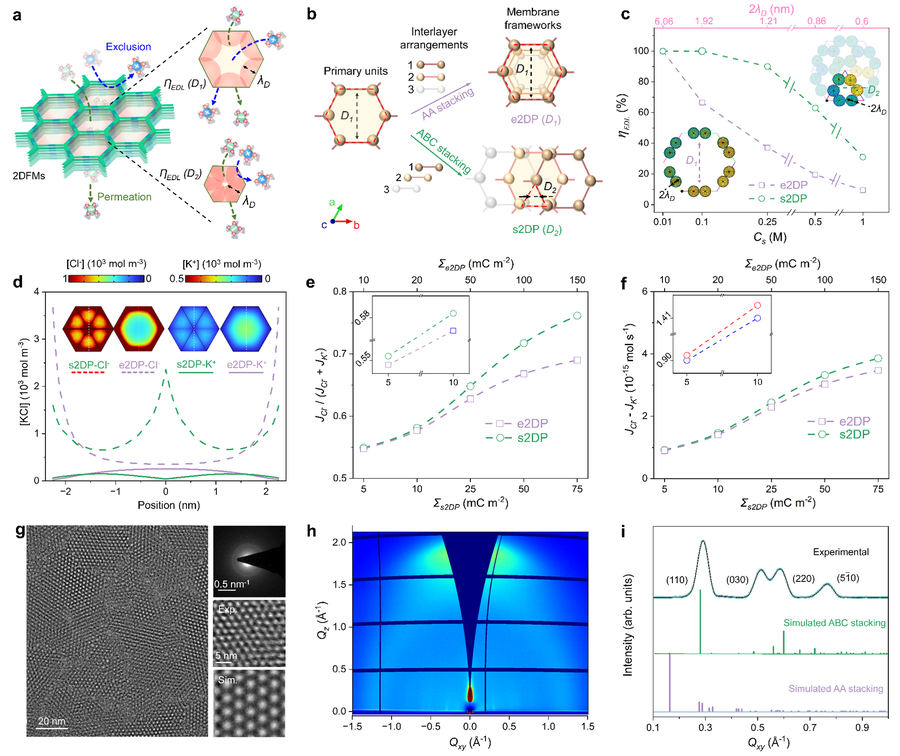
Two-dimensional framework membranes (2DFMs) are promising materials for osmotic energy harvesting because their ordered nanochannels and charged surfaces can regulate ion transport under salinity gradients. However, many existing 2DFMs contain relatively large channels and/or insufficient charge density, resulting in limited electric double-layer coverage and reduced ion selectivity.
A recent article by researchers from the Max Planck Institute of Microstructure Physics, TU Dresden, and collaborating institutions, published in Nature Communications, reports an ultrathin staggered viologen-incorporated 2D polymer membrane, termed sV2DP, for high-performance osmotic energy harvesting. Through ABC interlayer-stacking engineering, the membrane forms vertically aligned ultranarrow triangular nanochannels with an effective diameter of 1.36 nm and densely distributed positively charged pyridinium sites. This structural design substantially enhances the electric double-layer (EDL) coverage within the nanochannels. Compared with its non-staggered analogue, the sV2DP membrane shows a 3.2-fold enhancement in EDL coverage under a 50-fold KCl gradient. As a result, the membrane combines high anion selectivity with efficient ion conduction, achieving an inferred chloride transference number of 0.85 and a selective current density of 14.6 kA m-2. Molecular dynamics simulations further reveal that the spirally arranged charged sites in the ABC-stacked channels guide chloride ions along a characteristic “screw-like” migration pathway, promoting efficient transmembrane anion transport.
When integrated into micro-aperture osmotic power generators, the sV2DP membrane delivered a peak power density of 243 W m-2 under a 50-fold NaCl gradient, placing it among the highest-performing 2DFM systems reported under comparable conditions. The membrane also exhibited high mechanical robustness, with a Young’s modulus of 37.5 ± 1.2 GPa, enabling its integration into aperture-array devices. In a 45 × 45 aperture-array osmotic power generator, the membrane maintained stable power generation over nine days under artificial seawater/river water conditions, demonstrating its potential for scaled-area operation and long-term durability.
Copyright for picture*:©Springer Nature (https://www.nature.com/articles/s41467-026-74696-4)
Acknowledgements: This work was financially supported by the ERC Synergy Grant (2DPolyMembrane, grant no. 101167472), ERC Consolidator Grant (T2DCP), GRK2861 (no. 491865171), CRC 1415 (Chemistry of Synthetic Two-Dimensional Materials, no. 417590517), the DFG priority program SPP 2244, as well as the German Science Council and Center of Advancing Electronics Dresden. M.P. and T.D.K. were supported by the Center for Advanced Systems Understanding, which is financed by Germany’s Federal Ministry of Education and Research and by the Saxon state government out of the State budget approved by the Saxon State Parliament. The authors gratefully acknowledge the computing time provided to them on the high-performance computer Noctua 2 at the NHR Center NHR@Paderborn (PC2), the NHR Center at TU Dresden (ZIH), and on the cluster Hemera at Helmholtz-Zentrum Dresden-Rossendorf (HZDR). We also acknowledge Elettra Sincrotrone Trieste for providing access to its synchrotron radiation facilities, and we thank Luisa Barba for assistance in using beamline XRD1. F.N. acknowledges the support of the Alexander von Humboldt Foundation. Funding by the German Research Foundation (Deutsche Forschungsgemeinschaft, DFG) via the "Responsible Electronics in the Climate Change Era – REC²" Cluster of Excellence (EXC 3035, Project-ID 533607596) is gratefully acknowledged. We also thank Dr. Abhay Kant Srivastava at Max Planck Institute of Microstructure Physics for his support with FIB technology in this work.
Reference: Feng Ni, Ye Yang, Shuangjie Zhao, Mahabir Prasad, Naveen Goyal, Xusheng Yang, Dongxu Wang, Jianjun Zhang, Mike Hambsch, Miroslav Polozij, Stefan C. B. Mannsfeld, Ute Kaiser, Grégory F. Schneider, Thomas D. Kühne, Thomas Heine, Zhiyong Wang, and Xinliang Feng, Ultranarrow nanochannels in a staggered two-dimensional polymer membrane enhance electric double-layer coverage for osmotic energy harvesting. Nat Commun 17, 5460 (2026). https://doi.org/10.1038/s41467-026-74696-4
DOI: 10.1038/s41467-026-74696-4
Contact: Feng Ni
+49 3455582913